
Life, 1923-11-29 · page 28 of 38
Life — November 29, 1923 — page 28: what you’re looking at
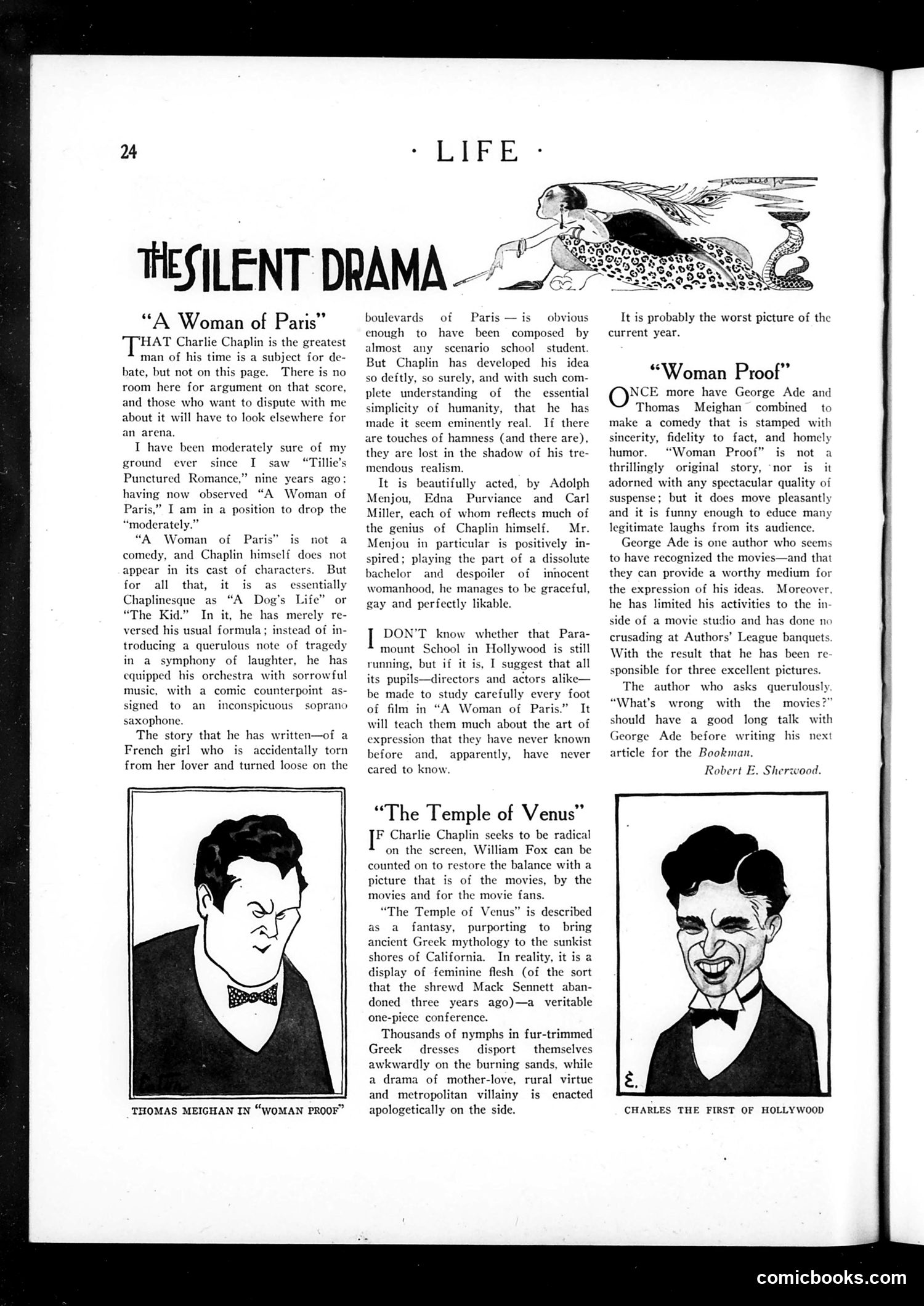
What you’re looking at
This page reviews three 1920s silent films. The critic praises Charlie Chaplin's *"A Woman of Paris"* as masterful dramatic filmmaking—notable because Chaplin doesn't appear in it himself, yet it bears his artistic stamp. The reviewer suggests film students study it to learn visual storytelling. By contrast, William Fox's *"The Temple of Venus"* is savagely dismissed as "probably the worst picture of the current year"—essentially soft-core mythology dressed up with scantily-clad extras in "fur-trimmed Greek dresses," abandoning any pretense of serious narrative. *"Woman Proof,"* starring George Ade and Thomas Meighan, is praised as competent, honest entertainment—not spectacular, but genuinely funny and well-crafted. The caricature portraits accompany reviews praising restraint and artistic merit while mocking empty spectacle. The overall message: serious filmmaking (Chaplin, Ade) versus exploitative trash (Fox).
📄 Transcribed text from this page (OCR, searchable)
Machine-transcribed from the original scan — historical spelling and the odd misread are preserved.
TESILENT DRAMA - “A Woman of Paris” "THAT Charlie Chaplin is the greatest man of his time is a subject for de- bate, but not on this page. There is no room here for argument on that score, and those who want to dispute with me about it will have to look elsewhere for an arena, T ha ground since I saw “Tillie’s Punctured Romance,” nine years ago: having now observed “A Woman of ¢ been moderately sure of my ever Paris,” I am in a position to drop the “moderately.” “A Woman of Paris” is not a comedy, and Chaplin himself does not appear in its cast of characters. But for all that, it is as essentially Chaplinesque as “A Dog's Life” or “The Kid.” In it, he has merely re- versed his usual formula; instead of in- troducing a querulous note of traged, in a symphony of laughter, he has equipped his orchestra with sorrowful music, with a comic counterpoint as- signed to an inconspicuous saxophone. The story that he has written—of a French girl who is accidentally torn from her lover and turned loose on the soprano THOMAS MEIGHAN IN “WOMAN PROOF” boulevards of Paris — is enough to have been composed by almost any scenario school student. But Chaplin has developed his idea so deftly, so surely, and with such com- plete understanding of the essential simplicity of humanity, that he has made it seem eminently real. If there are touches of hamness (and there are), they are lost in the shadow of his tre- mendous realism. It is beautifully acted, by Adolph Menjou, Edna Purviance and Carl Miller, each of whom reflects much of the genius of Chaplin himself. Mr. Menjou in particular is positively in- spired; playing the part of a dissolute bachelor and despoiler of innocent womanhood, he manages to be graceful, gay and perfectly likable. obvious DON’T know whether that Para- mount School in Hollywood is still running, but if it is, I suggest that all its pupils—directors and actors alike— be made to study carefully every foot of film in “A Woman of Pari It will teach them much about the art of expression that they have never known before and, apparently, have never cared to know “The Temple of Venus” F Charlie Chaplin seeks to be radical on the screen, William Fox can be counted on to restore the balance with a picture that is of the movies, by the movies and for the movie fans. “The Temple of Venus” is described fantasy, purporting to bring ancient Greek mythology to the sunkist shores of California. In reality, it is a display of feminine flesh (of the sort that the shrewd Mack Sennett aban- doned three years ago)—a veritable one-piece conference. as a Thousands of nymphs in fur-trimmed Greek dresses disport themselves awkwardly on the burning sands, while a drama of mother-love, rural virtue and metropolitan villainy is enacted apologetically on the side. It is probably the worst picture of the current year. “Woman Proof” CE more have George Ade and Thomas Meighan combined to make a comedy that is stamped with sincerity, fidelity to fact, and homely humor. “Woman Proof” is not a thrillingly original story, ‘nor is it adorned with any spectacular quality of suspense; but it does move pleasantly and it is funny enough to educe many legitimate laughs from its audience. George Ade is one author who seems to have recognized the movies—and that they can provide a worthy medium for the expression of his ide: Moreover, he has limited his activities to the in side of a movie studio and has done no crusading at Authors’ League banquets With the result that he has been re- sponsible for three excellent pictures. The author who asks querulously “What's wrong movies?” should have a good long talk George Ade before writing his next article for the Bookman. Robert E. Sherwood. with the ? with CHARLES THE FIRST OF HOLLYWOOD comicbooks.com