
Life, 1923-11-29 · page 24 of 38
Life — November 29, 1923 — page 24: what you’re looking at
What you’re looking at
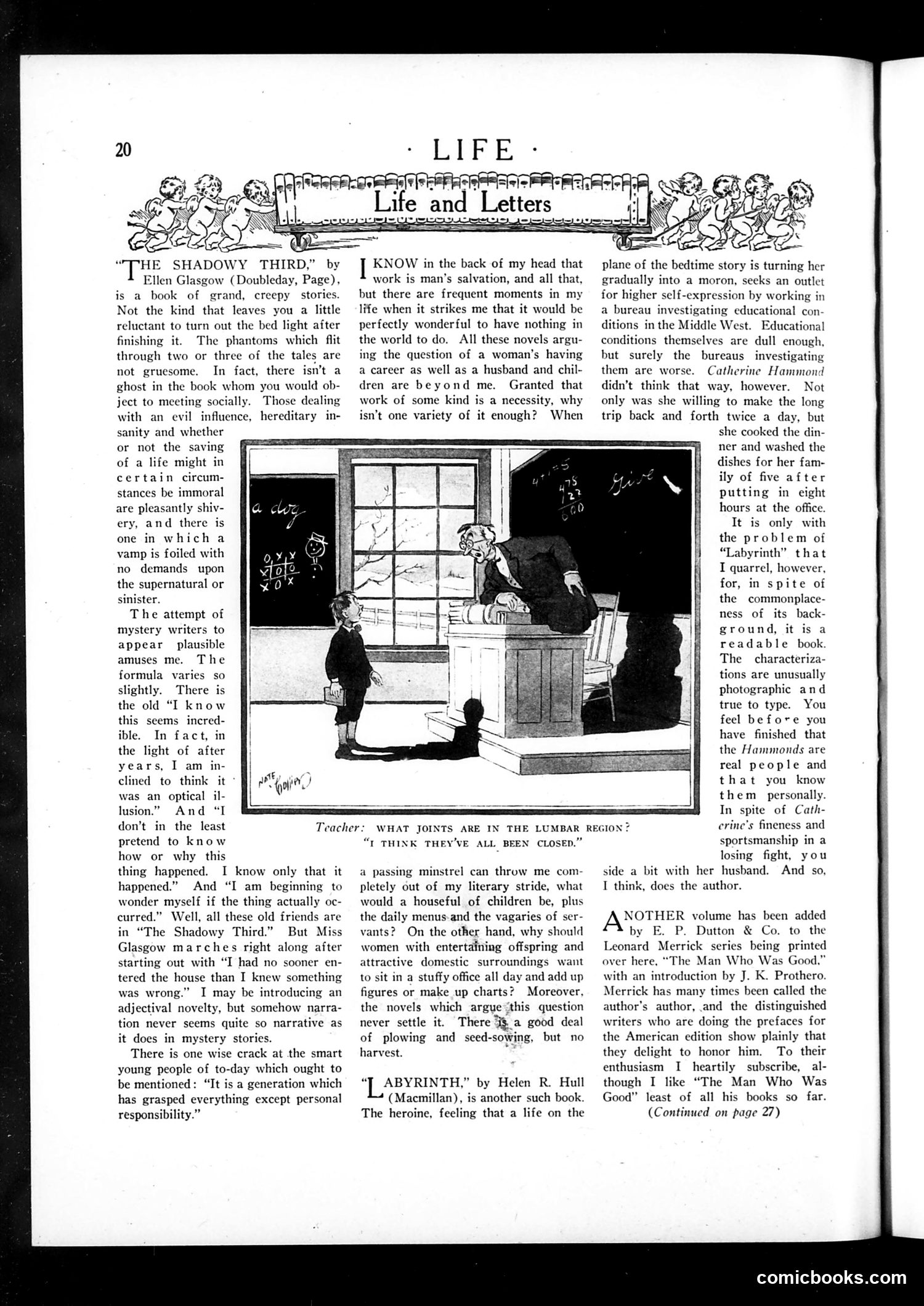
This page from *Life* magazine contains a book review column titled "Life and Letters." The main cartoon depicts a classroom scene where a teacher asks students "What joints are in the lumbar region?" and a student responds "I think they've all been closed." **The Joke:** This is a Depression-era gag playing on double meaning. "Joints" colloquially refers to speakeasies and bars (illegal establishments during Prohibition). The student's answer—that they've "all been closed"—works on two levels: anatomically absurd but socially relevant, as speakeasies were being shut down by authorities. The humor assumes readers understood contemporary slang about underground drinking establishments. **Context for Modern Readers:** During Prohibition (1920-1933), "joints" was common slang for illegal bars. The cartoon satirizes how pervasive this vocabulary was, suggesting even schoolchildren used the term naturally. The joke relies entirely on knowing that speakeasies were a major social issue of the era. The surrounding text reviews novels by Ellen Glasgow and Helen R. Hull, discussing women's roles in marriage versus careers.
📄 Transcribed text from this page (OCR, searchable)
Machine-transcribed from the original scan — historical spelling and the odd misread are preserved.
RACER els her Rel FF} Life and ‘Letters SHADOWY THIRD,” by Ellen Glasgow (Doubleday, Page), is a book of grand, creepy stories. Not the kind that leaves you a little reluctant to turn out the bed light after finishing it. The phantoms which flit through two or three of the tales are not gruesome. In fact, there isn’t a ghost in the book whom you would ob- ject to meeting socially. Those dealing with an evil influence, hereditary in- sanity and whether or not the saving of a life might in certain circum- stances be immoral are pleasantly shiv- ery, and there is one in which a vamp is foiled with no demands upon the supernatural or sinister. The attempt of mystery writers to appear _ plausible amuses me. The formula varies so slightly. There is the old “I know this seems incred- ible. In fact, in the light of after years, I am in- clined to think it was an optical il- KNOW in the back of my head that work is man’s salvation, and all that, but there are frequent moments in my life when it strikes me that it would be perfectly wonderful to have nothing in the world to do. All these novels argu- ing the question of a woman's having a career as well as a husband and chil- dren are beyond me. Granted that work of some kind is a necessity, why isn’t one variety of it enough? When plane of the bedtime story is turning her gradually into a moron, seeks an outlet for higher self-expression by working in a bureau investigating educational con- ditions in the Middle West. Educational conditions themselves are dull enough, but surely the bureaus investigating them are worse. Catherine Hammond didn’t think that way, however. Not only was she willing to make the long trip back and forth twice a day, but she cooked the din- ner and washed the dishes for her fam- ily of five after putting in eight hours at the office. It is only with the problem of “Labyrinth” that I quarrel, however, for, in spite of the commonplace- ness of its back- ground, it is a readable book. The characteriza- tions are unusually photographic and true to type. You feel before you have finished that the Hammonds are real people and that you know them_ personally. lusion.”. And “I don’t in the least pretend to know how or why this thing happened. I know only that it happened.” And “I am beginning to wonder myself if the thing actually oc- curred.” Well, all these old friends are in “The Shadowy Third.” But Miss Glasgow marches right along after starting out with “I had no sooner en- tered the house than I knew something was wrong.” I may be introducing an adjectival novelty, but somehow narra- tion never seems quite so narrative as it does in mystery stories. There is one wise crack at the smart young people of to-day which ought to be mentioned: “It is a generation which has grasped everything except personal responsibility.” Teacher: “I THINK THEY'VE ALL BEEN CLOSED.” a passing minstrel can throw me com- pletely out of my literary stride, what would a houseful of children be, plus the daily menus-and the vagaries of ser- vants? On the other hand, why should women with entertaining offspring and attractive domestic surroundings want to sit in a stuffy office all day and add up figures or make up charts? Moreover, the novels which argue<this question never settle it. There %§ a good deal of plowing and seed-sowing, but no harvest. i “[ABYSINTH,” by Helen R. Hull (Macmillan), is another such book. The heroine, feeling that a life on the WHAT JOINTS ARE IN THE LUMBAR REGION ? In spite of Cath- erine’s fineness and sportsmanship in a losing fight, you side a bit with her husband. And so, I think, does the author. NOTHER volume has been added by E. P. Dutton & Co. to the Leonard Merrick series being printed over here, “The Man Who Was Good.” with an introduction by J. K. Prothero. Merrick has many times been called the author's author, and the distinguished writers who are doing the prefaces for the American edition show plainly that they delight to honor him. To their enthusiasm I heartily subscribe, al- though I like “The Man Who Was Good” least of all his books so far. (Continued on page 27) comicbooks.com