
Life, 1923-11-29 · page 22 of 38
Life — November 29, 1923 — page 22: what you’re looking at
What you’re looking at
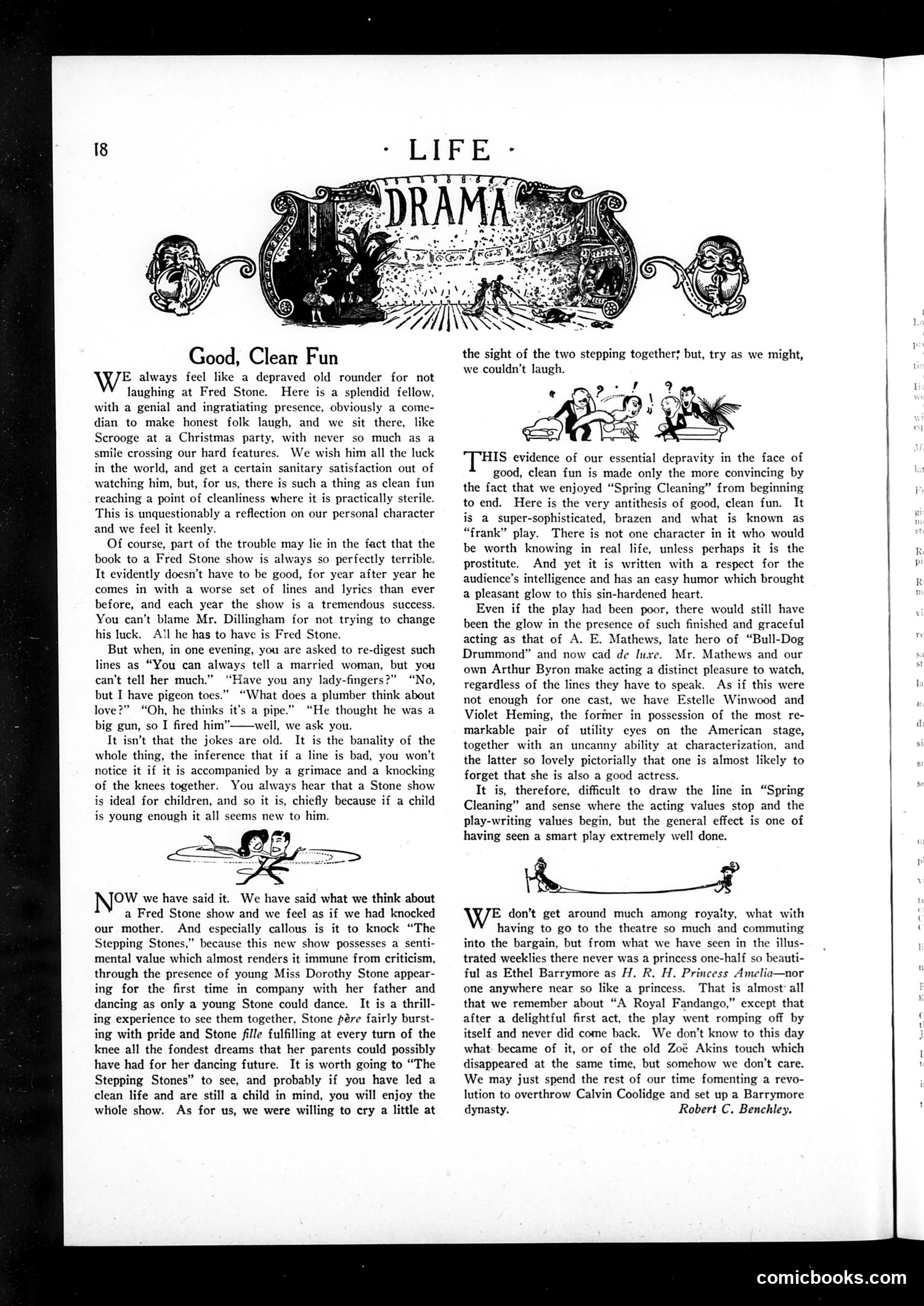
This is a theater review comparing two Broadway shows. The critic expresses guilty ambivalence about **Fred Stone**, a popular vaudeville-style comedian known for wholesome, family-friendly entertainment. Despite Stone's likability and current show "The Stepping Stones" (notably featuring his daughter Dorothy dancing alongside him), the critic finds the material—recycled puns and slapstick—tediously "clean" to the point of sterility. The review's ironic punchline: the critic actually *enjoyed* **"Spring Cleaning,"** a morally "frank" (likely sexually suggestive) play featuring sophisticated adult characters including a prostitute. The critic credits excellent acting by A.E. Mathews and Arthur Byron for elevating mediocre material. The satire targets middle-class hypocrisy: audiences prize wholesome entertainment, yet intelligent theater with morally ambiguous characters proves more engaging. The critic's self-aware "depravity" undercuts sanctimonious entertainment values of the era.
📄 Transcribed text from this page (OCR, searchable)
Machine-transcribed from the original scan — historical spelling and the odd misread are preserved.
Good, Clean Fun WE always feel like a depraved old rounder for not laughing at Fred Stone. Here is a splendid fellow, with a genial and ingratiating presence, obviously a come- dian to make honest folk laugh, and we sit there, like Scrooge at a Christmas party, with never so much as a smile crossing our hard features. We wish him all the luck in the world, and get a certain sanitary satisfaction out of watching him, but, for us, there is such a thing as clean fun reaching a point of cleanliness where it is practically sterile. This is unquestionably a reflection on our personal character and we feel it keenly. Of course, part of the trouble may lie in the fact that the book to a Fred Stone show is always so perfectly terrible. It evidently doesn’t have to be good, for year after year he comes in with a worse set of lines and lyrics than ever before, and each year the show is a tremendous success. You can’t blame Mr. Dillingham for not trying to change his luck. Atl he has to have is Fred Stone. But when, in one evening, you are asked to re-digest such lines as “You can always tell a married woman, but you can't tell her much.” “Have you any lady-fingers?” “No, but I have pigeon toes.” “What does a plumber think about love?” “Oh, he thinks it’s a pipe.” “He thought he was a big gun, so I fired him”——well, we ask you. It isn’t that the jokes are old. It is the banality of the whole thing, the inference that if a line is bad, you won't notice it if it is accompanied by a grimace and a knocking of the knees together. You always hear that a Stone show is ideal for children, and so it is, chiefly because if a child is young enough it all seems new to him. OW we have said it. We have said what we think about a Fred Stone show and we feel as if we had knocked our mother. And especially callous is it to knock “The Stepping Stones,” because this new show possesses a senti- mental value which almost renders it immune from criticism, through the presence of young Miss Dorothy Stone appear- ing for the first time in company with her father and dancing as only a young Stone could dance. It is a thrill- ing experience to see them together, Stone pére fairly burst- ing with pride and Stone fille fulfilling at every turn of the knee all the fondest dreams that her parents could possibly have had for her dancing future. It is worth going to “The Stepping Stones” to see, and probably if you have led a clean life and are still a child in mind, you will enjoy the whole show. As for us, we were willing to cry a little at the sight of the two stepping together? but, try as we might, we couldn’t laugh. THs evidence of our essential depravity in the face of good, clean fun is made only the more convincing by the fact that we enjoyed “Spring Cleaning” from beginning to end. Here is the very antithesis of good, clean fun. It is a super-sophisticated, brazen and what is known as “frank” play. There is not one character in it who would be worth knowing in real life, unless perhaps it is the prostitute. And yet it is written with a respect for the audience’s intelligence and has an easy humor which brought a pleasant glow to this sin-hardened heart. Even if the play had been poor, there would still have been the glow in the presence of such finished and graceful acting as that of A. E. Mathews, late hero of “Bull-Dog Drummond” and now cad de luxe. Mr. Mathews and our own Arthur Byron make acting a distinct pleasure to watch, regardless of the lines they have to speak. As if this were not enough for one cast, we have Estelle Winwood and Violet Heming, the former in possession of the most re- markable pair of utility eyes on the American stage, together with an uncanny ability at characterization, and the latter so lovely pictorially that one is almost likely to forget that she is also a good actress. It is, therefore, difficult to draw the line in “Spring Cleaning” and sense where the acting values stop and the play-writing values begin, but the general effect is one of having seen a smart play extremely well done. E don’t get around much among royalty, what with having to go to the theatre so much and commuting into the bargain, but from what we have seen in the illus- trated weeklies there never was a princess one-half so beauti- ful as Ethel Barrymore as H. R. H. Princess Amelia—nor one anywhere near so like a princess. That is almost’ all that we remember about “A Royal Fandango,” except that after a delightful first act, the play went romping off by itself and never did come back. We don’t know to this day what: became of it, or of the old Zoé Akins touch which disappeared at the same time, but somehow we don’t care. We may just spend the rest of our time fomenting a revo- lution to overthrow Calvin Coolidge and set up a Barrymore dynasty. Robert C. Benchley. comicbooks.com