
Life, 1923-11-29 · page 18 of 38
Life — November 29, 1923 — page 18: what you’re looking at
What you’re looking at
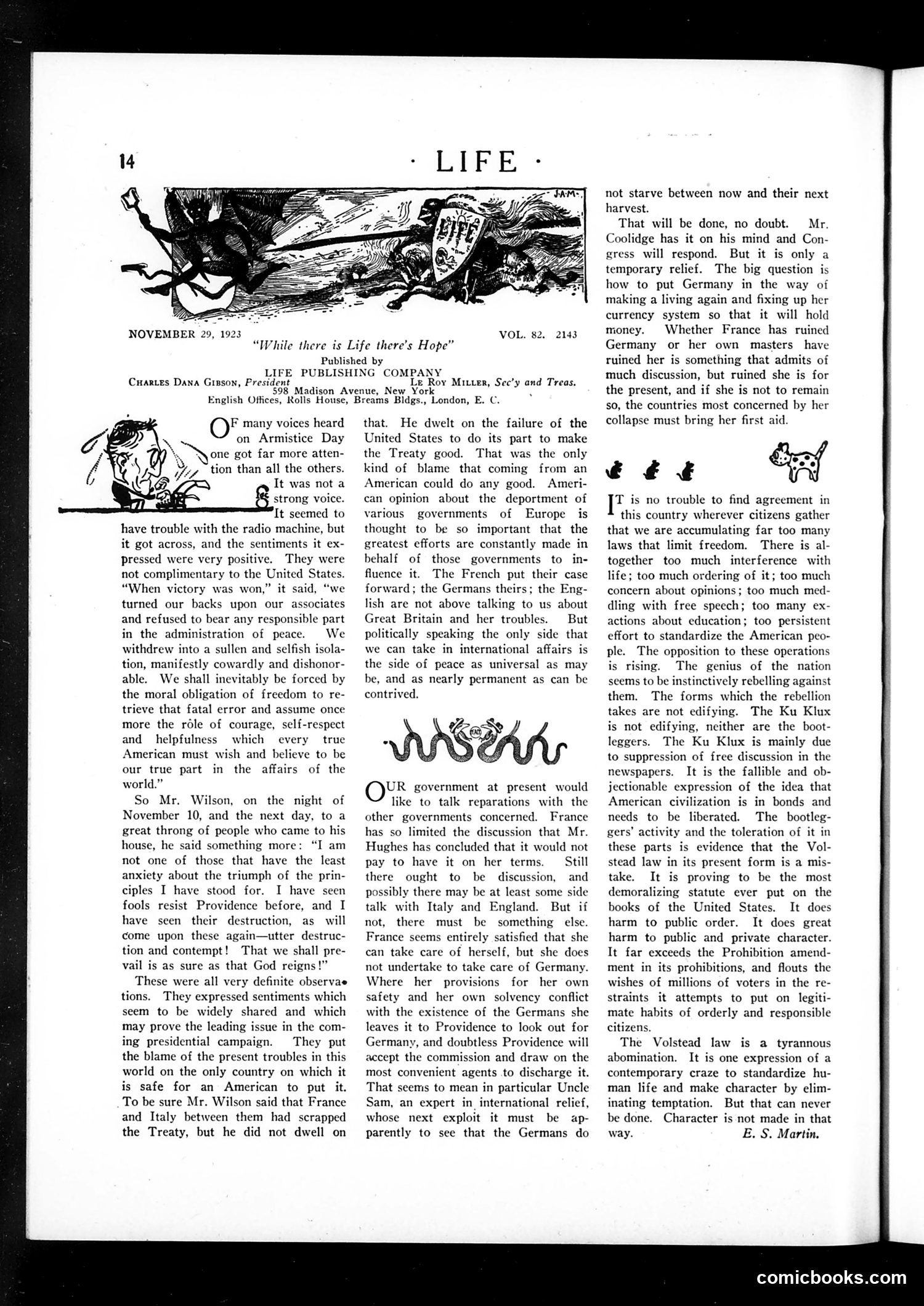
This page features former President Woodrow Wilson's Armistice Day remarks criticizing American isolationism. Wilson argues the U.S. betrayed its post-WWI obligations by withdrawing from international affairs rather than enforcing the Treaty of Versailles. The editorial commentary supports Wilson's position, arguing America cannot escape responsibility for global stability. It specifically addresses the reparations crisis: France won't help Germany survive economically, leaving the burden to the U.S. ("Uncle Sam") through international relief efforts. The cartoon (top left, captioned "While there is Life there's Hope") appears to depict this entanglement—though the specific figures are unclear from the image quality. The piece reflects 1923 anxieties about American isolationism versus internationalism and growing concerns about European economic collapse post-war.
📄 Transcribed text from this page (OCR, searchable)
Machine-transcribed from the original scan — historical spelling and the odd misread are preserved.
NOVEMBER 29, 1923 VOL. 82. 2143 “While there is Life there's Hope” Published by LIFE PUBLISHING Cuares Dana Ginson, President COMPANY Le Roy Miter, Sec’y and Treas, 598 Madison Avenue, New York English Offices, Rolls House, Breams Bldgs., London, E. C. F many voices heard on Armistice Day one got far more atten- tion than all the others. It was not a strong voice. It seemed to have trouble with the radio machine, but it got across, and the sentiments it ex- pressed were very positive. They were not complimentary to the United States. “When victory was won,” it said, “we turned our backs upon our associates and refused to bear any responsible part in the administration of peace. We withdrew into a sullen and selfish isola- tion, manifestly cowardly and dishonor- able. We shall inevitably be forced by the moral obligation of freedom to re- trieve that fatal error and assume once more the rdle of courage, self-respect and helpfulness which every true American must wish and believe to be our true part in the affairs of the world.” So Mr. Wilson, on the night of November 10, and the next day, to a great throng of people who came to his house, he said something more: “I am not one of those that have the least anxiety about the triumph of the prin- ciples I have stood for. I have seen fools resist Providence before, and I have seen their destruction, as will come upon these again—utter destruc- tion and contempt! That we shall pre- vail is as sure as that God reigns!” These were all very definite observae tions. They expressed sentiments which seem to be widely shared and which may prove the leading issue in the com- ing presidential campaign. They put the blame of the present troubles in this world on the only country on which it is safe for an American to put it. To be sure Mr. Wilson said that France and Italy between them had scrapped the Treaty, but he did not dwell on that. He dwelt on the failure of the United States to do its part to make the Treaty good. That was the only kind of blame that coming from an American could do any good. Ameri- can opinion about the deportment of various governments of Europe is thought to be so important that the greatest efforts are constantly made in behalf of those governments to in- fluence it. The French put their case forward; the Germans theirs; the Eng- lish are not above talking to us about Great Britain and her troubl But politically speaking the only side that we can take in international affairs is the side of peace as universal as may be, and as nearly permanent as can be contrived. @ R government at present would like to talk reparations with the other governments concerned. France has so limited the discussion that Mr. Hughes has concluded that it would not pay to have it on her term: Still there ought to be discussion, and possibly there may be at least some side talk with Italy and England. But if not, there must be something else. France seems entirely satisfied that she can take care of herself, but she does not undertake to take care of Germany. Where her provisions for her own safety and her own solvency conflict with the existence of the Germans she leaves it to Providence to look out for Germany, and doubtless Providence will accept the commission and draw on the most convenient agents to discharge it. That seems to mean in particular Uncle Sam, an expert in. international relief, whose next exploit it must be ap- parently to see that the Germans do not starve between now and their next harvest. That will be done, no doubt. Mr. Coolidge has it on his mind and Con- gress will respond. But it is only a temporary relief. The big question is how to put Germany in the way of making a living again and fixing up her currency system so that it will hold money. Whether France has ruined Germany or her own masters have ruined her is something that admits of much discussion, but ruined she is for the present, and if she is not to remain so, the countries most concerned by her collapse must bring her first aid. T is no trouble to find agreement in this country wherever citizens gather that we are accumulating far too many laws that limit freedom. There is al- together too much interference with life; too much ordering of it; too much concern about opinions; too much med- dling with free speech; too many ex- actions about education; too persistent effort to standardize the American peo- ple. The opposition to these operations is rising. The genius of the nation seems to be instinctively rebelling against them. The forms which the rebellion takes are not edifying. The Ku Klux is not edifying, neither are the boot- leggers. The Ku Klux is mainly due to suppression of free discussion in the newspapers. It is the fallible and ob- jectionable expression of the idea that American civilization is in bonds and needs to be liberated. The bootleg- gers’ activity and the toleration of it in these parts is evidence that the Vol- stead law in its present form is a mis- take. It is proving to be the most demoralizing statute ever put on the books of the United States. It does harm to public order. It does great harm to public and private character. It far exceeds the Prohibition amend- ment in its prohibitions, and flouts the wishes of millions of voters in the re- straints it attempts to put on legiti- mate habits of orderly and responsible citizens. The Volstead law is a tyrannous abomination. It is one expression of a contemporary craze to standardize hu- man life and make character by elim- inating temptation. But that can never be done. Character is not made in that way. E. S. Martin. comicbooks.com