
Life, 1898-10-27 · page 3 of 20
Life — October 27, 1898 — page 3: what you’re looking at
What you’re looking at
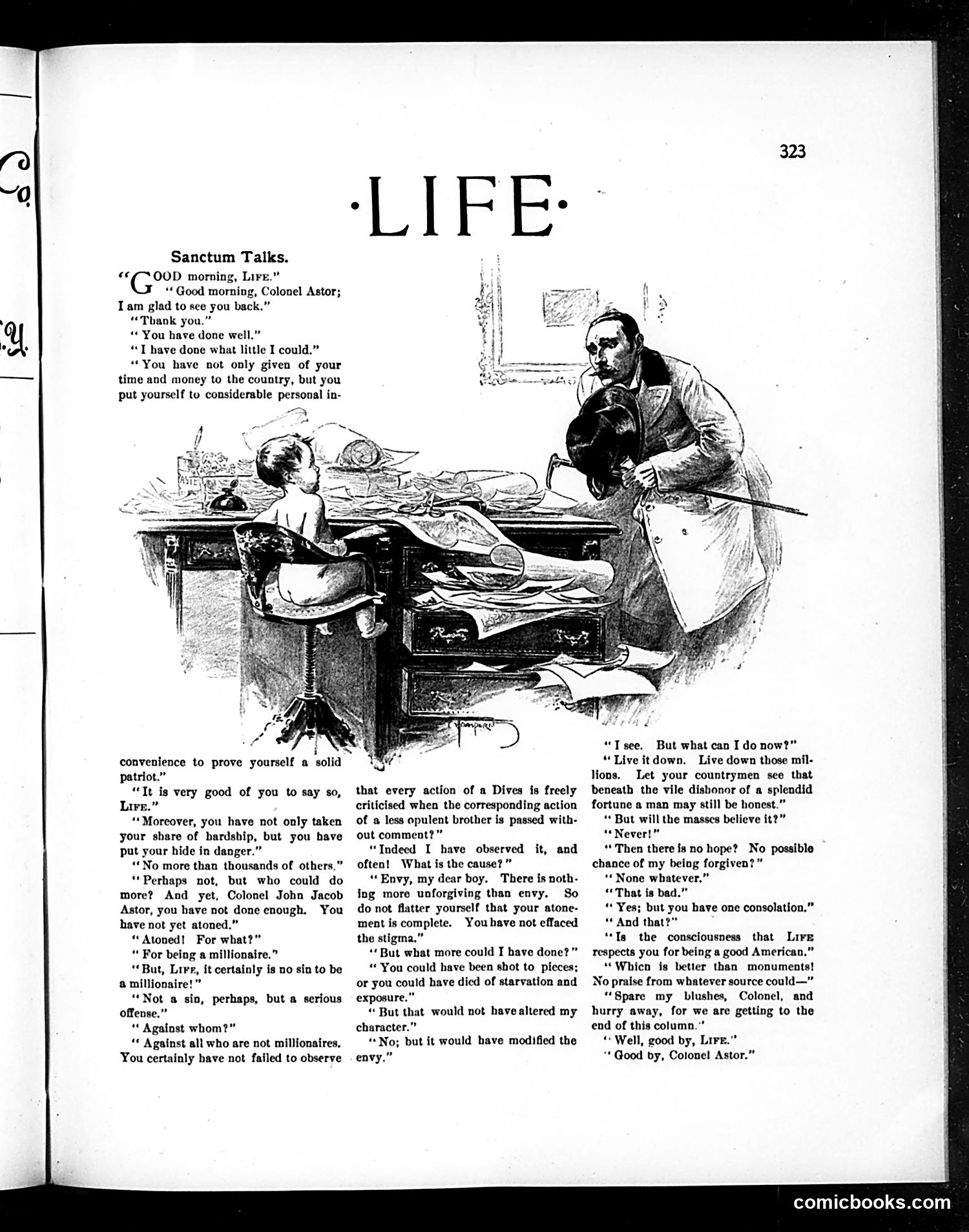
This page features a dialogue between Colonel Astor (identifiable as a wealthy millionaire) and an unnamed visitor. The satire critiques wealthy philanthropists who give money and time to charitable causes while claiming personal sacrifice. The Colonel argues that his charitable work has cost him considerably, but the visitor counters that true sacrifice would mean actual hardship—starvation or financial ruin. The exchange suggests that wealthy donors' "sacrifices" are trivial compared to real suffering. The satirical point: American millionaires congratulate themselves for modest charitable giving while remaining wealthy, never experiencing genuine deprivation. The cartoon mocks the self-congratulatory nature of elite philanthropy and questions whether comfortable charity constitutes real moral action.
📄 Transcribed text from this page (OCR, searchable)
Machine-transcribed from the original scan — historical spelling and the odd misread are preserved.
Sanctum Talks. cs OOD morning, Lire.” ‘*Good morning, Colonel Astor; Tam glad to see you back.” “Thank you.” “You have done well.” “T have done what little I could.” “You have not only given of your time and money to the country, but you put yourself to considerable personal in- £ONS convenience to prove yourself a solid patriot.” “Tt is very good of you to say so, Lire.” “Moreover, you have not only taken your share of hardship, but you have put your hide in danger.” “No more than thousands of others.” “Perhaps not, but who could do more? And yet, Colonel John Jacob Astor, you have not done enough. You have not yet atoned.” “ Atoned! For what?” “ For being a millionaire.” “But, Lire, it certainly is no sin to be a millionaire!” “Not a sino, perhaps, but a serious offense.” “ Against whom?” “* Against all who are not millionaires, You certainly have not failed to observe that every action of a Dives is freely criticised when the corresponding action of a less opulent brother is passed with- out comment?” “Indeed I have observed often! What is the cause?” “Envy, my dear boy. There is noth- ing more unforgiving than envy. So do not flatter yourself that your atone- ment is complete. You have not effaced the stigma.” “*But what more could I have done?” “You could have been shot to pieces; or you could have dicd of starvation and exposure.” “ But that would not have altered my character.” “No; but it would have modified the envy.” it, and “Tsee. But what can I do now?” “Live itdown. Live down those mil- lions. Let your countrymen see that beneath the vile dishonor of a splendid fortune a man may still be honest.” “ But will the masses believe it?” “Never!” “Then there is no hope? No possible chance of my being forgiven?” *« None whatever.” “That is bad.” “ Yes; but you have one consolation.” “And that?” ‘Is the consciousness that Lire respects you for being a good American.” “Whicn is better than monuments! No praise from whatever source could—” “Spare my blushes, Colonel, and hurry away, for we are getting to the end of this column.” “ Well, good by, Lire.” “* Good by, Colonel Astor.” comicbooks.com