
Life, 1898-10-27 · page 12 of 20
Life — October 27, 1898 — page 12: what you’re looking at
What you’re looking at
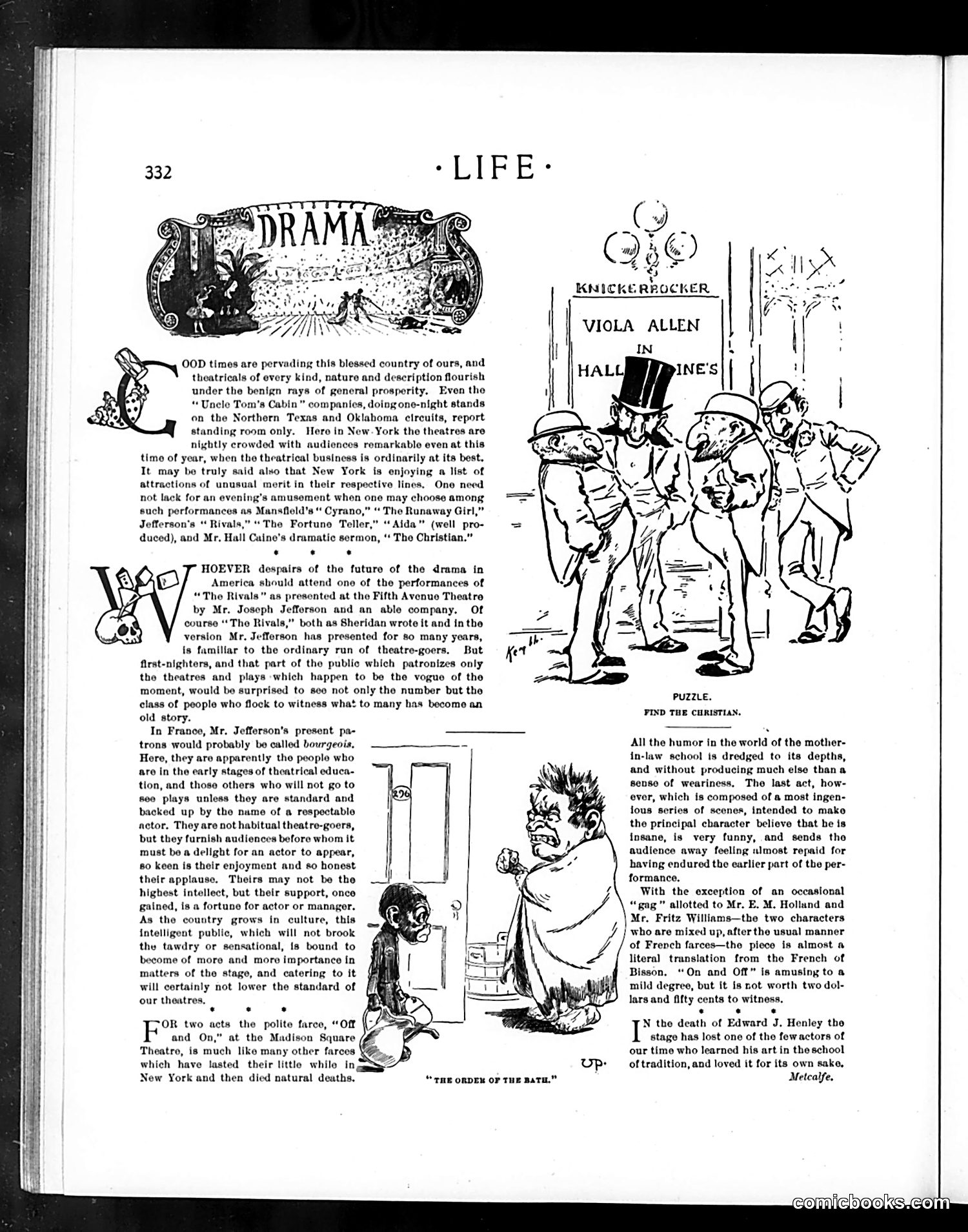
This page reviews theatrical productions on Broadway, focusing on a play called "The Rivals" at the Fifth Avenue Theatre. The main illustration shows a caricatured scene titled "Puzzle: Find the Christian," depicting exaggerated figures in what appears to be a comedic critique of morality in theater. The text discusses American drama's future, noting that while New York theaters are crowded, audiences flock to popular rather than high-quality productions. It criticizes the "vogue of the moment" drawing crowds based on celebrity rather than artistic merit. The review mentions a French farce "Off and On" at the Madison Square Theatre that "lasted their little while in New York and then died natural deaths"—satirizing the disposable nature of certain theatrical productions.
📄 Transcribed text from this page (OCR, searchable)
Machine-transcribed from the original scan — historical spelling and the odd misread are preserved.
OOD times are pervading this blessed country of ours, and theatricals of every kind, nature and description flourish under the benign rays of general prosperity. Even tho “Uncle Tom's Cabin” companies, doing one-night stands on the Northern Texas and Oklaboma circuits, report standing room only. Hero in New-York the theatres aro nightly crowded with audiences remarkable even at this timo of year, when the theatrical business is ordinarily at its best. It may be truly said also that New York is enjoying a list of attractions of unusual merit in their respective lines. One need not lack for an evening's amusement when one may choose among such performances as Mansfleld’s “ Cyrano,” “ The Runaway Girl,” Jefferson's “ Rivals,” “Tho Fortuno Teller,” “Aida” (well pro- duced), and Mr, Hall Cuino’s dramatic sermon, “ Tho Christian.” . + oe HOEVER despairs of tho futuro of the drama in America should attend ono of the performances of “Tho Rivals” as presented at tho Fifth Avenuo Theatro by Mr. Josoph Jefferson and an able company. Of course “Tho Rivals,” both as Sheridan wrote it and in tho vorsion Mr, Jefferson has presented for 80 many years, is familiar to the ordinary run of theatro-goers. But first-nighters, and that part of tho public which patronizes only tho theatres and plays which happen to be the voguo of tho moment, would be surprised to seo not only the number but tho class of people who flock to witness what to many has becomo an old story. In France, Mr. Jefferson's present pa- trons would probably bo called bourgeois, Here, they aro apparently tho people who aro in the early stages of theatrical educa- tion, and those others who will not go to seo plays unless they are standard and backed up by tho nume of a respectablo actor. They are not habitual theatro-goers, but they furnish audiences before whom it must be a delight for an actor to appear, 60 keen is their enjoyment and 80 honest their applause, Theirs may not be the highest intellect, but their support, onco gained, is a fortune for actor or manager. As the country grows in culture, this intelligent public, which will not brook the tawdry or sensational, {s bound to become of more and more importance in matters of tho stage, and catering to it will cortainly not lower the standard of our theatres, . . . OR two acts the polite farce, “Off and On,” at the Madison Square Theatro, is much like many other farces ¥ which have lasted their little while ing New York and then died natural deaths, “ THE ORDEM OF THE BATH.” x PUZZLE. FIND THE CHRISTIAN. All the humor in the world of the mother- in-law school 1s dredged to its depths, and without producing much else than a senso of weariness, Tho last act, how- ever, which is composed of a most ingen- fous series of scenes, intended to mako the principal character believe that be is insane, is very funny, and sends tho audience away feeling ulmost repaid for having endured the earlier part of the per- formance. With the exception of an occasional “gag” allotted to Mr. E. M. Holland and Mr, Fritz Williams—the two characters who are mixed up, after the usual manner of French farces—the piece is almost a literal translation from the French of Bisson. “On and Off” is amusing to a mild degree, but it is not worth two dol- lars and fifty cents to witness. . <8 N tho death of Edward J. Henley tho stage has lost ono of the fewactors of our time who learned his art in the school of tradition, and loved it for its own sake, Metcalfe,