
Life, 1892-11-24 · page 16 of 22
Life — November 24, 1892 — page 16: what you’re looking at
What you’re looking at
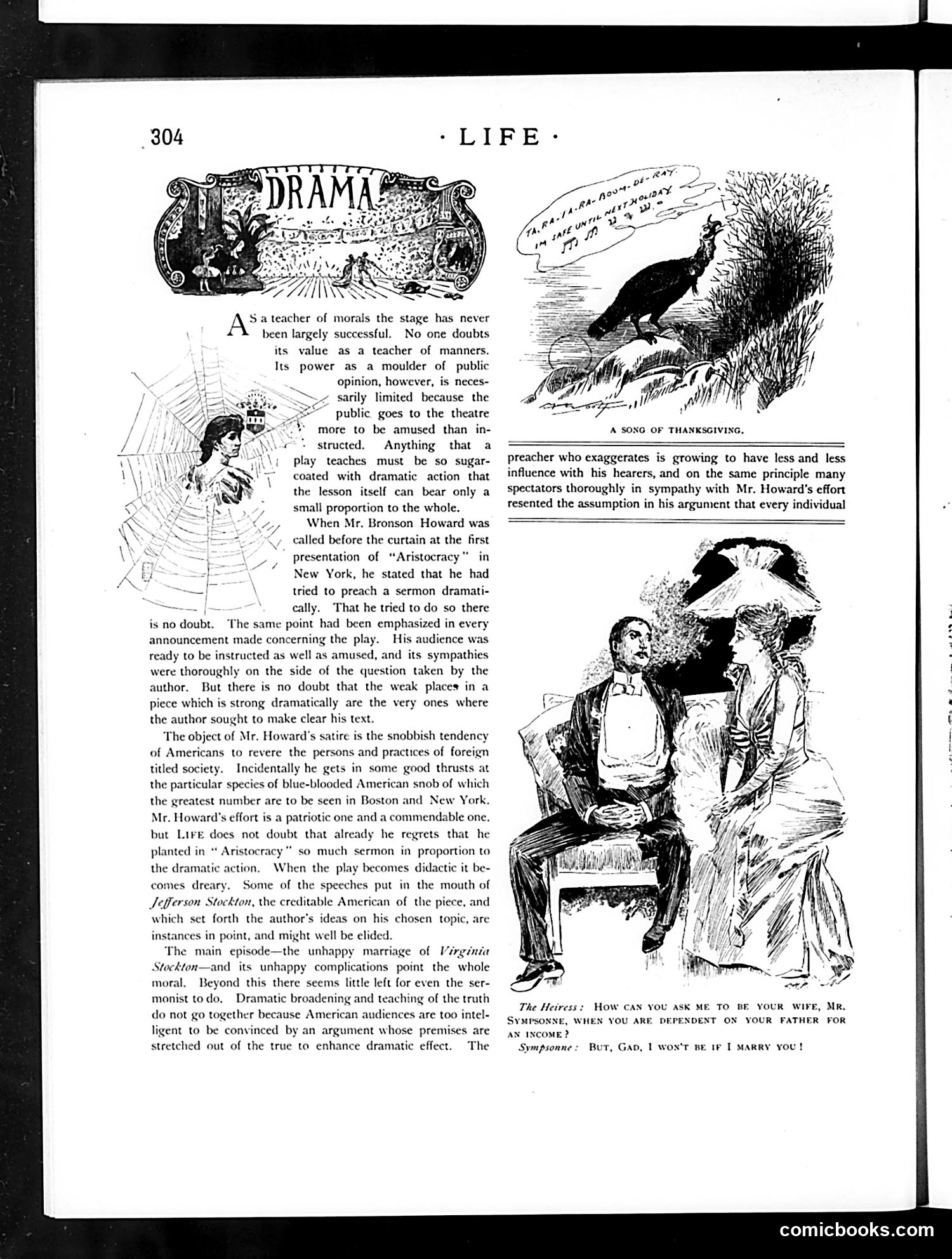
This page critiques playwright Bronson Howard's play "Aristocracy," which satirizes American snobbery toward European nobility. The text argues that while Howard's patriotic message—mocking Americans who revere foreign titles—is commendable, the play fails because it prioritizes moral preaching over entertainment. The article contends American audiences are too intelligent to accept artificially stretched arguments and find didactic plays tedious rather than persuasive. The lower cartoon depicts a social-climbing conflict: a wealthy heiress refuses to marry a man dependent on his father's income, despite his insistence he won't marry *her* for money. It illustrates the very snobbish materialism Howard critiques—the assumption that a man's worth depends on independent wealth rather than character. The "Song of Thanksgiving" illustration (top right) remains unclear without additional context.
📄 Transcribed text from this page (OCR, searchable)
Machine-transcribed from the original scan — historical spelling and the odd misread are preserved.
3 ateacher of morals the stage has never been largely successful. No one doubts its value as a teacher of manners. Its power as a moulder of public opinion, however, is neces- - sarily limited because the public goes to the theatre more to be amused than in- structed. Anything that a play teaches must be so sugar- coated with dramatic action that the lesson itself can bear only a small proportion to the whole. When Mr. Bronson Howard was called before the curtain at the first presentation of “Aristocracy" in New York, he stated that he had tried to preach a sermon dramati- 7 , cally. That he tried to do so there is no doubt. The same point had been emphasized in every announcement made concerning the play. His audience was ready to be instructed as well as amused, and its sympathies were thoroughly on the side of the question taken by the author. But there is no doubt that the weak places in a piece which is strong dramatically are the very ones where the author sought to make clear his text. The object of Mr. Howard's satire is the snobbish tendency of Americans to revere the persons and practices of foreign titled society. Incidentally he gets in some good thrusts at the particular species of blue-blooded American snob of which the greatest number are to be seen in Boston and New York. Mr. Howard's effort is a patriotic one and a commendable one, but Lire does not doubt that already he regrets that he planted in “ Aristocracy” so much sermon in proportion to the dramatic action. When the play becomes didactic it be- comes dreary. Some of the speeches put in the mouth of Jefferson Stockton, the creditable American of the piece, and which set forth the author's ideas on his chosen topic, are i in point, and might well be elided. he main episode—the unhappy marriage of Virgénia Stockton—and its unhappy complications point the whole moral, Beyond this there seems little left for even the ser- monist todo, Dramatic broadening and teaching of the truth do not go together because American audiences are too intel- ligent to be convinced by an argument whose premises are stretched out of the true to enhance dramatic effect. The A SONG OF THANKSGIVING, preacher who exaggerates is growing to have less and less influence with his hearers, and on the same principle many spectators thoroughly in sympathy with Mr. Howard's effort resented the assumption in his argument that every individual The Heiress: HOW CAN YOU ASK ME TO BE YOUR Wire, MR. SYMPSONNE, WHEN YOU ARE DEPENDENT ON YOUR FATHER FOR AN INCOME ? Sympsonne: But, Gao, 1 wox't ne IF T MARRY you! comicbooks.com