
Life, 1892-11-24 · page 12 of 22
Life — November 24, 1892 — page 12: what you’re looking at
What you’re looking at
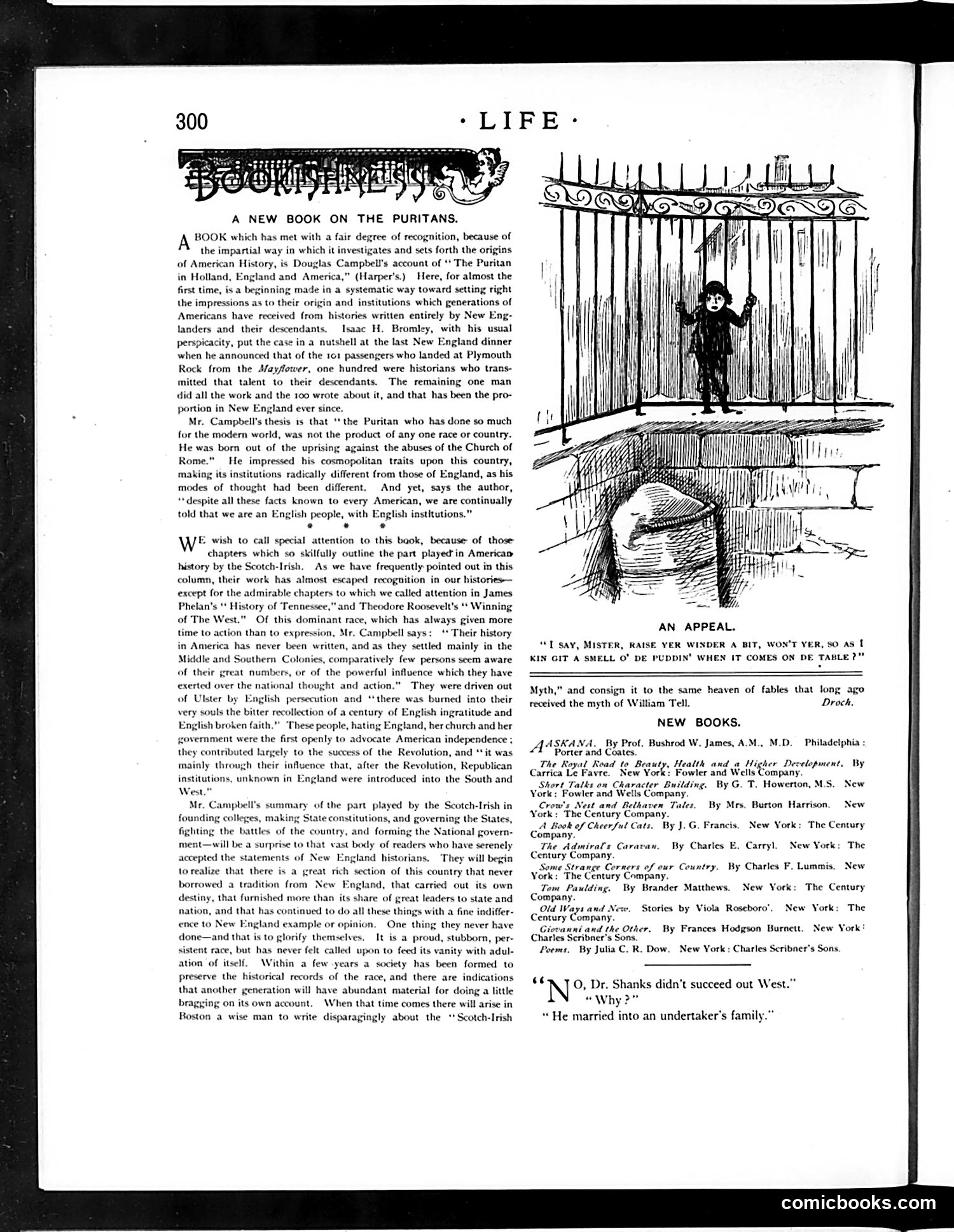
This page reviews Douglas Campbell's historical book about the Puritans, but the satirical **cartoon** (the small illustration labeled "AN APPEAL") mocks New England's historical self-importance. **The joke:** A figure appeals to raise a "winder" (window) so pudding smell doesn't come in through the table—a nonsensical complaint that ridicules fastidious pretension. **The broader satire:** The text criticizes how New England historians have monopolized American historical narratives. Isaac Bromley's quip states that of 101 Mayflower passengers, 100 were "historians" who transmitted this talent to descendants, while only one did actual work—yet the 100 wrote the accounts. This satirizes New England's disproportionate control over how American history gets told. Campbell's book apparently corrects this bias by documenting the Scotch-Irish and others' overlooked contributions to American independence and development, especially in the South and Middle Colonies—regions that "never borrowed a tradition from New England." The satire targets New England's cultural smugness and historical revisionism.
📄 Transcribed text from this page (OCR, searchable)
Machine-transcribed from the original scan — historical spelling and the odd misread are preserved.
A NEW BOOK ON THE PURITANS. A BOOK which has met with a fair degree of recognition, because of the impartial way in which it investigates and sets forth the origins of American History, is Douglas Campbell's account of The Puritan in Holland, England and America,” (Harper's) Here, for almost the first time, is a beginning made in a systematic way toward setting right the impressions as to their origin and institutions which generations of Americans have received from histories written entirely by New Eng- landers and their descendants. Isaac H. Bromley, with his usual perspicacity, put the case in a nutshell at the last New England dinner when he announced that of the 101 passengers who landed at Plymouth Rock from the Mayflower, one hundred were historians who trans- mitted that talent to their descendants, The remaining one man did all the work and the 100 wrote about it, and that has been the pro- portion in New England ever since. Mr. Campbell's thesis 1s that ‘the Puritan who has done so much for the modern world, was not the product of any one race or country. He was born out of the uprising against the abuses of the Church of Rome." He impressed his cosmopolitan traits upon this country, making its institutions radically different from those of England, as his modes of thought had been different. And yet, says the author, “+ despite all these facts known to every American, we are continually told that we are an English people, with English institutions e * ° E. wish to call special attention to this book, because of those chapters which so skilfully outline the part played in American history by the Scotch-Irish. As we have frequently: pointed out in this column, their work has almost escaped recognition in our histories— except for the admirable chapters to which we called attention in James Phelan’s ** History of Tennessee,” and Theodore Roosevelt's * Winning of The West." Of this dominant race, which has always given more time to action than to expression, Mr, Campbell says: Their history in America has never been written, and as they settled mainly in the Middle and Southern Colonies, comparatively few persons seem aware of their ¢ exerted over the 1 t numbers, or of the powerful influence which they have tional thought and action.” They were driven out of Ulster by English persecution and “there was burned into their very souls the bitter recollection of a century of English ingratitude and slish broken faith.” These people, hating England, her church and her government were the first openly to advocate American independence ; they contributed largely to the success of the Revolution, and ‘it was mainly through their influence that, after the Revolution, Republican institutions, unknown in England were introduced into the South and West, Mr. Campbell's summary of the part played by the founding colleges, making State constitutions, and governing the States, fighting the battles of the country, and forming the National govern- ment—will be a surprise to that vast body of readers who have serenely accepted the statements of New England historians. ‘They will begin torealize that there is a great rich section of this country that never borrowed a tradition from New England, that carried out its own destiny, that furnished more than its share of great leaders to state and nation, and that has continued to do all these things with a fine indiffer- ch-lrish in ence to New England example or opinion, One thing they never have done—and that is to glorify themselves. It is a proud, stubborn, per- sistent race, but has never felt called upon to feed its vanity with adul- ation of itself. Within a few -years a society has been formed to preserve the historical records of the race, and there are indications that another generation will have abundant material for doing a little bragging on its own account. When that time comes there will arise in Boston a wise man to write disparagingly about the * Scotch-Irish AN APPEAL. “TL SAY, MISTER, RAISE YER WINDER A BIT, WON'T YER, 80 AS I KIN GIT A SMELL O' DE PUDDIN' WHEN IT COMES ON DE TABLE? Myth,” and consign it to the same heaven of fables that long ago received the myth of William Tell. Droch. NEW BOOKS. ASKANA, By Prof, Bushrod W. James, A.M., M.D. Porter and Coates. The Royal Koad to Beauty, Health and a Higher Development, By Carrica Le Favre. New York: Fowler and Wells Company ks on Character Building. By G. T. Howerton, ‘owler and Wells Compa 4 me Tales. The Century Company. A Book of Cheerful Cats. By J.G. Francis. Company. The Admirals Caravan, Century Company. Some Strange Corners of our Country. York: The Century Company, Tom Paulding, By Brander Matthews. Company. Old Ways and N Century Compan; Gievanni and the Other. Charles Scribner's Sons. By Julia C. R. Dow. hiladelphia : Z Philadelphia 1S. New By Mrs. Burton Harrison. New New York: The Century By Charles E. Carryl, New York: The By Charles F. Lummis. New New York: The Century Stories by Viola Roseboro’, New York: The By Frances Hodgson Burnett. New York! Poems. New York : Charles Scribner's Sons. se O, Dr. Shanks didn’t succeed out West.” “Why 2” “He married into an undertakers family. comicbooks.com