
Life, 1890-05-01 · page 6 of 18
Life — May 1, 1890 — page 6: what you’re looking at
What you’re looking at
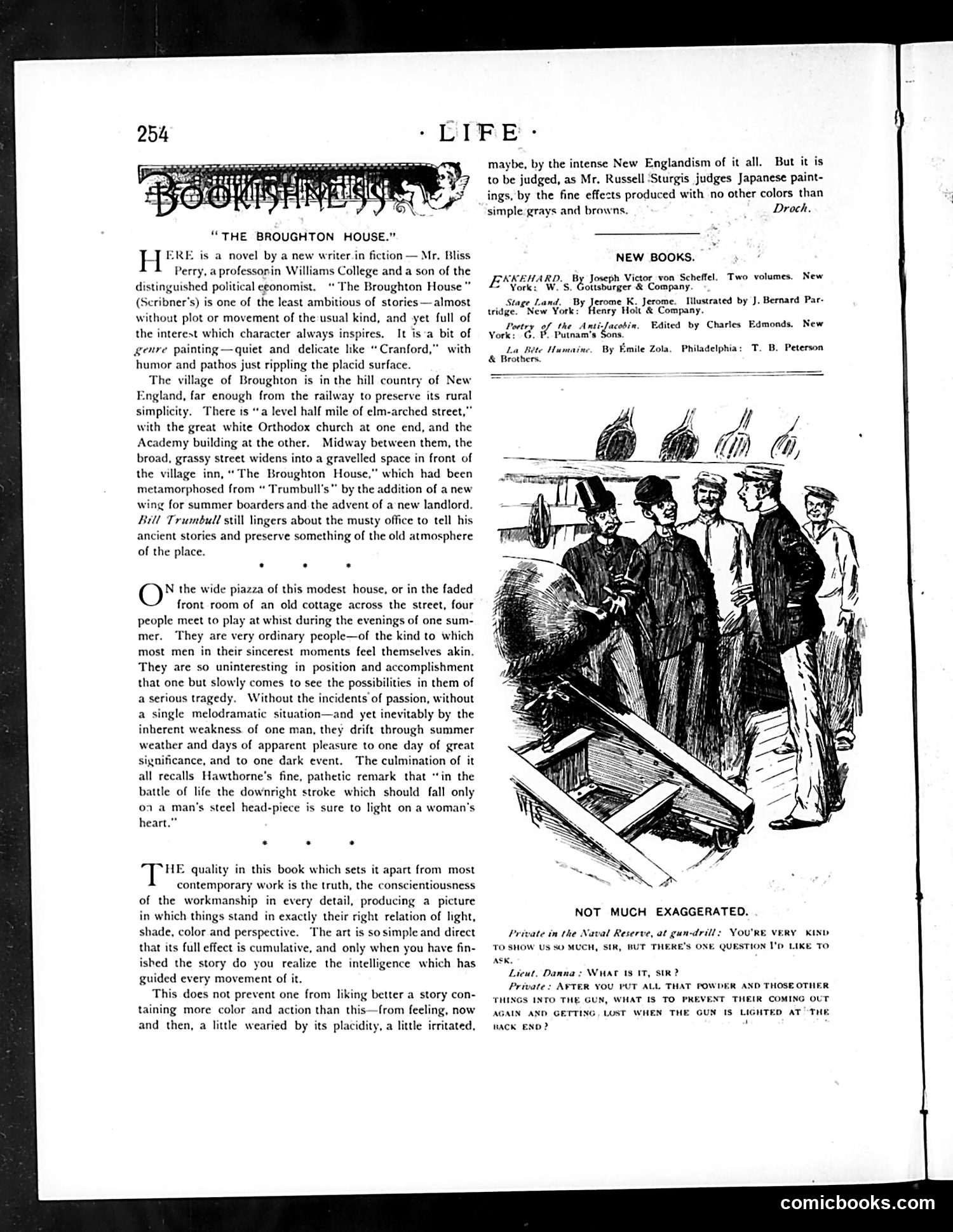
This cartoon satirizes a Naval Reserve gunnery drill. A Private in the Naval Reserve converses with a Lieutenant, claiming he wants to ask about preventing powder and other materials from coming out again after the gun is lighted at the back end. The humor lies in the Private's ignorance: he appears unfamiliar with basic gun mechanics—specifically that firing a gun necessarily ejects spent materials backward. His naïve question suggests he doesn't understand fundamental weaponry. The cartoon's title, "Not Much Exaggerated," implies this exchanges represents a real type of military incompetence or training gap the magazine's readers would recognize. It mocks the Naval Reserve's preparedness by showing recruits lacking basic technical knowledge about the weapons they operate.
📄 Transcribed text from this page (OCR, searchable)
Machine-transcribed from the original scan — historical spelling and the odd misread are preserved.
“THE BROUGHTON HOUSE.” E ERE is a novel by a new writer.in fiction — Mr. Bliss Perry, a professonin Williams College and a son of the distinguished political egonomist. “ The Broughton House ” (Scribner's) is one of the least ambitious of stories —almost without plot or movement of the usual kind, and yet full of the interest which character always inspires. It is’a bit of genre painting —quiet and delicate like “Cranford,” with humor and pathos just rippling the placid surface. The village of Broughton is in the hill country of New England, far enough from the railway to preserve its rural simplicity. There is “a level half mile of elm-arched street,” with the great white Orthodox church at one end, and the Academy building at the other. Midway between them, the broad, grassy street widens into a gravelled space in front of the village inn, The Broughton House,” which had been metamorphosed from “ ‘Trumbull’s” by the addition of a new wing for summer boarders and the advent of a new landlord. Bill Trumbull still lingers about the musty office to tell his ancient stories and preserve something of the old atmosphere of the place. ON the wide piazza of this modest house, or in the faded front room of an old cottage across the street, four people meet to play at whist during the evenings of one sum- mer. They are very ordinary people—of the kind to which most men in their sincerest moments feel themselves akin, They are so uninteresting in position and accomplishment that one but slowly comes to see the possibilities in them of a serious tragedy. Without the incidents of passion, without a single melodramatic situation—and yet inevitably by the inherent weakness of one man, they drift through summer weather and days of apparent pleasure to one day of great significance, and to one dark event. The culmination of it all recalls Hawthorne's fine, pathetic remark that “in the battle of life the downright stroke which should fall only 02 a man’s steel head-piece is sure to light on a woman's heart.” . . . T = quality in this book which sets it apart from most contemporary work is the truth, the conscientiousness of the workmanship in every detail, producing a picture in which things stand in exactly their right relation of light, shade, color and perspective. ‘The art is so simple and direct that its full effect is cumulative, and only when you have fin- ished the story do you realize the intelligence which has guided every movement of it. This does not prevent one from liking better a story con- taining more color and action than this—from feeling, now and then, a little wearied by its placidity, a little irritated, - DIFE- maybe, by the intense New Englandism of it all. But it is to be judged, as Mr. Russell ‘Sturgis judges Japanese paint- ings, by the fine effects produced with no other colors than simple grays and browns, Droch. NEW BOOKS. EXKEHARD. By Joseph Victor, von Scheffel. Two volumes. New York: W.'S. Gottsburger & Company. Stage Land. By Jerome K. Jerome, Illustrated by J. Bernard Par- tridge. New York: Henry Holt & Company, Poetry of the Anti-facobin, Edited by Charles Edmonds. New York: G. B Putnam's Sons. La Bite Humaine. By Emile Zola, Philadelphia: T. B. Peterson & Brothers NOT MUCH EXAGGERATED. Private in the Naval Reserve, at gun-drill: YOU'RE VERY KIND ‘TO SHOW US SO MUCH, SIR, HUT THERE'S ONE QUESTION I'D LIKE TO ask. Lieut, Danna : WMAt 18 17, SIR? Private: AFTER YOU PUT ALL THAT POWDER AND THOSE OTHER THINGS INTO TH N, WHAT IS TO PREVENT THEIR COMING OUT AGAIN AND GETTING, LUST WHEN THE GUN IS LIGHTED AT THE RACK END? = comicbooks.com