
Life, 1890-05-01 · page 4 of 18
Life — May 1, 1890 — page 4: what you’re looking at
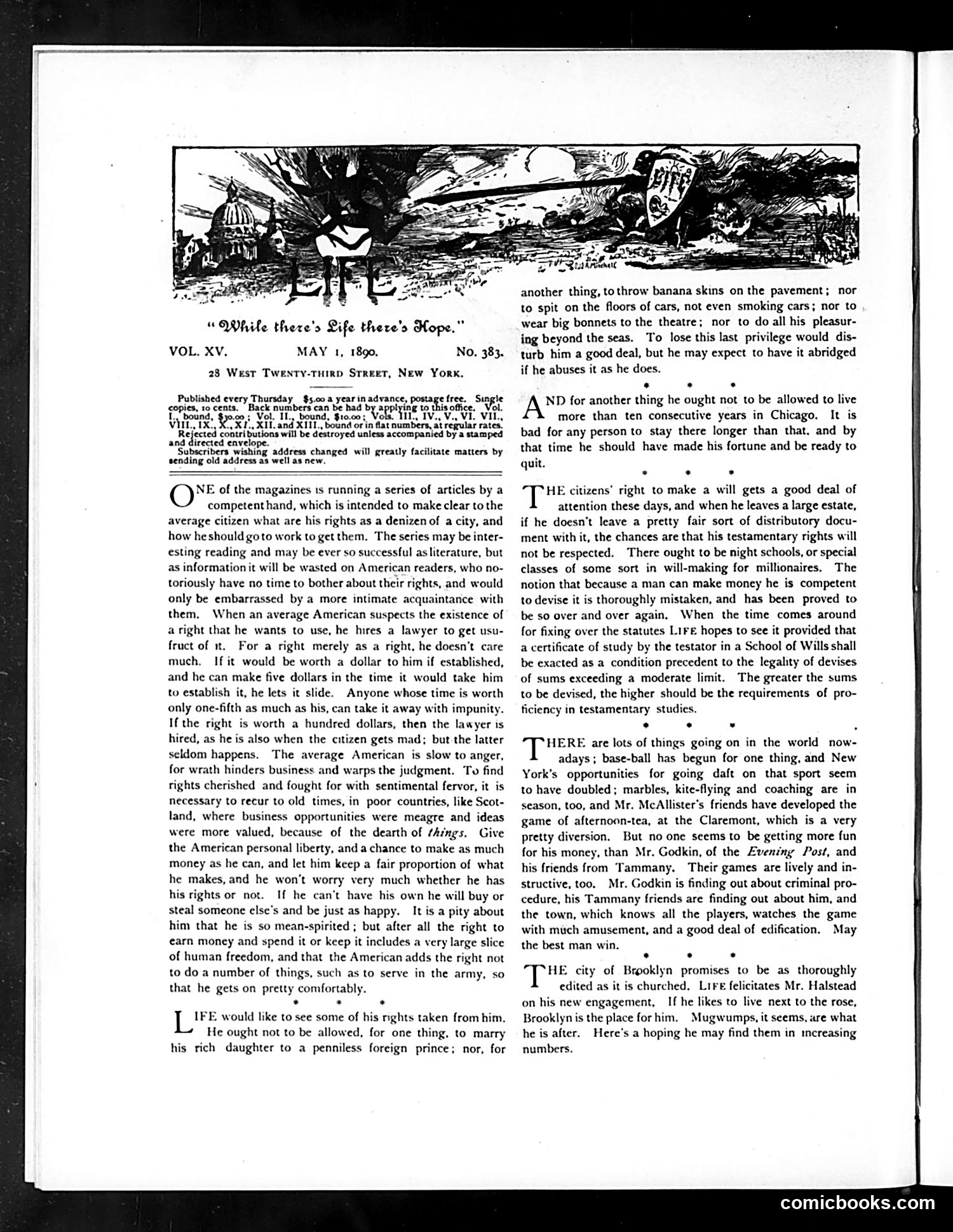
A restored page from Life, 1890-05-01. Page through the whole issue in the reader above.
📄 Transcribed text from this page (OCR, searchable)
Machine-transcribed from the original scan — historical spelling and the odd misread are preserved.
“WMhile there's Life there's Hope.” VOL. xv. MAY 1, 1890, No. 383. 28 West Twenty-tHirp Street, New York. Published every Thursday $5.00 a year in advanc ants Single copies, to cents. Back Dumrbers can be had Dyappleing to thisofice, Vol. I $9; Vol. I, bound. $10.00: 11, 1V. . VI 1, Bound or in fat numbers, Ref fd contri Surions will be destroyed unless accompanied Oa stamped and directed envelope. Subscribers wishing address changed will greatly facilitate matters by sending old address as well as new. E of the magazines 1s running a series of articles by a competenthand, which is intended to make clear tothe average citizen what are his rights as a denizen of a city, and how he should goto work to get them. The series may be inter- esting reading and may be ever so successful asliterature, but as information it will be wasted on American readers, who no- toriously have no time to bother about their rights, and would only be embarrassed by a more intimate acquaintance with them. When an average American suspects the existence of a right that he wants to use, he hires a lawyer to get usu- fruct of 1. For a right merely as a right, he doesn’t care much, If it would be worth a dollar to him if established, and he can make five dollars in the time it would take him to establish it, he lets it slide. Anyone whose time is worth only one-fifth as much as his, can take it away with impunity. If the right is worth a hundred dollars, then the lawyer is hired, as he is also when the citizen gets mad; but the latter seldom happens. The average American is slow to anger, for wrath hinders business and warps the judgment. To find rights cherished and fought for with sentimental fervor, it is necessary to recur to old times, in poor countries, like Scot- land, where business opportunities were meagre and ideas were more valued, because of the dearth of things. Give the American personal liberty, and a chance to make as much money as he can, and let him keep a fair proportion of what he makes, and he won't worry very much whether he has his rights or not. If he can’t have his own he will buy or steal someone else's and be just as happy. It is a pity about him that he is so mean-spirited ; but after all the right to earn money and spend it or keep it includes a very large slice of human freedom, and that the American adds the right not to do a number of things, such as to serve in the army, so that he gets on pretty comfortably. . . IFE would like to see some of his mghts taken from him. He ought not to be allowed, for one thing, to marry his rich daughter to a penniless foreign prince; nor, for another thing, to throw banana skins on the pavement; nor to spit on the floors of cars, not even smoking cars; nor to wear big bonnets to the theatre; nor to do all his pleasur- ing beyond the seas. To lose this last privilege would dis- turb him a good deal, but he may expect to have it abridged if he abuses it as he does. . . . ND for another thing he ought not to be allowed to live more than ten consecutive years in Chicago. It is bad for any person to stay there longer than that. and by that time he should have made his fortune and be ready to quit. . . . HE citizens’ right to make a will gets a good deal of attention these days, and when he leaves a large estate, if he doesn’t leave a pretty fair sort of distributory docu- ment with it, the chances are that his testamentary rights will not be respected. There ought to be night schools, or special classes of some sort in will-making for millionaires. The notion that because a man can make money he is competent to devise it is thoroughly mistaken, and has been proved to be so over and over again, When the time comes around for fixing over the statutes LiFe hopes to see it provided that a certificate of study by the testator in a School of Wills shall be exacted as a condition precedent to the legality of devises of sums exceeding a moderate limit. The greater the sums to be devised, the higher should be the requirements of pro- ficiency in testamentary studies. . . . HERE are lots of things going on in the world now- adays ; base-ball has begun for one thing, and New York's opportunities for going daft on that sport seem to have doubled; marbles, kite-flying and coaching are in season, too, and Mr. McAllister’s friends have developed the game of afternoon-tea, at the Claremont, which is a very pretty diversion. But no one seems to be getting more fun for his money, than Mr. Godkin, of the Evening Post, and his friends from Tammany. Their games are lively and in- structive, too. Mr. Godkin is finding out about criminal pro- cedure, his Tammany friends are finding out about him, and the town, which knows all the players, watches the game with much amusement, and a good deal of edification. May the best man win. . . HE city of Brooklyn promises to be as thoroughly edited as it is churched. Lire felicitates Mr. Halstead on his new engagement, If he likes to live next to the rose, Brooklyn is the place for him. Mugwumps, it seems, are what he is after. Here's a hoping he may find them in increasing numbers. comicbooks.com