
Judge, 1938-12 · page 19 of 41
Judge — December 1938 — page 19: what you’re looking at
A restored page from Judge, 1938-12. Page through the whole issue in the reader above.
📄 Transcribed text from this page (OCR, searchable)
Machine-transcribed from the original scan — historical spelling and the odd misread are preserved.
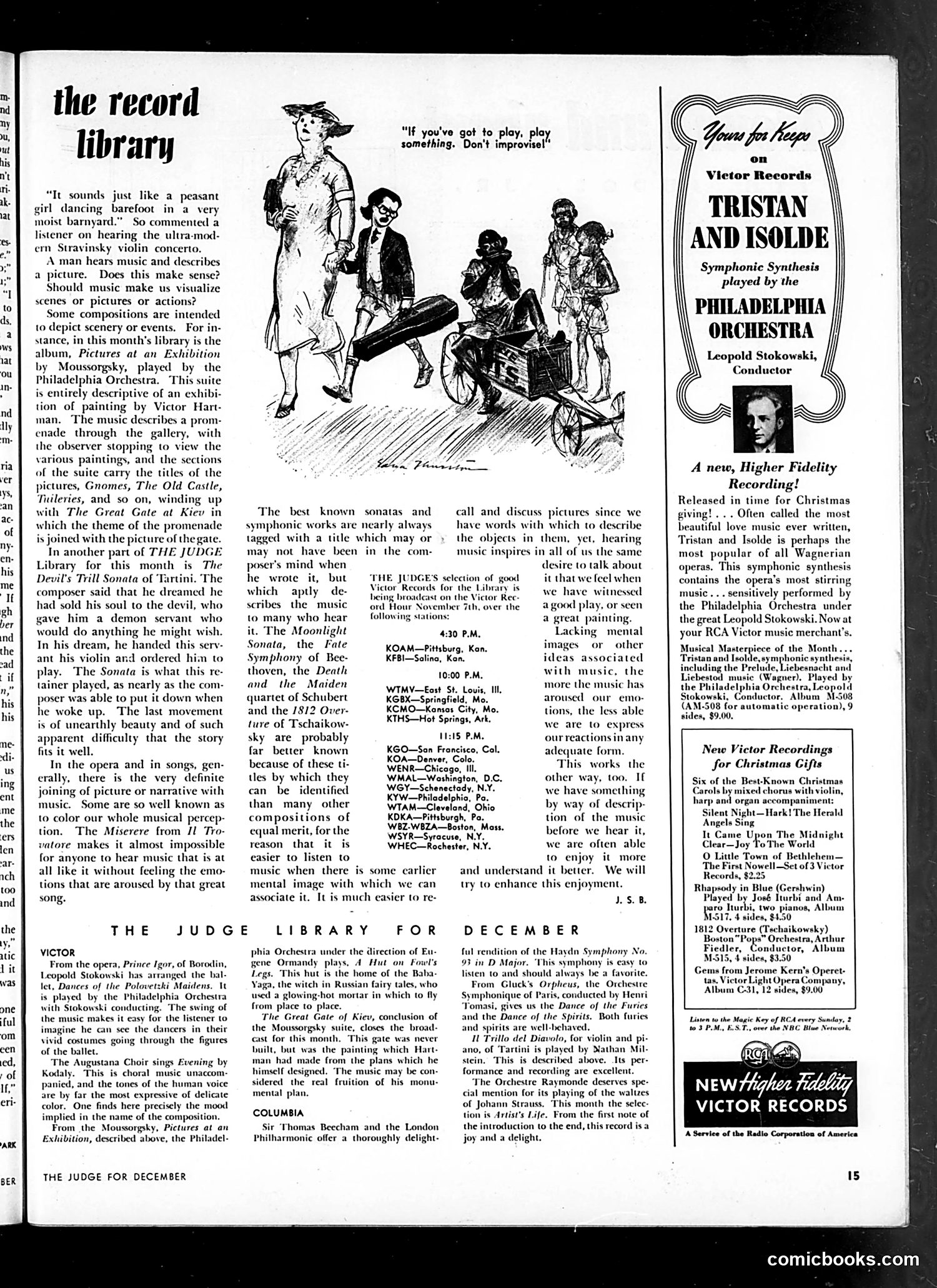
the record library “It sounds just like a peasant girl dancing barefoot in a very moist barnyard.” So commented a listener on hearing the ultra-mod- rn Stravinsky violin concerto. man hears music and describes a picture. Does this make sense? Should music make us ralize scenes or pictures or actions? Some compositions are intended to depict scenery or events. For in- stance, in this month's library is the album, Pictures at an Exhibition by Moussorgsky, played by the Philadelphia Orchestra. This suite is entirely descriptive of an exhibi- tion of painting by Victor Hart- man. The music describes a prom- cnade through the gallery, with the observer stopping to view the various paintings, and the sections of the suite carry the titles of the pictures, Gnomes, The Old Castle, Tuileries, and so on, winding up with The Great Gate at Kiev in which the theme of the promenade is joined with the picture of the gate. In another part of THE JUDGE Library for this month is The Devil's Trill Sonata of Tartini. The composer said that he dreamed he had sold his soul to the devil, who gave him a demon servant who would do anything he might wish. In his dream, he handed this serv- ant his violin and ordered him to play. The Sonata is what this re- tainer played, as nearly as the com- poser was able to put it down when he woke up. The last movement is of unearthly beauty and of such apparent difficulty that the story fits it well. In the opera and in songs, gen- erally, there is the very definite joining of picture or narrative with music. Some are so well known as to color our whole musical percep: tion, The Miserere from Il Tro- vatore makes it almost impossible for anyone to hear music that is at all like it without feeling the emo- tions that are aroused by that great song. THE VICTOR From the opera, Prince Igor, of Borodin, Leopold Stokowski has arranged the bal- let, Dances of the Polovetzki Maidens. Wt is played by the Philadelphia Orchestra with Stokowski conducting. The swing of the music makes it easy for the listener to imagine he can see the dancers in their vivid costumes going through the figures of the ballet. The Augustana Choir sings Evening by Kodaly. This is choral music unaccom- panied, and the tones of the human voice are by far the most expressive of delicate color. One finds here precisely the mood implied in the name of the composition. From the Moussorgsky, Pictures at an Exhibition, described above, the Philadel- THE JUDGE FOR DECEMBER JUDGE “If you've got to play, pla something. Don't inproveel”™ The best known sonatas and symphonic works are nearly always tagged with a title which may or may not have been in the com- poser’s mind when he wrote it, but which aptly de- scribes the music to many who hear it. The Moonlight Sonata, the Fate Symphony of Bee- thoven, the Death and the Maiden quartet of Schubert and the /8/2 Ouver- ture of Tschaikow- sky are probably far better known because of these ti- tles by which they can be identified than many other compositions of equal merit, for the reason that it is easier to listen to music when there is some earlier mental image with which we can associate it. It is much easier to re- being broad KOAM—Pi WENR—CI LIBRARY FOR phia Orchestra under the direction of Eu- gene Ormandy plays, A Hut on Fowl’s Legs. This hut is the home of the Baba- Yaga, the witch in Russian fairy tales, who used a glowing-hot mortar in which to fly from place to place. The Great Gate of Kiev, conclusion of the Moussorgsky suite, closes the broad- cast for this month, This gate was never built, but was the pai ing which Hart- man had made from the plans which he himself designed. ‘The music may be con- sidered the real fruition of his monu- mental pla COLUMBIA Sir ‘Thomas Beecham and the London Philharmonic offer a thoroughly delight- THE JUDGE'S selection of good tor Records fo ord Flour November 7th, over the following stations: 4:30 P.M. burg, Kon. KFBI—Solino, Kan. 10:00 P.M. WIMV—Eost St. Louis, Ill, KGBX—Springfield, Mo. KCMO—Konsos City, Mo. KTHS—Hot 5; ar This works the WMAL—Washington, D.C, KDKA—Pittsburgh, Po. WBZ-WBZA—Boston, Mass. WSYR—Syracuse, N.Y. WHEC—Rochester, N.Y. call and discuss pictures since we have words with which to describe the objects in them, yet, hearing music inspires in all of us the same desire to talk about it that we feel when we have witnessed good play, or seen a great painting. Lacking mental images or other ideas associated with music, the more the music has aroused our emo- tions, the less able we are to express our reactions inany adequate form. ctor Rec- ings, Ark, UsIS PLM, KGO—Son Francisco, Col. KOA—Denw other way, too. If we have something by way of descrip: tion of the music before we hear it, we are often able to enjoy it more and understand it better. We will try to enhance this enjoyment. 4, S. B. DECEMBER ful rendition of the Haydn Symphony 93 in D Major. ‘This symphony is easy to listen to and should always be a favorite. From Gluck’s Orpheus, the Orchestre Symphonique of Paris, conducted by Henri Tomasi, gives us the Dance of the Furies and the Dance of the Spirits. Both furies and spirits are well-behaved, I Trillo det Diavolo, for violin and ano, of Tartini is played by Nathan M stein, This is described above. Its per- formance and recording are excellent. ‘The Orchestre Raymonde deserves spe- cial mention for its playing of the waltzes of Johann . This month the selec- tion is Artist’s Life. From the first note of troduction to the end, this record isa Guns fo Rape visise meceeas TRISTAN AND ISOLDE Symphonic Synthesis played by the PHILADELPHIA ORCHESTRA Leopold Stokowski, Conductor A new, Higher Fidelity Recording! Released in time for Christmas giving!... Often called the most beautiful love music ever written, Tristan and Isolde is perhaps the most popular of all Wagnerian operas. This symphonic synthesis contains the opera’s most stirring music... sensitively performed by the Philadelphia Orchestra under the great Leopold Stokows! your RCA Victor music merchant's. Musical Masterpiece of the Month... Tristan and Isolde,symphonic synthesis, including the Prelude, Liebesnacht and Liebestod music (Wagner), Played by the Philadelphia Orchestra, Leopold Stokowski, Conductor. Album M-508 (AM-508 for automatic operation), 9 sides, $9.00, New Victor Recordings for Christmas Gi Six of the Best-Known Christmas Carols by mixed ch ith violi harp and organ accompani t Night—Hark! The Herald ng It Came Upon The Midnight Clear—Joy To The World © Little Town of Bethleh The First Nowell Set of 3 Vi Records, $2.25 Rhapsody in Blue (Gershwin) Played by José Iturbi and Am- paro Hturbi, two pianos, Album 1-517, 4 sides, $4.50 1812 Overture (Techaikowsky) Boston Pops” Orchestra, Arthur Fiedler, Conductor, Album 5, 4 sides, $3.50 Gems from Jerome Kern's Operet- tas. V ht Opera C VICTOR RECORDS A Service of the Radio Corporation of America 15 comicbooks.com