
Judge, 1938-12 · page 18 of 41
Judge — December 1938 — page 18: what you’re looking at
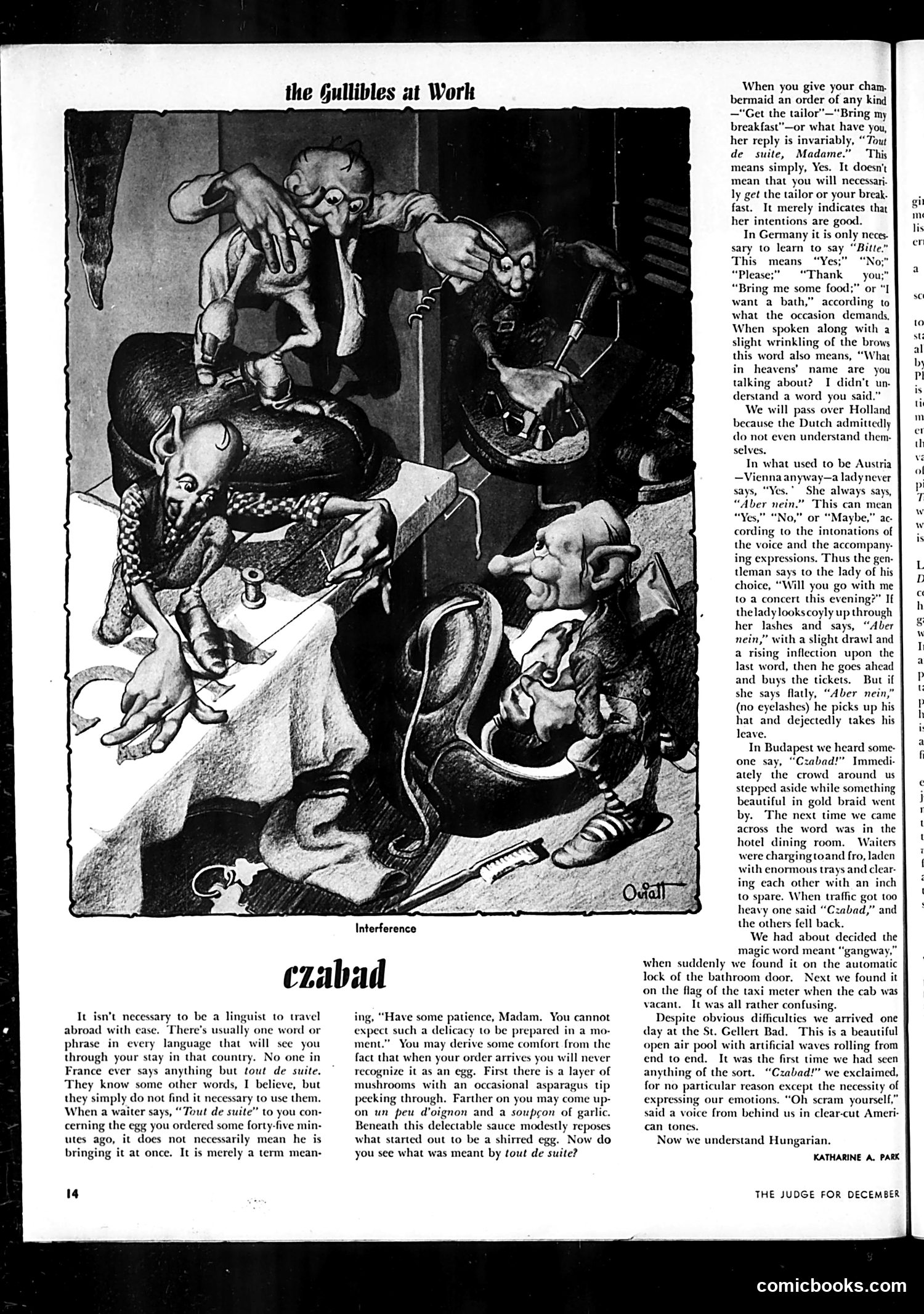
A restored page from Judge, 1938-12. Page through the whole issue in the reader above.
📄 Transcribed text from this page (OCR, searchable)
Machine-transcribed from the original scan — historical spelling and the odd misread are preserved.
the Gullibles at Work Interference czabad It isn’t necessary to be a linguist to travel abroad with ease. There's usually one word or phrase in every language that will see you through your stay in that country. No one in France ever says anything but tout de suite. They know some other words, I believe, but they simply do not find it necessary to use them. When a waiter says, “Tout de suite” to you con- cerning the egg you ordered some forty-five min- utes ago, it does not necessarily mean he is bringing it at once. It is merely a term mean- 14 ing, “Have some patience, Madam. You cannot expect such a delicacy to be prepared in a mo- ment.” You may derive some comfort from the fact that when your order arrives you will never recognize it as an egg. First there is a layer of mushrooms with an occasional asparagus tip pecking through. Farther on you may come up- on un peu d’oignon and a soupcon of garlic. Beneath this delectable sauce modestly reposes what started out to be a shirred egg. Now do you see what was meant by tout de suite? When you give your cham. bermaid an order of any kind —"Get the tailor’—“Bring my breakfast"—or what have you, her reply is invariably, “Tout de suite, Madame.” This means simply, Yes. It doesn't mean that you will necessai ly get the tailor or your break. fast. It merely indicates that her intentions are good. In Germany it is only neces. sary to learn to say “Bitte.” This means “Yes;" “N “Please; “Thank you “Bring me some food;” or “I want a bath,” according to what the occasion demands, When spoken along with a slight wrinkling of the brows this word also means, “What in heavens’ name are you talking about? I didn't un- derstand a word you said.” We will pass over Holland because the Dutch admittedly do not even understand them. selves. In what used to be Austria —Vienna anyway—a lady never says, "Yes." She always says, “Aber nein.” This can mean “Yes,” “No,” or “Maybe,” ac. cording to the intonations of the voice and the accompany- ing expressions. Thus the gen- tleman says to the lady of his choice, “Will you go with me to a concert this evening?” If thelady looks coyly up through her lashes and says, “Aber nein,” with a slight drawl and a rising inflection upon the last word, then he goes ahead and buys the tickets. But if she says flatly, “Aber nein,” (no eyelashes) he picks up his hat and dejectedly takes his leave. In Budapest we heard some- one say, “Czabad!” Immedi- ately the crowd around us stepped aside while something beautiful in gold braid went by. The next time we came across the word was in the hotel dining room. Waiters were chargingtoand fro, laden with enormous trays and clear- ing cach other with an inch to spare. When traffic got too heavy one said “Czabad,” and the others fell back. We had about decided the magic word meant “gangway,” when suddenly we found it on the automatic lock of the bathroom door. Next we found it on the flag of the taxi meter when the cab was vacant. It was all rather confusing. Despite obvious difficulties we arrived one day at the St. Gellert Bad. This is a beautiful open air pool with artificial waves rolling from end to end. It was the first time we had seen anything of the sort. “Czabad!” we exclaimed, for no particular reason except the necessity of expressing our emotions. “Oh scram yourself,” said a voice from behind us in clear-cut Ameri- can tones. Now we understand Hungarian. KATHARINE A. PARK THE JUDGE FOR DECEMBER comicbooks.com gi mi lis er