
Judge, 1938-08 · page 26 of 36
Judge — August 1938 — page 26: what you’re looking at
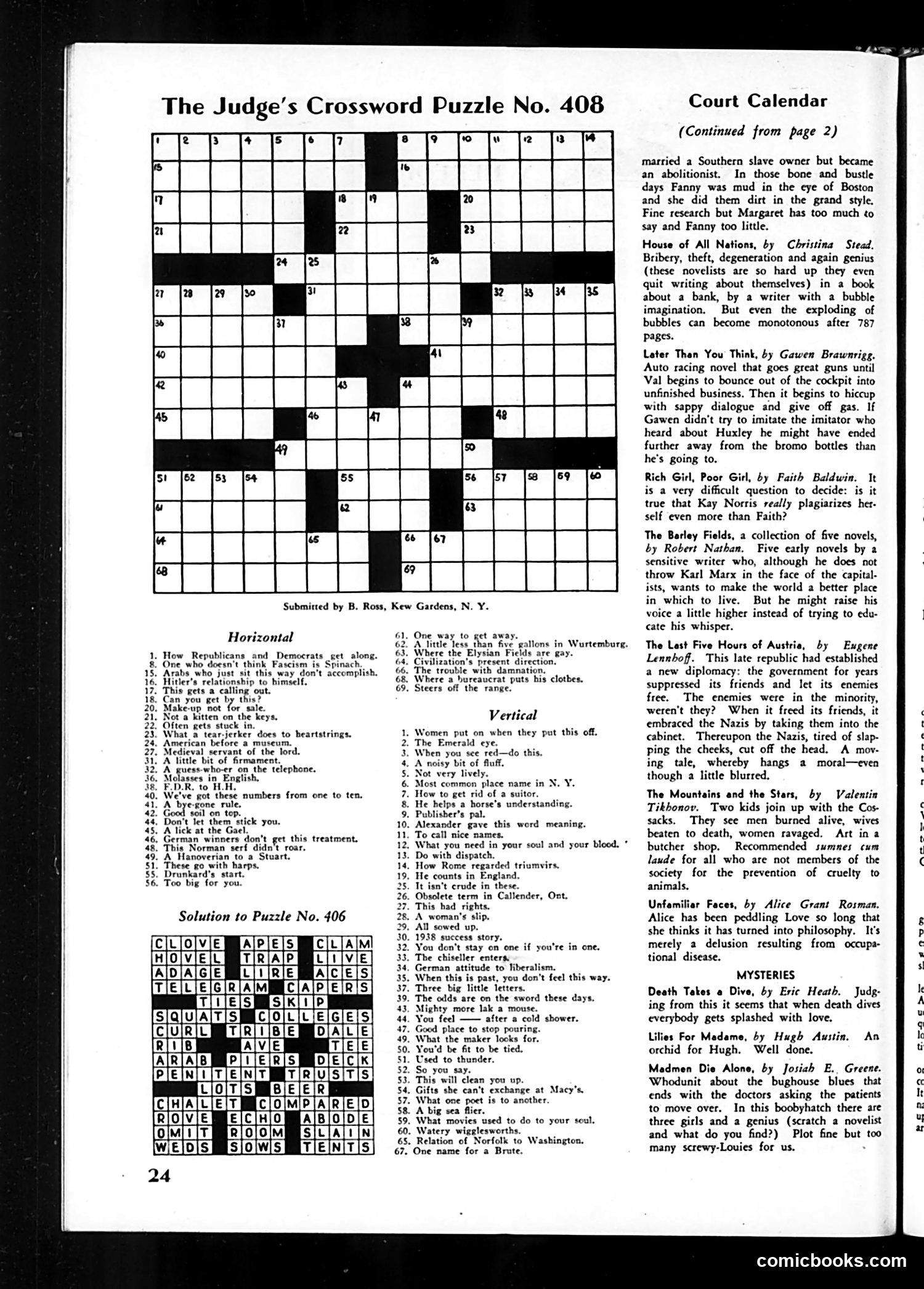
A restored page from Judge, 1938-08. Page through the whole issue in the reader above.
📄 Transcribed text from this page (OCR, searchable)
Machine-transcribed from the original scan — historical spelling and the odd misread are preserved.
The Judge’s Crossword Puzzle No. 408 Submited by B. Ross, Kew Gardens, N. Y. Horizontal . How Republicans and Democrats get along. E Gne whe'decen't think Fasciom te Spinach. ; Arabs who just sit this way don't accomplish, : Hitler's relationship to himself. . This gets a calling out. . Can you get by this? . Make-up not for sale. + Not a kitten on the keys, : Often gets stuck in, What a tear-jerker does to heartstrings. . American before a museum. Medieval servant of the lord. * A little bit of firmament. "A guess-who-er on the telephone. . Molasses in English, F.D.R, to H.H. We've got these numbers from one to ten. 2A bye-gone rule. Good soil on ‘top. ; Don’t let them stick you. . A lick at the Gael. ; German winners don’t get this treatment. . This Norman serf didn't roar. . A Hanoverian to a Stuart. . These go with harps. Drunkard’s start. Too big for you. Solution to Puzzle No. 406 . One way to get away. A little tess ¢ |. Where the Elysian Fields are gay. ; Civilization’s present direction. . The trouble with damnation. Where a bureaucrat puts his clothes, . Steers off the range. Vertical . Women put on when they put this off. . The Emerald eye. 3. When you see red—do this. . A noisy bit of fluff. . Not very lively. . Most common place name in N. Y. . How to get rid of a suitor. . He helps a horse’s understanding. |. Publisher's pal. . Alexander gave this word meaning. . To call nice names. . What you need in your soul and your blood. * ; Do with dispatch. . How Rome regarded triumvirs, . He counts in England. 25. It isn’t crude in these. Obsolete term in Callender, Ont. This had rights. . A woman's slip. 29. All sowed up. . 1938 success story. . You don't stay on one if you're in one. . The chiseller enters. German attitude to liberalism. When this is past, you don’t feel this way. . Three big little letters. . The odds are on the sword these days. Mighty more lak a mouse. You feel — after a cold shower. . Good place to stop pouring. . What the maker looks for. . You'd be fit to be tied. . Used to thunder. So you say. . This will clean you up. . Gifts she can't exchange at Macy's. . What one poet is to another. . A big sea flier. . What movies used to do to your soul. . Watery wigglesworths. Relation of Norfolk to Washington. 67. One name for a Brute. in five gallons in Wurtemburg. Court Calendar (Continued from page 2) married a Southern slave owner but became an abolitionist. In those bone and bustle days Fanny was mud in the eye of Boston and she did them dirt in the grand style. Fine research but Margaret has too much to say and Fanny too little. House of All Nations, by Christina Stead. Bribery, theft, degeneration and again genius (these novelists are so hard up they even quit writing about themselves) in a book about a bank, by a writer with a bubble imagination. But even the exploding of bubbles can become monotonous after 787 pages. Loter Then You Think, by Gawen Brawnrigg. Auto racing novel that goes great guns until Val begins to bounce out of the cockpit into unfinished business. Then it begins to hiccup with sappy dialogue and give off gas. If Gawen didn’t try to imitate the imitator who heard about Huxley he might have ended further away from the bromo bottles than he's going to. Rich Girl, Poor Girl, by Faith Baldwin. It is a very difficult question to decide: is it true that Kay Norris really plagiarizes her- self even more than Faith? The Barley Fields, a collection of five novels, by Robert Nathan. Five early novels by a sensitive writer who, although he does not throw Karl Marx in the face of the capital- ists, wants to make the world a better place in which to live. But he might raise his voice a little higher instead of trying to edu- cate his whisper. The Last Five Hours of Austr by Eugene Lennboff. This late republic had established a new diplomacy: the government for years suppressed its friends and let its enemies free. The enemies were in the minority, weren't they? When it freed its friends, it embraced the Nazis by taking them into the cabinet. Thereupon the Nazis, tired of slap- ping the cheeks, cut off the head. A mov- ing tale, whereby hangs a moral—even though a little blurred. The Mountains and the Stars, Tikhonov. Two kids join up with the Cos- sacks. They see men burned alive, wives beaten to death, women ravaged. Art in a butcher shop. Recommended summnes cum laude for all who are not members of the society for the prevention of cruelty to animals. by Valentin Unfamiliar Faces, by Alice Grant Rosman, Alice has been peddling Love so long that she thinks it has turned into philosophy. It's merely a delusion resulting from occupa- tional disease. MYSTERIES Death Takes a Dive, by Eric Heath. Judg- ing from this it seems that when death dives everybody gets splashed with love. Lilies For Madame, by Hugh Austin. An orchid for Hugh. Well done. Madmen Die Alone, by Josiah E.. Greene. Whodunit about the bughouse blues that ends with the doctors asking the patients to move over. In this boobyhatch there are three girls and a genius (scratch a novelist and what do you find?) Plot fine but too many screwy-Louies for us. comicbooks.com