
Judge, 1937-11 · page 23 of 36
Judge — November 1937 — page 23: what you’re looking at
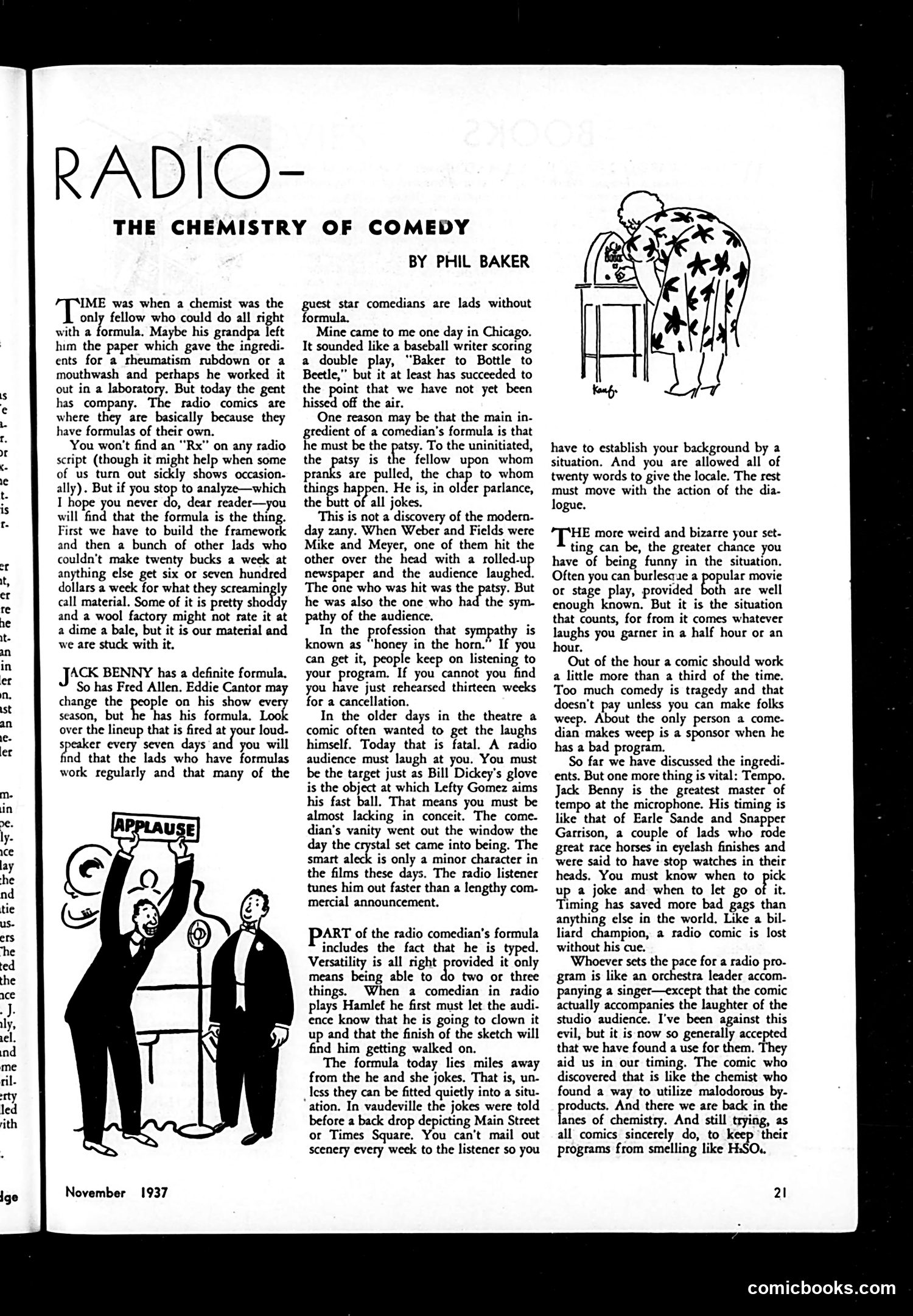
A restored page from Judge, 1937-11. Page through the whole issue in the reader above.
📄 Transcribed text from this page (OCR, searchable)
Machine-transcribed from the original scan — historical spelling and the odd misread are preserved.
RADIO- THE CHEMISTRY OF COMEDY IME was when a chemist was the only fellow who could do all right with a formula. Maybe his grandpa left him the paper which gave the ingredi- ents for a rheumatism rubdown or a mouthwash and perhaps he worked it out in a laboratory. But today the gent has company. The radio comics are where they are basically because they have formulas of their own. You won't find an “Rx” on any radio script (though it might help when some of us turn out sickly shows occasion. ally). But if you stop to analyze—which I hope you never do, dear reader—you will find that the formula is the thing. First we have to build the framework and then a bunch of other lads who couldn’t make twenty bucks a week at anything else get six or seven hundred dollars a week for what they screamingly call material. Some of it is pretty shoddy and a wool factory might not rate it at a dime a bale, but it is our material and we are stuck with it. Jax BENNY has a definite formula. So has Fred Allen. Eddie Cantor may change the peo season, but he has his formula. Loo! over the lineup that is fired at your loud. speaker every seven days and you will ind that the lads who have formulas work regularly and that many of the ple on his show erery November 1937 BY PHIL BAKER guest star comedians are lads without formula. Mine came to me one day in Chicago. It sounded like a baseball writer scoring a double play, “Baker to Bottle to Beetle,” but it at least has succeeded to the point that we have not yet been hissed off the air. One reason may be that the main in- gtedient of a comedian’s formula is that he must be the patsy. To the uninitiated, the patsy is he fellow upon whom pra: are pulled, the chap to whom things happen. He is, in older parlance, the butt of all jokes. This is not a discovery of the modern. day zany. When Weber and Fields were Mike and Meyer, one of them hit the other over the head with a rolled-u newspaper and the audience laughed. The one who was hit was the patsy. But he was also the one who had the sym. pathy of the audience. In the profession that sympathy is known as “honey in the horn.” If you can get it, people keep on listening to your program. If you cannot you find you have just rehearsed thirteen weeks for a cancellation. In the older days in the theatre a comic often wanted to get the laughs himself. Today that is fatal. A radio audience must laugh at you. You must be the target just as Bill Dickey's glove is the object at which Lefty Gomez aims his fast ball. That means you must be almost lacking in conceit. The come. dian’s vanity went out the window the day the crystal set came into being. The smart aleck is only a minor character in the films these days. The radio listener tunes him out faster than a lengthy com- mercial announcement. ART of the radio comedian’s formula includes the fact that he is typed. Versatility is all right provided it only means being able to do two or three things. When a comedian in radio plays Hamlet he first must let the audi- ence know that he is going to clown it up and that the finish of the sketch will find him getting walked on. The formula today lies miles away from the he and she jokes. That is, un- _ less they can be fitted quietly into a situ. ation. In vaudeville the jokes were told before a back drop depicting Main Street or Times Square. You can’t mail out scenery every week to the listener so you have to establish your background by a situation. And you are allowed all of twenty words to give the locale. The rest must move with the action of the dia- logue. ‘THE more weird and bizarre your set- ting can be, the greater chance you have of being funny in the situation. Often you can burlesque a Popular movie or stage play, provided both are well enough known. But it is the situation that counts, for from it comes whatever laughs you garner in a half hour or an hour. Out of the hour a comic should work a little more than a third of the time. Too much comedy is tragedy and that doesn’t pay unless you can make folks weep. About the only person a come- dian makes weep is a sponsor when he has a bad program. So far we have discussed the ingredi- ents. But one more thing is vital: Tempo. Jack Benny is the greatest master of tempo at the microphone. His timing is like that of Earle Sande and Snapper Garrison, a couple of lads who rode great race horses in eyelash finishes and were said to have stop watches in their heads. You must know when to pick up a joke and when to let go of it. Timing has saved more bad gags than anything else in the world. Like a bil- liard champion, a radio comic is lost without his cue. Whoever sets the pace for a radio pro- gram is like an orchestra leader accom. panying a singer—except that the comic actually accompanies the laughter of the studio audience. I've been against this evil, but it is now so generally accepted that we have found a use for them. They aid us in our timing. The comic who discovered that is like the chemist who found a way to utilize malodorous by- oducts. And there we are back in the lanes of chemistry. And still trying, as all comics sincerely do, to keep their programs from smelling like ee comicbooks.com