
Judge, 1937-11 · page 24 of 36
Judge — November 1937 — page 24: what you’re looking at
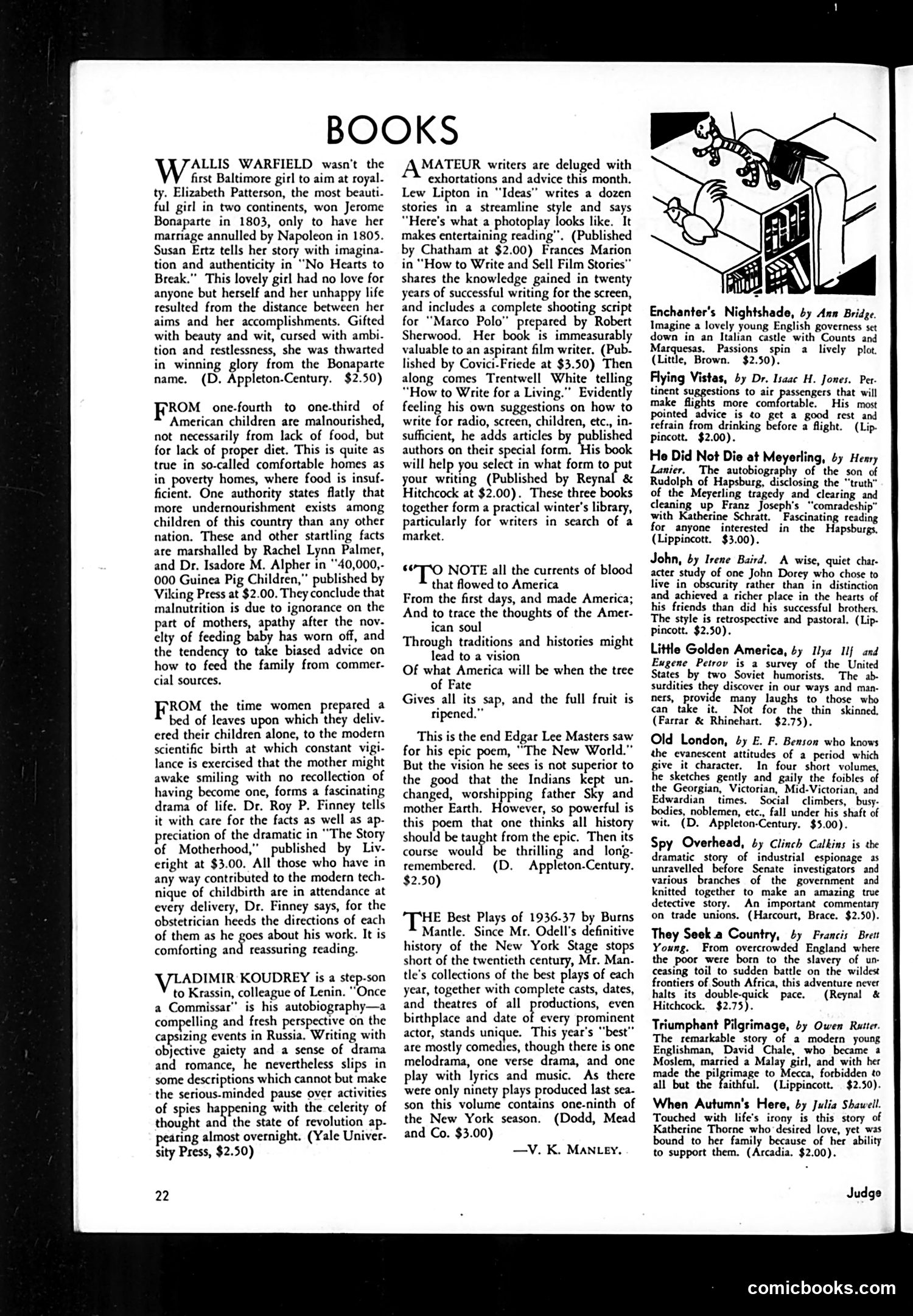
A restored page from Judge, 1937-11. Page through the whole issue in the reader above.
📄 Transcribed text from this page (OCR, searchable)
Machine-transcribed from the original scan — historical spelling and the odd misread are preserved.
BOOKS ALLIS WARFIELD wasn't the first Baltimore girl to aim at royal. ty. Elizabeth Patterson, the most beauti- ful girl in two continents, won Jerome Bonaparte in 1803, only to have her marriage annulled by Napoleon in 1805. Susan Ertz tells her story with imagina- tion and authenticity in “No Hearts to Break.” This lovely girl had no love for anyone but herself and her unhappy life resulted from the distance between her aims and her accomplishments. Gifted with beauty and wit, cursed with ambi- tion and restlessness, she was thwarted in winning glory from the Bonaparte name. (D. Appleton-Century. $2.50) FROM one-fourth to one-third of American children are malnourished, not necessarily from lack of food, but for lack of proper diet. This is quite as true in so-called comfortable homes as in poverty homes, where food is insuf- ficient. One authority states flatly that more undernourishment exists among children of this country than any other nation, These and other startling facts are marshalled by Rachel Lynn Palmer, and Dr. Isadore M. Alpher in “40,000,- 000 Guinea Pig Children,” published by Viking Press at $2.00. They conclude that malnutrition is due to ignorance on the part of mothers, apathy after the nov- elty of feeding baby has worn off, and the tendency to take biased advice on how to feed the family from commer- cial sources. FROM the time women prepared a bed of leaves upon which they deliv- ered their children alone, to the modern scientific birth at which constant vigi- lance is exercised that the mother might awake smiling with no recollection of having become one, forms a fascinating drama of life. Dr. Roy P. Finney tells it with care for the facts as well as ap- preciation of the dramatic in “The Story of Motherhood,” published by Liv- eright at $3.00. All those who have in any way contributed to the modern tech- nique of childbirth are in attendance at every delivery, Dr. Finney says, for the obstetrician heeds the directions of each of them as he goes about his work. It is comforting and reassuring reading. VLADIMIR KOUDREY is a step-son to Krassin, colleague of Lenin. “Once a Commissar” is his autobiography—a compelling and fresh perspective on the capsizing events in Russia. Writing with objective gaiety and a sense of drama and romance, he nevertheless slips in some descriptions which cannot but make the serious-minded pause over activities of spies happening with the celerity of thought and the state of revolution ap. ring almost overnight. (Yale Univer. sity Press, $2.50) 22 AMATEUR writers are deluged with exhortations and advice this month. Lew Lipton in “Ideas” writes a dozen stories in a streamline style and says “Here's what a photoplay looks like. It makes entertaining reading”. (Published by Chatham at $2.00) Frances Marion in “How to Write and Sell Film Stories” shares the knowledge gained in twenty years of successful writing for the screen, and includes a complete shooting script for “Marco Polo” prepared by Robert Sherwood. Her book is immeasurably valuable to an aspirant film writer. (Pub- lished by Covici-Friede at $3.50) Then along comes Trentwell White telling “How to Write for a Living.” Evidently feeling his own suggestions on how to write for radio, screen, children, etc., in- sufficient, he adds articles by published authors on their special form. itis book will help you select in what form to put your writing (Published by Reynat & Hitchcock at $2.00). These three books together form a practical winter's library, particularly for writers in search of a market. se NOTE all the currents of blood that flowed to America From the first days, and made America; And to trace the thoughts of the Amer- ican soul Through traditions and histories might lead to a vision Of what America will be when the tree of Fate Gives all its sap, and the full fruit is ripened.” This is the end Edgar Lee Masters saw for his epic poem, “The New World.” But the vision he sees is not superior to the good that the Indians kept un. changed, worshipping father Sky and mother Earth. However, so powerful is this poem that one thinks all history should be taught from the epic. Then its course would be thrilling and long- remembered. (D. Appleton-Century. $2.50) ‘THE Best Plays of 1936.37 by Burns Mantle. Since Mr. Odell's definitive history of the New York Stage stops short of the twentieth century, Mr. Man- tle’s collections of the best plays of each year, together with complete casts, dates, and theatres of all productions, even birthplace and date of every prominent actor, stands unique. This year's “best” are mostly comedies, though there is one melodrama, one verse drama, and one play with lyrics and music. As there were only ninety plays produced last sea- son this volume contains one-ninth of the New York season. (Dodd, Mead and Co. $3.00) —V. K. MANLey. Enchanter’s Nightshade, by Ann Bridge. Imagine a lovely young English governess set down in an Italian castle with Counts and Marquesas. Passions spin a lively plot. (Little, Brown. $2.50). Flying Vistas, by Dr. Isaac H. Jones. Per. tinent suggestions to air passengers that will make flights more comfortable. His most pointed advice is ¢o get a good rest and refrain from drinking before a flight. (Lip- Pincott. $2.00). He Did Not Die at Meyerling, by Henry Lanier. The autobiography of the son of Rudolph of Hapsburg, disclosing the “truth” of the Meyerling tragedy and clearing and cleaning up Franz Joseph's “comradeship” with Katherine Schratt. Fascinating reading for anyone interested in the Hapsburgs, (Lippincott. $3.00). John, by Irene Baird. A wise, quiet char acter study of one John Dorey who chose to live in obscurity rather than in distinction and achieved a richer place in the hearts of his friends than did his successful brothers, The style is retrospective and pastoral. (Lip- Pincott. $2.50). Little Golden America, by Iya Ilf and Eugene Petrov is a survey of the United States by two Soviet humorists. The ab- surdities the discover in our ways and man- ners, provide many laughs to those who can take it. Not for the thin skinned, (Farrar & Rhinehart. $2.75). Old London, 4y E. F. Benson who knows the evanescent attitudes of a period which give it character. In four short volumes, he sketches gently and gaily the foibles of the Georgian, Victorian, Mid-Victorian, and Edwardian times. Social climbers, busy: bodies, noblemen, etc., fall under his shaft of wit. (D. Appleton-Century. $5.00). Spy Overhead, by Clinch Calkins is the dramatic story of industrial espionage as unravelled before Senate investigators and various branches of the government and knitted together to make an amazing tre detective story. An important commentary on trade unions. (Harcourt, Brace. $2.50). They Seek.a Country, by Francis Brett Young. From overcrowded England where the poor were born to the slavery of un- ceasing toil to sudden battle on the wildest frontiers of South Africa, this adventure never halts its double-quick pace. (Reynal & Hitchcock. $2.75) Triumphant Pilgrimage, by Owen Rutter. The remarkable story of a modern young Englishman, David Chale, who became a Moslem, married a Malay girl, and with her made the pilgrimage to Mecca, forbidden to all but the faithful. (Lippincott. $2.50). When Autumn's Here, by Julia Shawell. Touched with life's irony is this story of Katherine Thorne who desired love, yet was bound to her family because of her ability to support them. (Arcadia. $2.00). Judge comicbooks.com