
Judge, 1937-11 · page 22 of 36
Judge — November 1937 — page 22: what you’re looking at
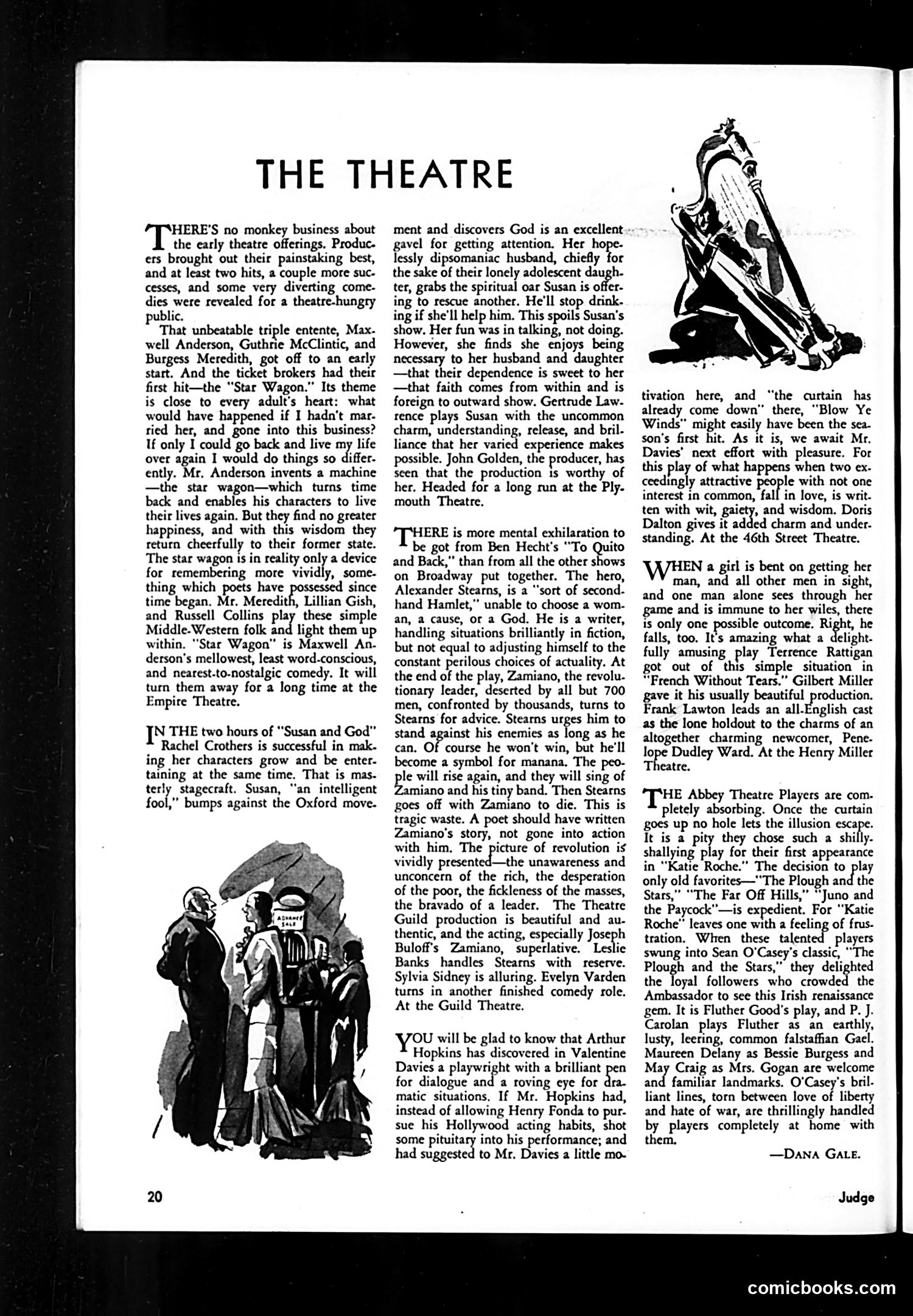
A restored page from Judge, 1937-11. Page through the whole issue in the reader above.
📄 Transcribed text from this page (OCR, searchable)
Machine-transcribed from the original scan — historical spelling and the odd misread are preserved.
THE THEATRE ‘Te no monkey business about the early theatre offerings. Produc. ers brought out their painstaking best, and at least two hits, a couple more suc- cesses, and some very diverting come- dies were revealed for a theatre-hungry public. That unbeatable triple entente, Max. well Anderson, Guthrie McClintic, and Burgess Meredith, got off to an early start. And the ticket brokers had their first hit—the “Star Wagon.” Its theme is close to every adult's heart: what would have happened if I hadn't mar- ried her, and gone into this business? If only I could go back and live my life over again I would do things so differ. ently. Mr, Anderson invents a machine —the star wagon—which turns time back and enables his characters to live their lives again, But they find no greater happiness, and with this wisdom they return cheerfully to their former state. The star wagon 1s in reality only a device for remembering more vividly, some- thing which poets have possessed since time began. Mr. Meredith, Lillian Gish, and Russell Collins play these simple Middle.Western folk and light them up within, “Star Wagon” is Maxwell An- derson’s mellowest, least word-conscious, and nearest-to-nostalgic comedy. It will turn them away for a long time at the Empire Theatre. JN THE two hours of “Susan and God” Rachel Crothers is successful in mak. ing her characters grow and be enter- taining at the same time. That is mas- terly stagecraft. Susan, “an intelligent fool,” bumps against the Oxford move. ment and discovers God is an excellent. gavel for getting attention. Her hope- lessly dipsomaniac husband, chiefly for the sake of their lonely adolescent daugh. ter, grabs the spiritual oar Susan is offer- ing to rescue another. He'll stop drink. ing if she'll help him. This spoils Susan's show. Her fun was in talking, not doing. However, she finds she enjoys being necessary to her husband and daughter —that their dependence is sweet to her —that faith comes from within and is foreign to outward show. Gertrude Law. rence plays Susan with the uncommon charm, understanding, release, and bril- liance that her varied experience makes possible. John Golden, the producer, has seen that the production is worthy of her. Headed for a long run at the Ply- mouth Theatre. ERE is more mental exhilaration to be got from Ben Hecht's “To Quito and Back,” than from all the other shows on Broadway put together. The hero, Alexander Stearns, is a “sort of second- hand Hamlet,” unable to choose a wom- an, a cause, or a God. He is a writer, handling situations brilliantly in fiction, but not equal to adjusting himself to the constant perilous choices of actuality. At the end of the play, Zamiano, the revolu- tionary leader, deserted by all but 700 men, confronted by thousands, turns to Stearns for advice. Stearns urges him to stand against his enemies as long as he can. Of course he won't win, but he'll become a symbol for manana, The ple will rise again, and they will sing of miano and his tiny band. Then Stearns goes off with Zamiano to die. This is tragic waste. A poet should have written Zamiano’s story, not gone into action with him. The picture of revolution is vividly presented—the unawareness and unconcern of the rich, the desperation of the poor, the fickleness of the masses, the bravado of a leader. The Theatre Guild production is beautiful and au. thentic, and the acting, especially Joseph Buloff's Zamiano, superlative. Leslie Banks handles Stearns with reserve. Sylvia Sidney is alluring. Evelyn Varden turns in another finished comedy role. At the Guild Theatre. you will be glad to know that Arthur Hopkins has discovered in Valentine Davies a playwright with a brilliant pen for dialogue and a roving eye for a matic situations. If Mr. Hopkins had, instead of allowing Henry Fonda to pur- sue his Hollywood acting habits, shot some pituitary into his performance; and had suggested to Mr. Davies a little mo- tivation here, and “the curtain has already come down” there, “Blow Ye Winds” might easily have been the sea- son's first hit. As it is, we await Mr. Davies’ next effort with pleasure. For this play of what happens when two ex. ceedingly attractive people with not one interest in common, fall in love, is writ- ten with wit, gaicty, and wisdom. Doris Dalton gives it added charm and under. standing. At the 46th Street Theatre. WHEN a girl is bent on getting her man, and all other men in sight, and one man alone sees through her game and is immune to her wiles, there is only one possible outcome. Right, he falls, too. It's amazing what a delight. fully amusing play Terrence Rattigan got out of this simple situation in “French Without Tears.” Gilbert Miller gave it his usually beautiful production. Frank Lawton leads an all-English cast as the lone holdout to the charms of an altogether charming newcomer, Pene- lope Dudley Ward. At the Henry Miller Theatre. ‘THE Abbey Theatre Players are com. pletely absorbing. Once the curtain goes up no hole lets the illusion care ity they chose such a shilly. It is a ity shallying play for their first appearance in “Katie Roche.” The decision to play only old favorites—The Plough and the Stars,” “The Far Off Hills,” “Juno and the Paycock”—is expedient. For “Katie Roche” leaves one with a feeling of frus- tration. When these talented players swung into Sean O'Casey’s classic, “The Plough and the Stars,” they delighted the foyal followers who crowded the Ambassador to see this Irish renaissance gem. It is Fluther Good's play, and P. J. Carolan plays Fluther as an earthly, lusty, leering, common falstaffian Gael. Maureen Delany as Bessie Burgess and May Craig as Mrs. Gogan are welcome and familiar landmarks. O'Casey’s bril- liant lines, torn between love of liberty and hate of war, are thrillingly handled by players completely at home with them, —Dana GALE. Judge comicbooks.com