
Judge, 1937-10 · page 24 of 36
Judge — October 1937 — page 24: what you’re looking at
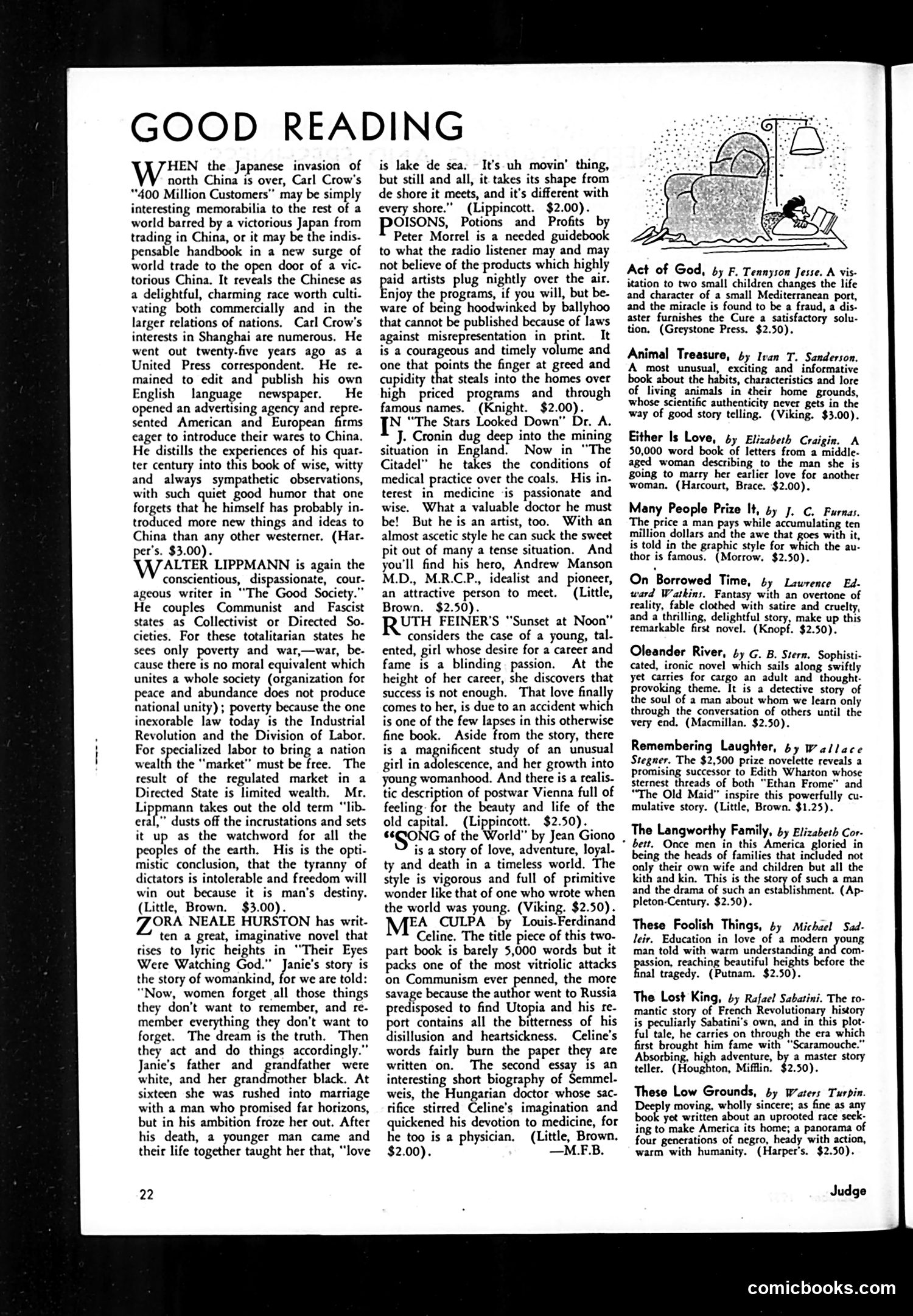
A restored page from Judge, 1937-10. Page through the whole issue in the reader above.
📄 Transcribed text from this page (OCR, searchable)
Machine-transcribed from the original scan — historical spelling and the odd misread are preserved.
GOOD READING Wie the Japanese invasion of north China is over, Carl Crow's “400 Million Customers” may be simply interesting memorabilia to the rest of a world barred by a victorious Japan from trading in China, or it may be the indis- pensable handbook in a new surge of world trade to the open door of a vic- torious China. It reveals the Chinese as a delightful, charming race worth culti- vating both commercially and in the larger relations of nations. Carl Crow's interests in Shanghai are numerous. He went out twenty-five years ago as a United Press correspondent. He re- mained to edit and publish his own English language newspaper. He opened an advertising agency and repre- sented American and European firms eager to introduce their wares to China. He distills the experiences of his quar- ter century into this book of wise, witty and always sympathetic observations, with such quiet good humor that one forgets that he himself has probably in- troduced more new things and ideas to China than any other westerner. (Har- per's. $3.00). ALTER LIPPMANN is again the conscientious, dispassionate, cour- ageous writer in “The Good Society.” He couples Communist and Fascist states as Collectivist or Directed So- cieties. For these totalitarian states he sees only poverty and war,—war, be. cause there is no moral equivalent which unites a whole society (organization for peace and abundance does not produce national unity); poverty because the one inexorable law today is the Industrial Revolution and the Division of Labor. For specialized labor to bring a nation wealth the “market” must be free. The result of the regulated market in a Directed State is limited wealth. Mr. Lippmann takes out the old term “lib- eral,” dusts off the incrustations and sets it up as the watchword for all the peoples of the earth. His is the opti- mistic conclusion, that the tyranny of dictators is intolerable and freedom will win out because it is man's destiny. (Little, Brown. $3.00). ORA NEALE HURSTON has writ- ten a great, imaginative novel that tises to lyric heights in “Their Eyes Were Watching God." Janie’s story is the story of womankind, for we are told: “Now, women forget all those things they don’t want to remember, and re- member everything they don’t want to forget. The dream is the truth. Then they act and do things accordingly.” Janie’s father and grandfather were white, and her grandmother black. At sixteen she was rushed into marriage with a man who promised far horizons, but in his ambition froze her out. After his death, a younger man came and their life together taught her that, “love 22 is lake de sea. It’s uh movin’ thing, but still and all, it takes its shape from de shore it meets, and it's different with every shore.” (Lippincott. $2.00). POISONS, Potions and Profits by Peter Morrel is a needed guidebook to what the radio listener may and may not believe of the products which highly ped artists plug nightly over the air. njoy the programs, if you will, but be- ware of being hoodwinked by ballyhoo that cannot be published because of laws against misrepresentation in pane It is a courageous and timely volume and one that points the finger at greed and cupidity that steals into the homes over high priced programs and through famous names. (Knight. $2.00). N “The Stars Looked Down” Dr. A. J. Cronin dug deep into the mining situation in England. Now in “The Citadel” he takes the conditions of medical practice over the coals. His in- terest in medicine ‘is passionate and wise. What a valuable doctor he must be! But he is an artist, too. With an almost ascetic style he can suck the sweet pit out of many a tense situation. And you'll find his hero, Andrew Manson M.D., M.R.C.P., idealist and pioneer, an attractive person to mect. (Little, Brown. $2.50). RUTH FEINER’S “Sunset at Noon” considers the case of a young, tal- ented, girl whose desire for a career and fame is a blinding passion. At the height of her career, she discovers that success is not enough. That love finall comes to her, is due to an accident which is one of the few lapses in this otherwise fine book. Aside from the story, there is a magnificent study of an unusual gitl in adolescence, and her growth into young womanhood. And there is a realis- tic description of postwar Vienna full of feeling: for the beauty and life of the old capital. (Lippincott. $2.50). S6QONG of the is a story of love, adventure, loyal. ty and death in a timeless world. The style is vigorous and full of primitive wonder like that of one who wrote when the world was young. (Viking. $2.50). MEA CULPA by Louis-Ferdinand Celine. The title piece of this two- part book is barely 5,000 words but it packs one of the most vitriolic attacks on Communism ever penned, the more savage because the author went to Russia predisposed to find Utopia and his re- port contains all the bitterness of his disillusion and heartsickness. Celine’s words fairly burn the paper they are written on. The second essay is an interesting short biography of Semmel- weis, the Hungarian doctor whose sac- tifice stirred Celine’s imagination and quickened his devotion to medicine, for he too is a physician, (Little, Brown. $2.00). —M.EB. orld” by Jean Giono , Act of God, by F. Tennyson Jesse. A vis- itation to two small children changes the life and character of a small Mediterranean port, and the miracle is found to be a fraud, a dis- aster furnishes the Cure a satisfactory solu- tion, (Greystone Press. $2.50). Animal Treasure, by Iran T. Sanderson. A most unusual, exciting and informative book about the habits, characteristics and lore of living animals in their home grounds, whose scientific authenticity never gets in the way of good story telling. (Viking. $3.00). Either Is Love, by Elizabeth Craigin. A 50,000 word book of letters from a middle- aged woman describing to the man she is going to marry her earlier love for another woman. (Harcourt, Brace. $2.00). Many People Prize It, sy J. C. Furnas. The price a man pays while accumulating ten million dollars and the awe that goes with it, is told in the graphic style for which the au- thor is famous. (Morrow. $2.50). On Borrowed Time, by Lawrence Ed- ward Watkins. Fantasy with an overtone of reality, fable clothed with satire and cruelty, and a thrilling, delightful story, make up this remarkable first novel. (Knopf. $2.50). Oleander River, by G. B. Stern. Sophisti- cated, ironic novel which sails along swiftly yet carries for cargo an adult and thought- provoking theme. It is a detective story of the soul of a man about whom we learn only through the conversation of others until the very end. (Macmillan. $2.50). Remembering Laughter, 6) Wallace Stegner. The $2,500 prize novelette reveals a promising successor to Edith Wharton whose sternest threads of both “Ethan Frome” and “The Old Maid” inspire this powerfully cu- mulative story. (Little, Brown. $1.25). The Langworthy Family, by Elizabeth Cor- bett. Once men in this America gloried in being the heads of families that included not only their own wife and children but all the kith and kin. This is the story of such a man and the drama of such an establishment. (Ap- pleton-Century. $2.50). These Foolish Things, by Michael Sad- leir. Education in love of a modern young man told with warm understanding and com- passion, reaching beautiful heights before the inal tragedy. (Putnam. $2.50). The Lost King, by Rafael Sabatini. The r0- mantic story of French Revolutionary history is peculiarly Sabatini’s own, and in this plot- ful tale, he carries on through the era which first brought him fame with “Scaramouche.” Absorbing, Hae adventure, a master story teller. (Houghton, Mifflin. $2.50). These Low Grounds, by Waters Turpin. Deeply moving, wholly sincere; as fine as any book yet written about an uprooted race seek- ing to make America its home; a panorama of four generations of negro, heady with action, warm with humanity. (Harper's. $2.50). Judge comicbooks.com