
Judge, 1937-10 · page 23 of 36
Judge — October 1937 — page 23: what you’re looking at
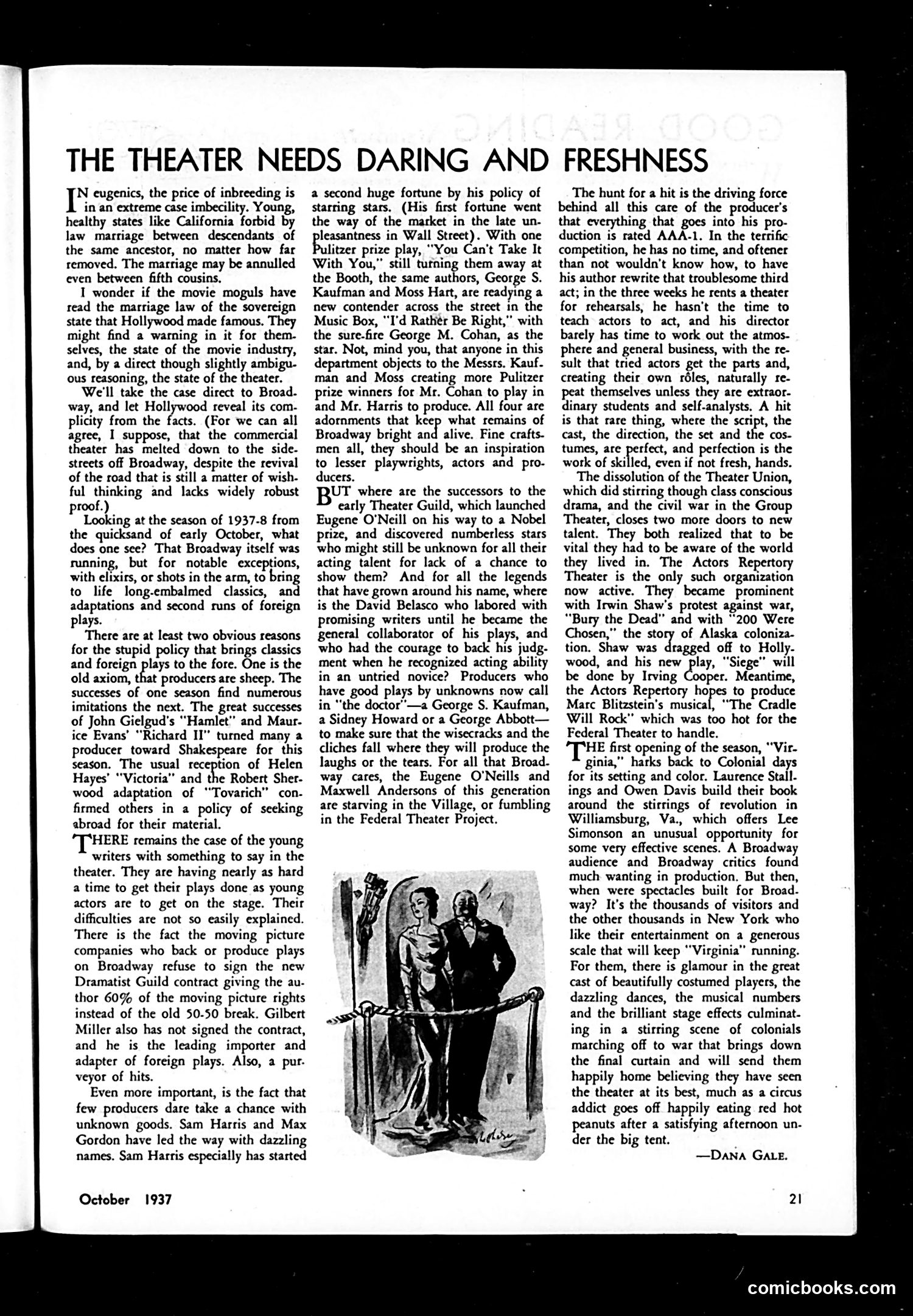
A restored page from Judge, 1937-10. Page through the whole issue in the reader above.
📄 Transcribed text from this page (OCR, searchable)
Machine-transcribed from the original scan — historical spelling and the odd misread are preserved.
THE THEATER NEEDS DARING AND FRESHNESS In eugenics, the price of inbreeding is in an extreme case imbecility. Young, healthy states like California forbid by law marriage between descendants of the same ancestor, no matter how far removed. The marriage may be annulled even between fifth cousins. I wonder if the movie moguls have read the marriage law of the sovereign state that Hollywood made famous. They might find a warning in it for them. selves, the state of the movie industry, and, by a direct though slightly ambigu- ous reasoning, the state of the theater. We'll take the case direct to Broad. way, and let Hollywood reveal its com- plicity from the facts. (For we can all agree, I suppose, that the commercial theater has melted down to the side- streets off Broadway, despite the revival of the road that is still a matter of wish- ful thinking and lacks widely robust proof.) Looking at the season of 1937-8 from the quicksand of early October, what does one see? That Broadway itself was running, but for notable exceptions, with elixirs, or shots in the arm, to bring to life long-embalmed classics, and adaptations and second runs of foreign plays. There are at least two obvious reasons for the stupid policy that brings classics and foreign plays to the fore. One is the old axiom, producers are sheep. The successes of one season find numerous imitations the next. The great successes of John Gielgud’s “Hamlet” and Maur- ice Evans’ “Richard II" turned many a producer toward Shakespeare for this season. The usual reception of Helen Hayes’ “Victoria” and the Robert Sher- wood adaptation of ‘Tovarich” con- firmed others in a policy of seeking abroad for their material. 'HERE remains the case of the young writers with something to say in the theater. They are having nearly as hard a time to get their plays done as young actors are to get on the stage. Their difficulties are not so easily explained. There is the fact the moving picture companies who back or produce plays on Broadway refuse to sign the new Dramatist Guild contract giving the au- thor 60% of the moving picture rights instead of the old 50-50 break. Gilbert Miller also has not signed the contract, and he is the leading importer and adapter of foreign plays. Also, a pur- veyor of hits. Even more important, is the fact that few producers dare take a chance with unknown goods. Sam Harris and Max Gordon have led the way with dazzling names. Sam Harris especially has started October 1937 a second huge fortune by his policy of starring stars. (His first fortune went the way of the market in the late un- leasantness in Wall Street). With one litzer prize play, “You Can't Take It With You,” still turning them away at the Booth, the same authors, George S. Kaufman and Moss Hart, are readying a new contender across the street in the Music Box, “I'd Rathér Be Right,” with the sure-fire George M. Cohan, as the star. Not, mind you, that anyone in this department objects to the Messrs. Kauf. man and Moss creating more Pulitzer prize winners for Mr. Cohan to play in and Mr. Harris to produce. All four are adornments that keep what remains of Broadway bright and alive. Fine crafts- men all, they should be an inspiration to lesser playwrights, actors and pro- ducers. UT where are the successors to the eatly Theater Guild, which launched Eugene O'Neill on his way to a Nobel prize, and discovered numberless stars who might still be unknown for all their acting talent for lack of a chance to show them? And for all the legends that have grown around his name, where is the David Belasco who labored with promising writers until he became the general collaborator of his plays, and who had the courage to back his judg- ment when he recognized acting ability in an untried novice? Producers who have good plays by unknowns now call in “the doctor’—a George S. Kaufman, a Sidney Howard or a George Abbott— to make sure that the wisecracks and the cliches fall where they will produce the laughs or the tears. For all that Broad- way cares, the Eugene O'Neills and Maxwell Andersons of this generation are starving in the Village, or fumbling in the Federal Theater Project. The hunt for a hit is the driving force behind all this care of the producer's that everything that goes into his pro- duction is rated AAA-1. In the terrific competition, he has no time, and oftener than not wouldn't know how, to have his author rewrite that troublesome third act; in the three weeks he rents a theater for rehearsals, he hasn't the time to teach actors to act, and his director barely has time to work out the atmos- phere and general business, with the re- sult that tried actors get the parts and, creating their own rdles, naturally re- peat themselves unless they are extraor- dinary students and self-analysts. A hit is that rare thing, where the script, the cast, the direction, the set and the cos- tumes, are perfect, and perfection is the work of skilled, even if not fresh, hands. The dissolution of the Theater Union, which did stirring though class conscious drama, and the civil war in the Group Theater, closes two more doors to new talent. They both realized that to be vital they had to be aware of the world they lived in. The Actors Repertory Theater is the only such organization now active. They became prominent with Irwin Shaw's protest against war, “Bury the Dead” and with “200 Were Chosen,” the story of Alaska coloniza- tion. Shaw was dragged off to Holly- wood, and his new play, “Siege” will be done by Irving per. Meantime, the Actors Repertory hopes to produce Marc Blitzstein’s msical, “The Cradle Will Rock”’ which was too hot for the Federal Theater to handle. THE first opening of the season, “Vir- ginia,” harks back to Colonial days for its setting and color. Laurence Stall. ings and Owen Davis build their book around the stirrings of revolution in Williamsburg, Va., which offers Lee Simonson an unusual opportunity for some very effective scenes. A Broadway audience and Broadway critics found much wanting in production, But then, when were spectacles built for Broad- way? It’s the thousands of visitors and the other thousands in New York who like their entertainment on a generous scale that will keep “Virginia” running. For them, there is glamour in the great cast of beautifully costumed players, the dazzling dances, the musical numbers and the brilliant stage effects culminat- ing in a stirring scene of colonials marching off to war that brings down the final curtain and will send them happily home believing they have seen the theater at its best, much as a circus addict goes off happily eating red hot peanuts after a satisfying afternoon un- der the big tent. —Dana Gate. 21 comicbooks.com