
Judge, 1937-10 · page 25 of 36
Judge — October 1937 — page 25: what you’re looking at
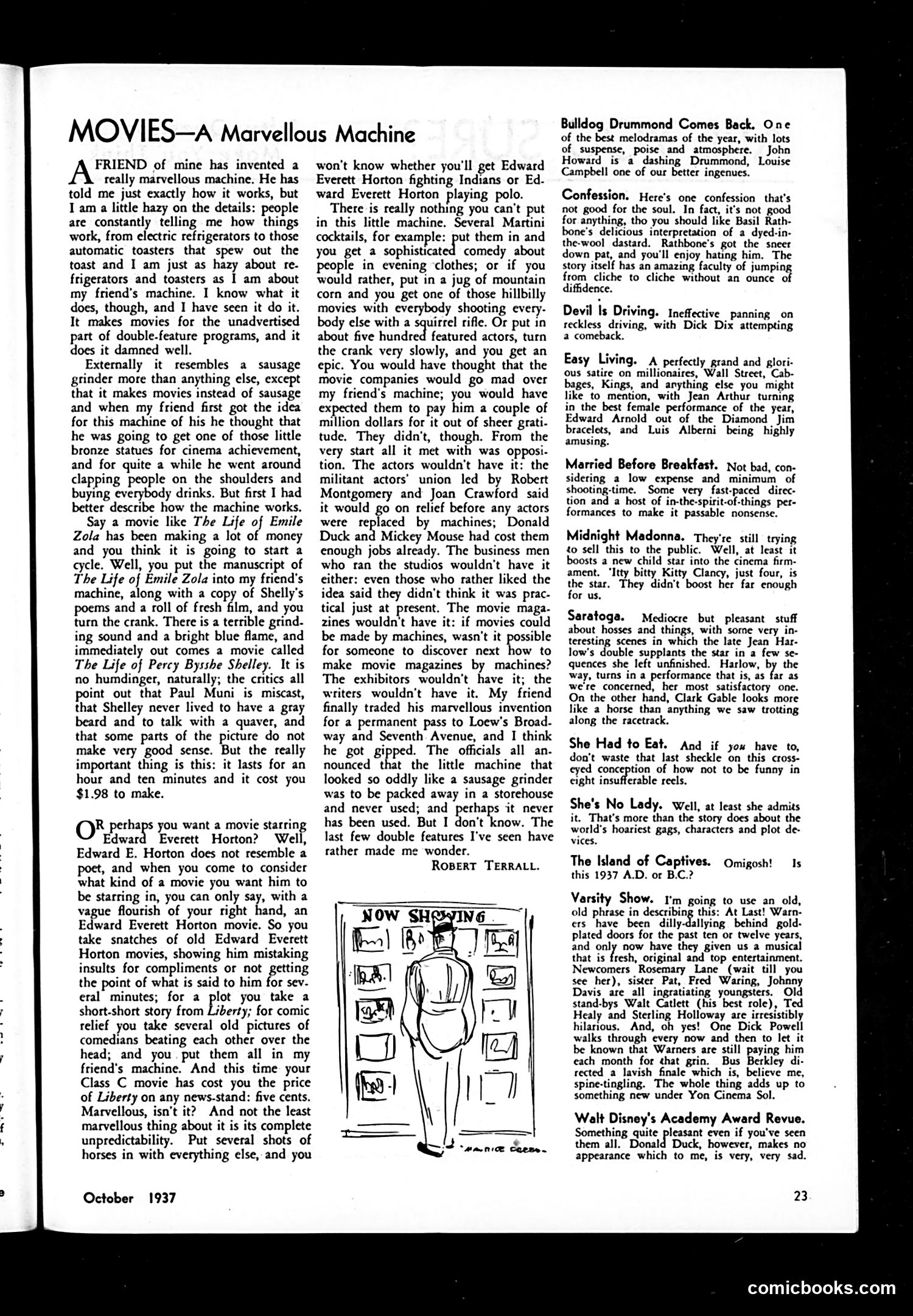
A restored page from Judge, 1937-10. Page through the whole issue in the reader above.
📄 Transcribed text from this page (OCR, searchable)
Machine-transcribed from the original scan — historical spelling and the odd misread are preserved.
MOVIES—A Marvellous Machine FRIEND of mine has invented a really marvellous machine. He has told me just exactly how it works, but I am a little hazy on the details: people are constantly telling me how things work, from electric refrigerators to those automatic toasters that spew out the toast and I am just as hazy about re- frigerators and toasters as I am about my friend’s machine. I know what it does, though, and I have seen it do it. It makes movies for the unadvertised part of double-feature programs, and it does it damned well. Externally it resembles a sausage grinder more than anything else, except that it makes movies instead of sausage and when my friend first got the idea for this machine of his he thought that he was going to get one of those little bronze statues for cinema achievement, and for quite a while he went around clapping people on the shoulders and buying everybody drinks. But first I had better describe how the machine works. Say a movie like The Life of Emile Zola has been making a lot of money and you think it is going to start a cycle. Well, you put the manuscript of The Life of Emile Zola into my friend's machine, along with a copy of Shelly's ms and a roll of fresh film, and you turn the crank. There is a terrible grind. ing sound and a bright blue flame, and immediately out comes a movie called The Life of Percy Bysshe Shelley. It is no humdinger, naturally; the critics all point out that Paul Muni is miscast, that Shelley never lived to have a gray beard and to talk with a quaver, and that some parts of the picture do not make very good sense. But the really important thing is this: it lasts for an hour and ten minutes and it cost you $1.98 to make. Or perhaps you want a movie starrin, Edward Everett Horton? Well, Edward E. Horton does not resemble a poet, and when you come to consider what kind of a movie you want him to be starring in, you can only say, with a vague flourish of your right hand, an Edward Everett Horton movie. So you take snatches of old Edward Everett Horton movies, showing him mistaking insults for compliments or not getting the point of what is said to him for sev- eral minutes; for a fie you take a short-short story from Liberty; for comic relief you take several old pictures of comedians beating each other over the head; and you. put them all in my friend’s machine. And this time your Class C movie has cost you the price of Liberty on any news.stand: five cents. Marvellous, isn’t it? And not the least marvellous thing about it is its complete unpredictability. Put several shots of horses in with everything else, and you October 1937 won't know whether you'll get Edward Everett Horton fighting Indians or Ed- ward Everett Horton playing polo. There is really nothing you can’t put in this little machine. Several Martini cocktails, for example: put them in and you get a sophisticated comedy about people in evening ‘clothes; or if you would rather, put in a jug of mountain corn and you get one of those hillbilly movies with everybody shooting every- body else with a que rifle. Or put in about five hundred featured actors, turn the crank very slowly, and you get an epic. You would have thought that the movie companies would go mad over my friend's machine; you would have expected them to pay him a couple of million dollars for it out of sheer grati- tude. They didn’t, though. From the very start all it met with was opposi- tion. The actors wouldn't have it: the militant actors’ union led by Robert Montgomery and Joan Crawford said it would go on relief before any actors were replaced by machines; Donald Duck and Mickey Mouse had cost them enough jobs already. The business men who ran the studios wouldn't have it either: even those who rather liked the idea said they didn’t think it was prac- tical just at present. The movie maga- zines wouldn't have it: if movies could be made by machines, wasn't it possible for someone to discover next how to make movie magazines by machines? The exhibitors wouldn't have it; the writers wouldn't have it. My friend finally traded his marvellous invention for a permanent pass to Loew's Broad. way and Seventh Avenue, and I think he got sipped. The officials all an. nounced that the little machine that looked so oddly like a sausage grinder was to be packed away in a storehouse and never used; and perhaps it never has been used. But I don’t know. The last few double features I've seen have rather made me wonder. ROBERT TERRALL. Now SH Bulldog Drummond Comes Back. One of the best melodramas of the year, with lots of suspense, poise and atmosphere. John Howard is a dashing Drummond, Louise Campbell one of our better ingenues. Confession. Here's one confession that's not good for the soul. In fact, it's not good for anything, tho you should like Basil Rath- bone’s delicious interpretation of a dyed-in- the-wool dastard. Rathbone’s got the sneer down pat, and you'll enjoy hating him. The story itself has an amazing faculty of jumpin; from cliche to cliche without an ounce of diffidence. Devil Is Driving. Ineffective panning on reckless driving, with Dick Dix attempting a comeback. Easy Living. A perfectly grand and glori- ‘ous satire on millionaires, Wall Street, Cab- bages, Kings, and anything else you might like to mention, with Jean Arthur turning in the best female performance of the year, Edward Arnold out of the Diamond Jim bracelets, and Luis Alberni being highly amusing. Married Before Breakfast. Not bad, con- sidering a low expense and minimum of shooting-time. Some very fast-paced direc- tion and a host of in-the-spirit-of-things per- formances to make it passable nonsense. Midnight Madonna. They're still trying to sell this to the public. Well, at least it boosts a new child star into the cinema firm- ament. ‘Itty bitty Kitty Clancy, just four, is ihe star. They didn’t boost her far enough Or us, Saratoga. Mediocre but pleasant stuff about hosses and things, with some very in- teresting scenes in which the late Jean Har- low’s double supplants the star in a few se- quences she left unfinished. Harlow, by the way, turns in a performance that is, as far as we're concerned, her most satisfactory one. On the other hand, Clark Gable looks more like a horse than anything we saw trotting along the racetrack. She Had to Eat. And if you have to, don’t waste that last sheckle on this cross- eyed conception of how not to be funny in eight insufterable reels. She's No Lady. well, at least she admits it. That's more than the story does about the world’s hoariest gags, characters and plot de- vices. The Island of Captives. Omigosh! Is this 1937 A.D. or B.C.? Varsity Show. I'm going to use an old, old phrase in describing this: At Last! Warn- ers have been dilly-dallying behind gold- plated doors for the past ten or twelve years, and only now have they given us a musical that is fresh, original and top entertainment. Newcomers Rosemary Lane (wait till you see her), sister Pat, Fred Waring, Johnny Davis are all ingratiating youngsters. Old stand-bys Walt Catlett (his best role), Ted Healy and Sterling Holloway are irresistibly hilarious. And, oh yes! One Dick Powell walks through every now and then to let it be known that Warners are still paying him each month for ehat grin. Bus Berkley di- rected a lavish finale which is, believe me, spine-tingling. The whole thing adds up to something new under Yon Cinema Sol. Walt Disney's Academy Award Revue. Something Guite plestsot even if you've seen them all. Donald Duck, however, makes no appearance which to me, is very, very sad. 23 comicbooks.com