
Judge, 1937-02 · page 26 of 45
Judge — February 1937 — page 26: what you’re looking at
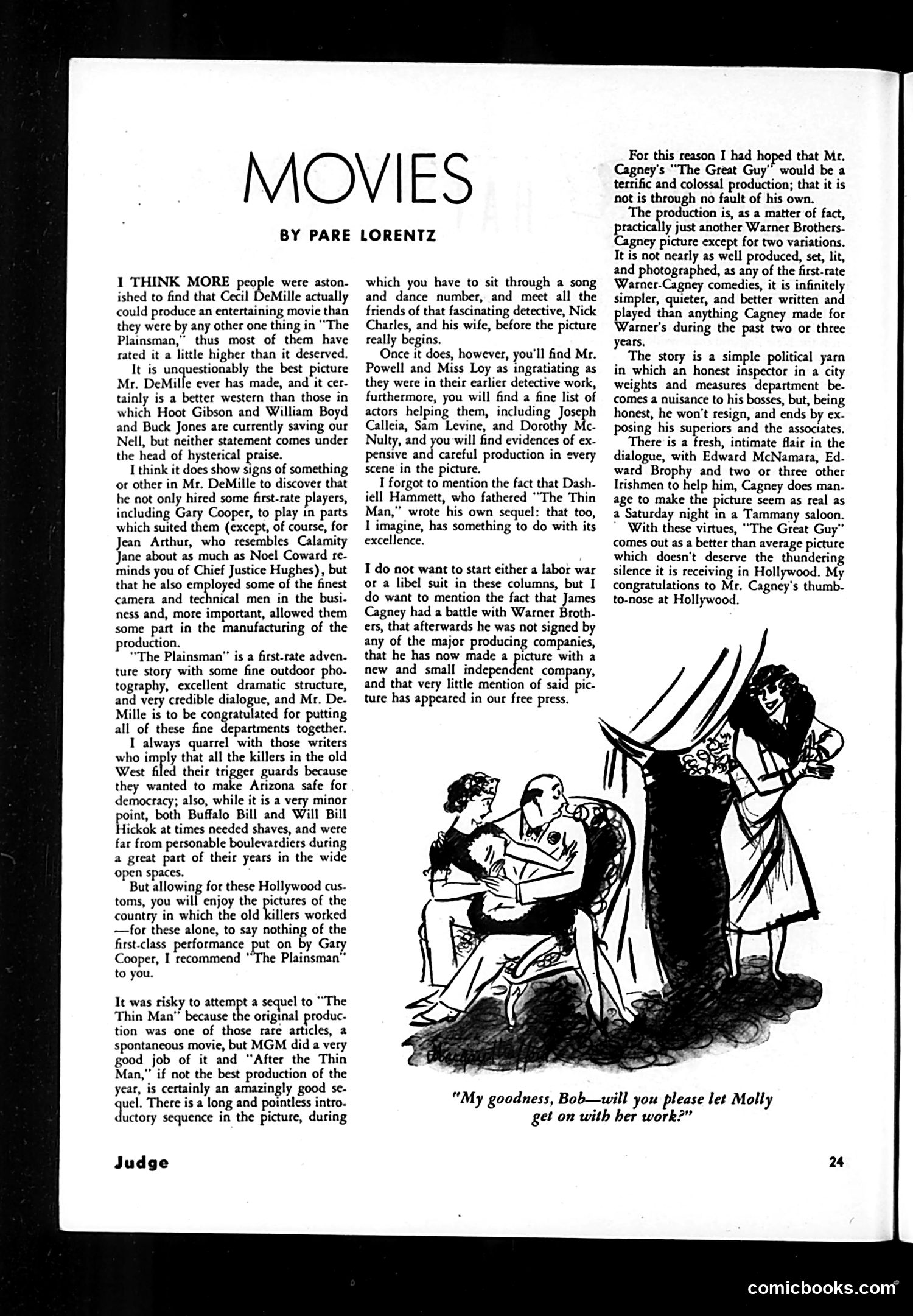
A restored page from Judge, 1937-02. Page through the whole issue in the reader above.
📄 Transcribed text from this page (OCR, searchable)
Machine-transcribed from the original scan — historical spelling and the odd misread are preserved.
MOVIES BY PARE LORENTZ 1 THINK MORE people were aston- ished to find that Cecil DeMille actually could produce an entertaining movie than they were by any other one thing in “The Plainsman,” thus most of them have rated it a little higher than it deserved. It is unquestionably the best picture Mr. DeMille ever has made, and it cer- tainly is a better western than those in which Hoot Gibson and William Boyd and Buck Jones are currently saving our Nell, but neither statement comes under the head of hysterical praise. I think it does show signs of something or other in Mr. DeMille to discover that he not only hired some first-rate players, including Gary Cooper, to play in parts which suited them (except, of course, for Jean Arthur, who resembles Calamity Jane about as much as Noel Coward re. minds you of Chief Justice Hughes), but that he also employed some of the finest camera and technical men in the busi- ness and, more important, allowed them some part in the manufacturing of the production. “The Plainsman”’ is a first-rate adven- ture story with some fine outdoor pho. tography, excellent dramatic structure, and very credible dialogue, and Mr. De- Mille is to be congratulated for putting all of these fine departments together. I always quarrel with those writers who imply that all the killers in the old West filed their trigger guards because they wanted to make Arizona safe for democracy; also, while it is a very minor int, both Buffalo Bill and Will Bill ickok at times needed shaves, and were far from personable boulevardiers during a great part of their years in the wide open spaces. But allowing for these Hollywood cus- toms, you will enjoy the pictures of the country in which the old killers worked —for these alone, to say nothing of the first-class performance put on by Gary Cooper, I recommend “The Plainsman” to you. Ic was risky to attempt a sequel to “The Thin Man” because the original produc- tion was one of those rare articles, a spontaneous movie, but MGM did a very good job of it and “After the Thin Man,” if not the best production of the year, is certainly an amazingly good se. uel. There is a long and pointless intro- ductory sequence in the picture, during Judge which you have to sit through a song and dance number, and meet all the friends of that fascinating detective, Nick Charles, and his wife, before the picture really begins. Once it does, however, you'll find Mr. Powell and Miss Loy as ingratiating as they were in their earlier detective work, furthermore, you will find a fine list of actors helping them, including Joseph Calleia, Sam Levine, and Dorothy Mc- Nulty, and you will find evidences of ex- pensive and careful production in every scene in the picture. I forgot to mention the fact that Dash- iell Hammett, who fathered “The Thin Man,” wrote his own sequel: that too, I imagine, has something to do with its excellence. I do not want to start either a labor war or a libel suit in these columns, but I do want to mention the fact that James Cagney had a battle with Warner Broth. ers, that afterwards he was not signed by any of the major producing companies, that he has now made a picture with a new and small independent company, and that very little mention of said pic. ture has appeared in our free press. For this reason I had hoped that Mr. Cagney's “'The Great Guy" would be a terrific and colossal production; that it is not is through no fault of his own. The production is, as a matter of fact, practically just another Warner Brothers- Cagney picture except for two variations. It is not nearly as well produced, set, lit, and photographed, as any of the first-rate Warner-Cagney comedies, it is infinitely simpler, quieter, and better written and played than anything Cagney made for ‘Warner's during the past two or three years. The story is a simple political yarn in which an honest inspector in a city weights and measures department be- comes a nuisance to his bosses, but, being honest, he won't resign, and ends by ex. posing his superiors and the associates. There is a fresh, intimate flair in the dialogue, with Edward McNamara, Ed- ward Brophy and two or three other Irishmen to help him, Cagney does man- age to make the picture seem as real as a Saturday night in a Tammany saloon. With these virtues, “The Great Guy” comes out as a better than average picture which doesn’t deserve the thundering silence it is receiving in Hollywood. My congratulations to Mr. Cagney's thumb. to-nose at Hollywood. "My goodness, Bob—will you please let Molly get on with her work?” comicbooks.com