
Judge, 1937-02 · page 25 of 45
Judge — February 1937 — page 25: what you’re looking at
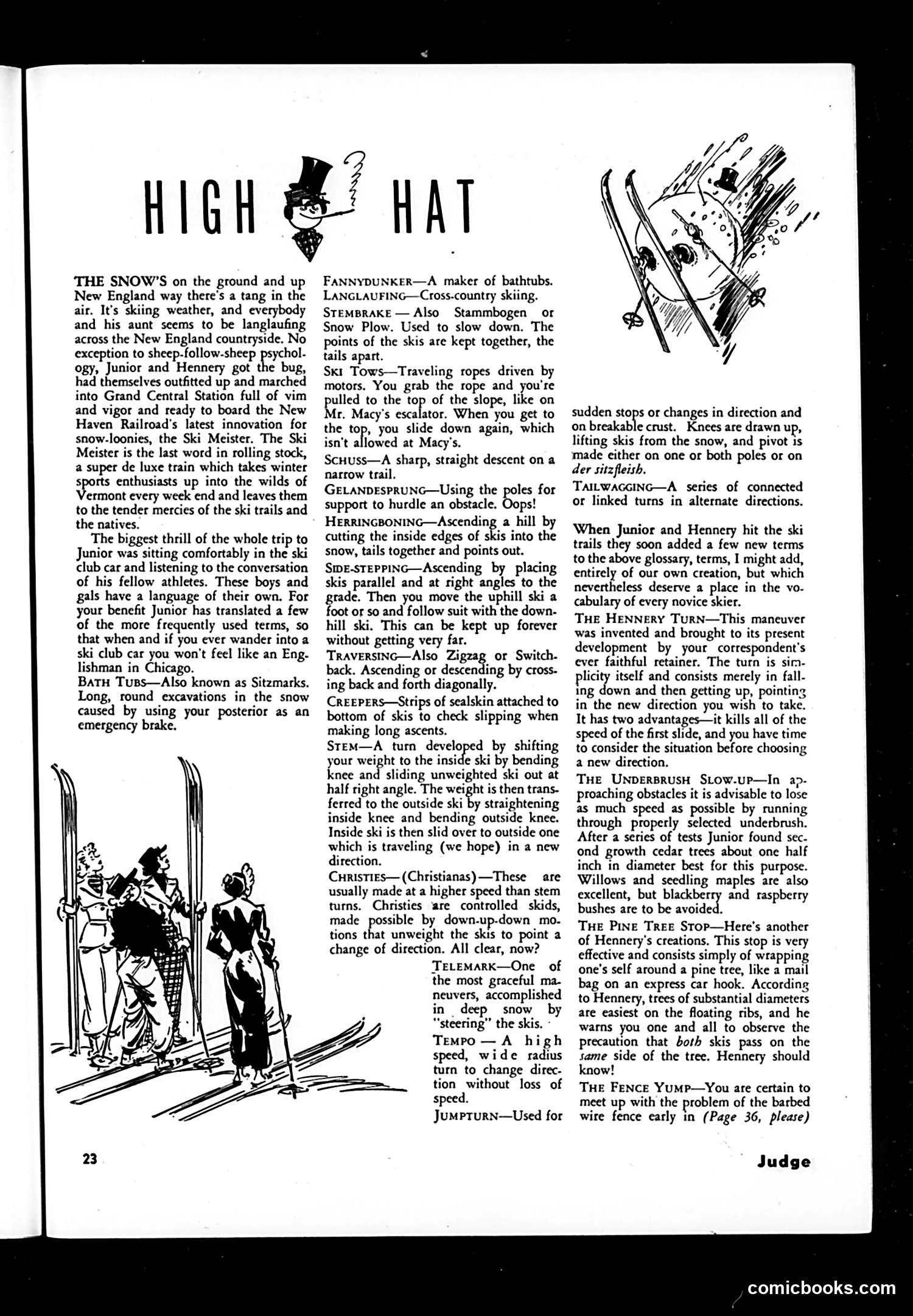
A restored page from Judge, 1937-02. Page through the whole issue in the reader above.
📄 Transcribed text from this page (OCR, searchable)
Machine-transcribed from the original scan — historical spelling and the odd misread are preserved.
HIGH @ HAT THE SNOW’S on the ground and up New England way there’s a tang in the air. It's skiing weather, and everybody and his aunt seems to be langlaufing across the New England countryside. No exception to sheep-follow-sheep psychol- ogy, Junior and Hennery got the bug, had themselves outfitted up and marched into Grand Central Station full of vim and vigor and ready to board the New Haven Railroad's latest innovation for snow-loonies, the Ski Meister. The Ski Meister is the last word in rolling stock, a super de luxe train which takes winter sports enthusiasts up into the wilds of ‘ermont every week end and leaves them to the tender mercies of the ski trails and the natives. The biggest thrill of the whole trip to Junior was sitting comfortably in the ski club car and listening to the conversation of his fellow athletes. These boys and gals have a language of their own. For your benefit Junior has translated a few of the more frequently used terms, so that when and if you ever wander into a ski club car you won't feel like an Eng- lishman in Chicago. Batu Tuss—Also known as Sitzmarks. Long, round excavations in the snow caused by using your posterior as an emergency brake. FANNYDUNKER—A maker of bathtubs. LANGLAUFING—Cross-country skiing. STEMBRAKE — Also Stammbogen _ or Snow Plow. Used to slow down. The points of the skis are kept together, the tails apart. Sx1 Tows—Traveling ropes driven by motors. You grab the rope and you're pulled to the top of the slope, like on t. Macy's escalator. When you get to the top, you slide down again, which isn’t allowed at Macy's. Scuuss—A sharp, straight descent on a narrow trail. GELANDESPRUNG—Using the poles for support to hurdle an obstacle. Oops! HERRINGBONING—Ascending a hill by cutting the inside edges of skis into the snow, tails together and points out. SwE-STEPPING—Ascending by placing skis parallel and at right angles to the rade. Then you move the uphill ski a ‘oot or so and follow suit with the down. hill ski. This can be kept up forever without getting very far. TRAVERSING—Also Zigzag or Switch. back. Ascending or descending by cross- ing back and forth diagonally. CREEPERS—Strips of sealskin attached to bottom of skis to check slipping when making long ascents. StemM—A turn developed by shifting your weight to the inside ski by bending knee and sliding unweighted ski out at half right angle. The weight is then trans- ferred to the outside ski by straightening inside knee and bending outside knee. Inside ski is then slid over to outside one which is traveling (we hope) in a new direction. Curisties—(Christianas)—These are usually made at a higher speed than stem turns. Christies are controlled skids, made possible by down-up-down mo. tions thee unweight the skis to point a change of direction. All clear, now? TELEMARK—One_ of the most graceful ma. neuvers, accomplished in deep snow by “steering” the skis. » Tempo — A high speed, wide radius turn to change direc- tion without loss of speed. JumPptTuRN—Used for sudden stops or changes in direction and on breakable crust. Knees are drawn up, lifting skis from the snow, and pivot is made either on one or both poles or on der sitzfleish. TAILWAGGING—A series of connected or linked turns in alternate directions. ‘When Junior and Hennery hit the ski trails they soon added a few new terms to the above glossary, terms, I might add, entirely of our own creation, but which nevertheless deserve a place in the vo- cabulary of every novice skier. Tue HENNERY TURN—This maneuver was invented and brought to its present development by your correspondent's ever faithful retainer. The turn is sim- plicity itself and consists merely in fall- ing down and then getting up, pointing in the new direction you wish to take. It has two advantages—it kills all of the speed of the first slide, and you have time to consider the situation before choosing a new direction. THe UNDERBRUSH SLow-up—In ap- proaching obstacles it is advisable to lose as much speed as possible by running through properly selected underbrush. After a series of tests Junior found sec. ond growth cedar trees about one half inch in diameter best for this purpose. Willows and seedling maples are also excellent, but blackberry and raspberry bushes are to be avoided. Tue Pine Tree Stop—Here’s another of Hennery’s creations. This stop is very effective and consists simply of wrapping one’s self around a pine tree, like a mail bag on an express car hook. According to Hennery, trees of substantial diameters are easiest on the floating ribs, and he warns you one and all to observe the precaution that both skis pass on the same side of the tree. Hennery should know! Tue FENCE YUMP—You are certain to meet up with the problem of the barbed wire fence early in (Page 36, please) Judge comicbooks.com