
Judge, 1937-02 · page 24 of 45
Judge — February 1937 — page 24: what you’re looking at
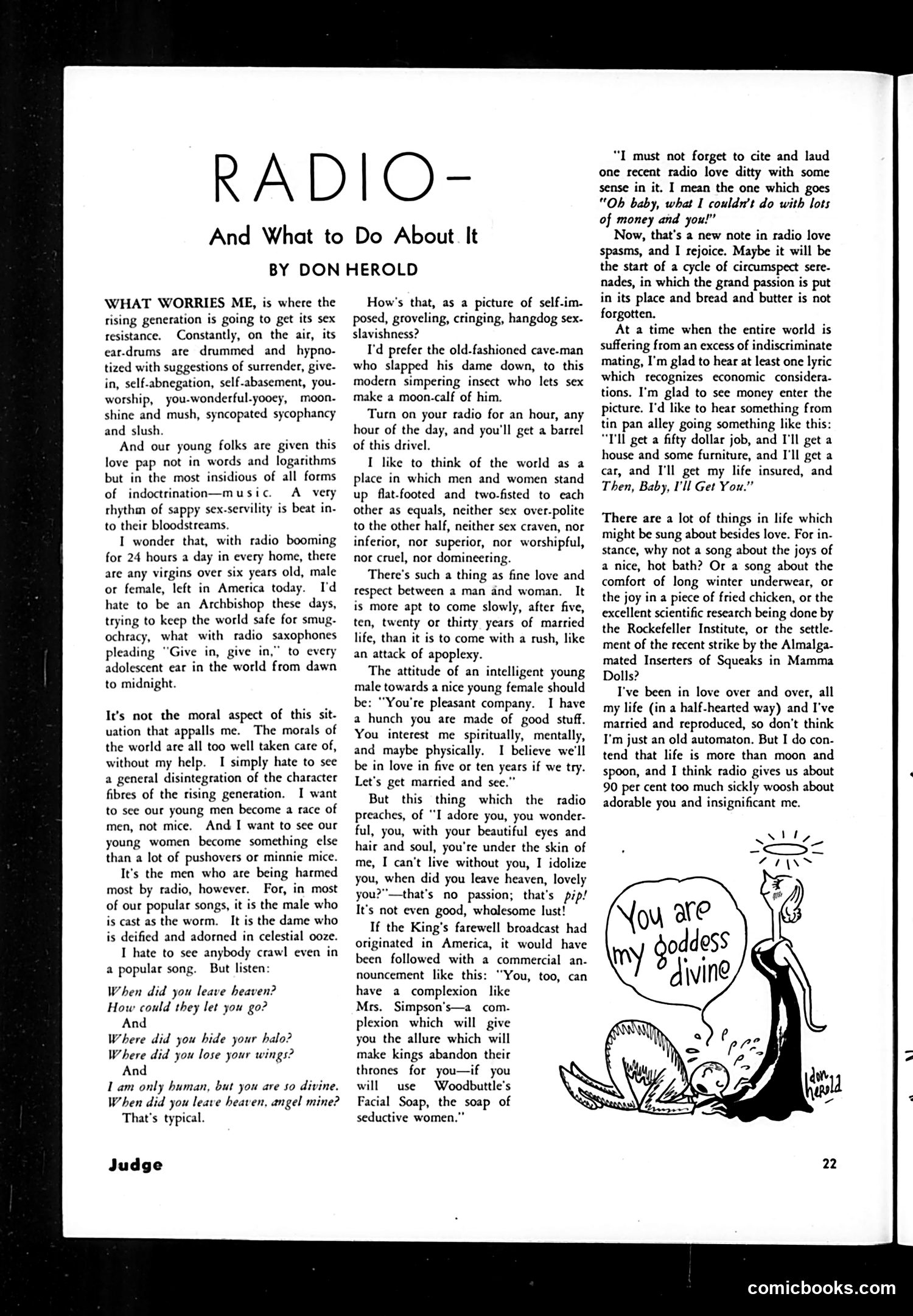
A restored page from Judge, 1937-02. Page through the whole issue in the reader above.
📄 Transcribed text from this page (OCR, searchable)
Machine-transcribed from the original scan — historical spelling and the odd misread are preserved.
RADIO- And What to Do About. It BY DON HEROLD WHAT WORRIES ME, is where the rising generation is going to get its sex resistance. Constantly, on the air, its ear-drums are drummed and hypno- tized with suggestions of surrender, give- in, self-abnegation, self-abasement, you- worship, you-wonderful-yooey, moon. shine and mush, syncopated sycophancy and slush. And our young folks are given this love pap not in words and logarithms but in the most insidious of all forms of indoctrination—music. A very rhythm of sappy sex-servility is beat in- to their bloodstreams. I wonder that, with radio booming for 24 hours a day in every home, there are any virgins over six years old, male or female, left in America today. I'd hate to be an Archbishop these days, trying to keep the world safe for smug- ochracy, what with radio saxophones pleading “Give in, give in,” to every adolescent ear in the world from dawn to midnight. It’s not the moral aspect of this sit- uation that appalls me. The morals of the world are all too well taken care of, without my help. I simply hate to see a general disintegration of the character fibres of the rising generation. I want to see our young men become a race of men, not mice. And I want to see our young women become something else than a lot of pushovers or minnie mice. It's the men who are being harmed most by radio, however. For, in most of our popular songs, it is the male who is cast as the worm. It is the dame who is deified and adorned in celestial ooze. I hate to see anybody crawl even in a popular song. But listen: When did you leave heaven? How could they let you go? And Where did you hide your halo? Where did you lose your wings? And 1 am only human, but you are so divine. When did you leave heaven, angel mine? That's typical. Judge How's that, as a picture of self-im. posed, groveling, cringing, hangdog sex- slavishness? I'd prefer the old-fashioned cave-man who slapped his dame down, to this modern simpering insect who lets sex make a moon.calf of him. Turn on your radio for an hour, any hour of the day, and you'll get a barrel of this drivel. I like to think of the world as a place in which men and women stand up flat-footed and two-fisted to cach other as equals, neither sex over-polite to the other half, neither sex craven, nor inferior, nor superior, nor worshipful, nor cruel, nor domineering. There's such a thing as fine love and respect between a man and woman. It is more apt to come slowly, after five, ten, twenty or thirty years of married life, than it is to come with a rush, like an attack of apoplexy. The attitude of an intelligent young male towards a nice young female should be: “You're pleasant company. I have a hunch you are made of good stuff. You interest me spiritually, mentally, and maybe physically. I believe we'll be in love in five or ten years if we try. Let's get married and see.” But this thing which the radio preaches, of “I adore you, you wonder- ful, you, with your beautiful eyes and hair and soul, you're under the skin of me, I can't live without you, I idolize you, when did you leave heaven, lovely you?"’—that’s no passion; that's pip! It's not even good, wholesome lust! If the King’s farewell broadcast had originated in America, it would have been followed with a commercial an. nouncement like this: “You, too, can have a complexion like Mrs. Simpson’s—a com. plexion which will give you the allure which will make kings abandon their thrones for you—if you will use © Woodbuttle’s Facial Soap, the soap of seductive women.” “I must not forget to cite and laud one recent radio love ditty with some sense in it. I mean the one which goes "Ob baby, what I couldn't do with lots of money and you!" Now, that's a new note in radio love spasms, and I rejoice. Maybe it will be the start of a cycle of circumspect sere- nades, in which the grand passion is put in its place and bread and butter is not forgotten. At a time when the entire world is suffering from an excess of indiscriminate mating, I'm glad to hear at least one lyric which recognizes economic considera- tions. I'm glad to see money enter the picture. I'd like to hear something from tin pan alley going something like this: “T'll get a fifty dollar job, and I'll get a house and some furniture, and I'll get a car, and I'll get my life insured, and Then, Baby, I'll Get You.” There are a lot of things in life which might be sung about besides love. For in- stance, why not a song about the joys of a nice, hot bath? Or a song about the comfort of long winter underwear, or the joy in a piece of fried chicken, or the excellent scientific research being done by the Rockefeller Institute, or the settle- ment of the recent strike by the Almalga- mated Inserters of Squeaks in Mamma Dolls? I've been in love over and over, all my life (in a half-hearted way) and I've married and reproduced, so don’t think I'm just an old automaton. But I do con- tend that life is more than moon and spoon, and I think radio gives us about 90 per cent too much sickly woosh about adorable you and insignificant me. Ciao comicbooks.com