
Judge, 1935-10 · page 20 of 36
Judge — October 1935 — page 20: what you’re looking at
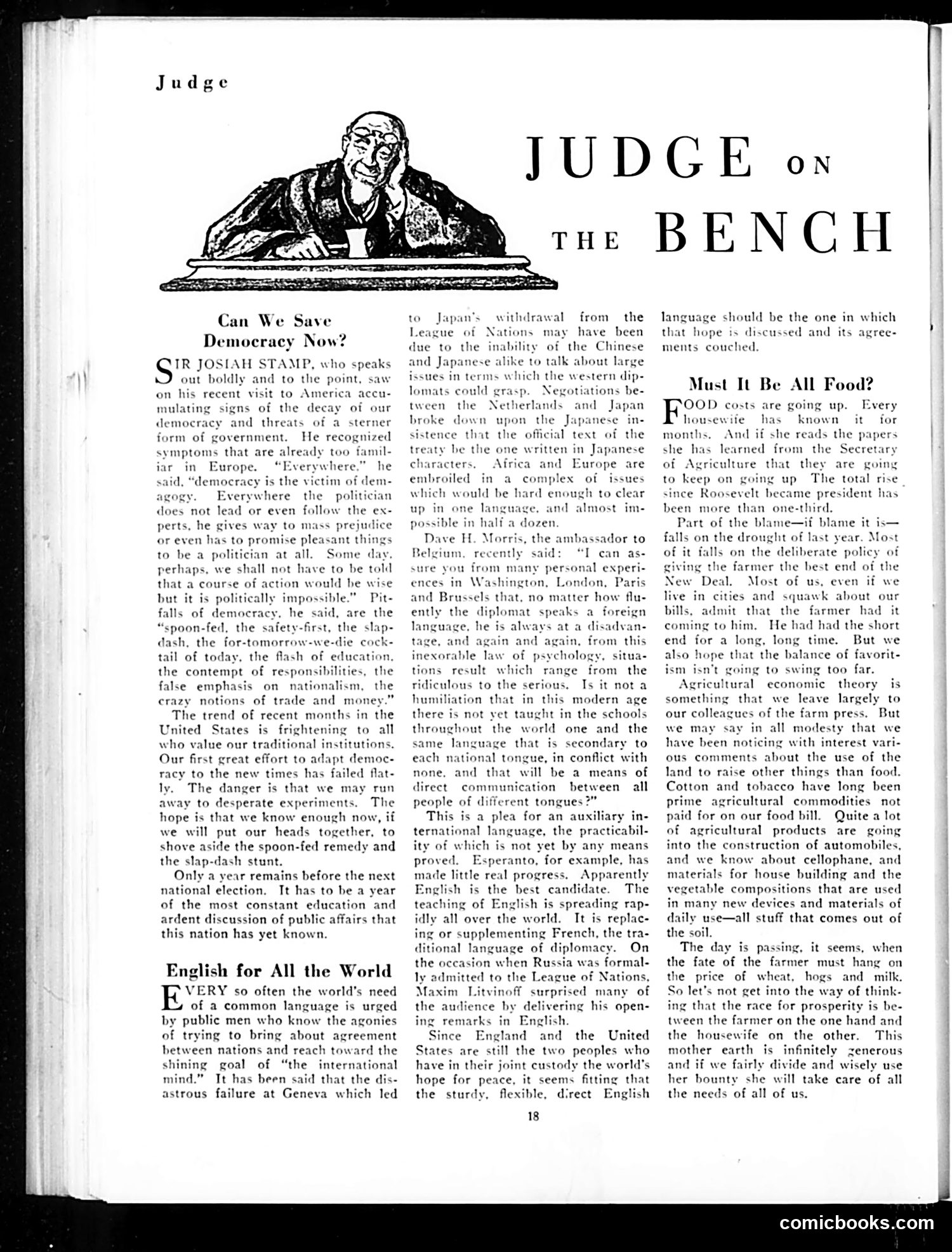
A restored page from Judge, 1935-10. Page through the whole issue in the reader above.
📄 Transcribed text from this page (OCR, searchable)
Machine-transcribed from the original scan — historical spelling and the odd misread are preserved.
Can We Save Democracy Now? IR JOSIAH STAMP, who speaks out boldly and to the point, saw on his recent visit to Ameri ccus mulating signs of the decay of our democracy and threats of a sterner form of government. He recognized symptoms that are already too famil- iar in Europe. verywher said, “democracy is the victim of dem- Everywhere the politician does not lead or even follow the ex- perts, he gives w or even has to p to be a politician at all. perhaps, we shall not have to be tol that a course of action would he wise but it is politically impossible.” Pit- alls of democracy, he said, are the “spoon-fed, the safety-first, the slap- dash, the for-tomorrow-we-die co tail of today, the flash of educati the contempt of responsibilit the false emphasis on nationalism, the crazy notions of trade and money.” The trend of recent months in the United States is frightening to all who value our traditional institutions. Our first great effort to adapt democ- racy to the new times has failed flat- ly, The danger is that we may run away to desperate experiments. The hope is that we know enough now, if we will put our heads together, to shove aside the spoon-fed remedy and the slap-dash stunt. Only a year remains before the next national election. Tt has to be a year of the most constant education and ardent discussion of public affairs that this nation has yet known. he ejudic omise pleasant things y to mass fF yme d. English for All the World VERY so often the world’s need of a common language is urged by public men who know the agonies of trying to bring about agreement between nations and reach toward the shining goal of “the international mind.” Tt has been said that the d astrous failure at Geneva which led withdra val from the Nations wm y have been inability of the Chinese ike to talk about large hich the western dip- to Japan's League of due to the and Japanese : issues in tern lomats could grasp. Negotiations be- tween the Netherlands Ja broke down upon th inese i the le written in Japanese Africa and Europe are complex of ch would be hard enough to clear ne language im- possible in hali a « Dave H. Mor Belgium, recen sure you from many personal experi- ences in Washington, London, Paris and Brussels that, no matter how flu- ently the diplomat speaks a foreign language, he at a disadvan- sistence that the official text aty be the characters, embroiled in issues w up in ¢ and almost zen. ambassador to “T can a y said s always tage, and in and again, from this inexorable law of psychology, situa- tions result which nge from the ridiculous to the serious. Is it not a humi yn that in this modern age there is not yet taught in the schools throughout the world one and the same language that is secondary to each national tongue, in conflict with none, and that will be a means of direct. communication between all people of different tongues?” This is a plea for an auxiliary in- ternational language, the practicabil- ity of which is not yet by any means proved. Esperanto, for example, has made little real progress. Apparently English is the best candidate. The teaching of English is spreading rap- idly all over the world. It is replac- ing or supplementing French, the tra- ditional language of diplomacy. On the occasion when Russia was formal- ly admitted to the League of Nations, Maxim Litvinoff surprised many of the audience by delivering his open- ing remarks in English. Since England and the United States are still the two peoples who have in their joint custody the world’s hope for peace, it seems fitting that the sturdy, flexible, direct English 18 language should be the one in which that hope is discussed and ments couched its agrec- Must It Be All Food? | iste costs are going up. Every housewife has known it for months. And if she reads the papers she has learned from the Secretary of Agriculture that they are going to keep on going up The total rise since Roosevelt became president has been more than one-third. Part of the blame—if blame it is— falls on the drought of last year. Mo of it falls on the deliberate polic giving the farmer the best end of the Most of us, even if we ies and squawk about our mit that the farmer had it coming to him, He had had the short end for a long, long time. But we also hope that the balance of favorit- ism isn't ge Agricultural somethi g to swing too far. economic is g that we leave largely to our colleagues of the farm press. But we may say in all modesty that we have been noticing with interest vari- ous comments about the use of the land to raise other things than food. Cotton and tobacco have long been prime agricultural commodities not paid for on our food bill. Quite a lot of agricultural products are going into the construction of automobiles, and we know about cellophane, and materials for house building and the vegetable compositions that are used in many new devices and materials of daily use—all stuff that comes out of the soil. The day is passing, it seems, when the fate of the farmer must hang on the price of wheat, hogs and milk. So let's not get into the way of think- ing that the race for prosperity is be- tween the farmer on the one hand and the housewife on the other. This mother earth is infinitely zenerous and if we fairly divide and wisely use her bounty she will take care of all the needs of all of us. theory comicbooks.com