
Judge, 1933-05 · page 20 of 36
Judge — May 1933 — page 20: what you’re looking at
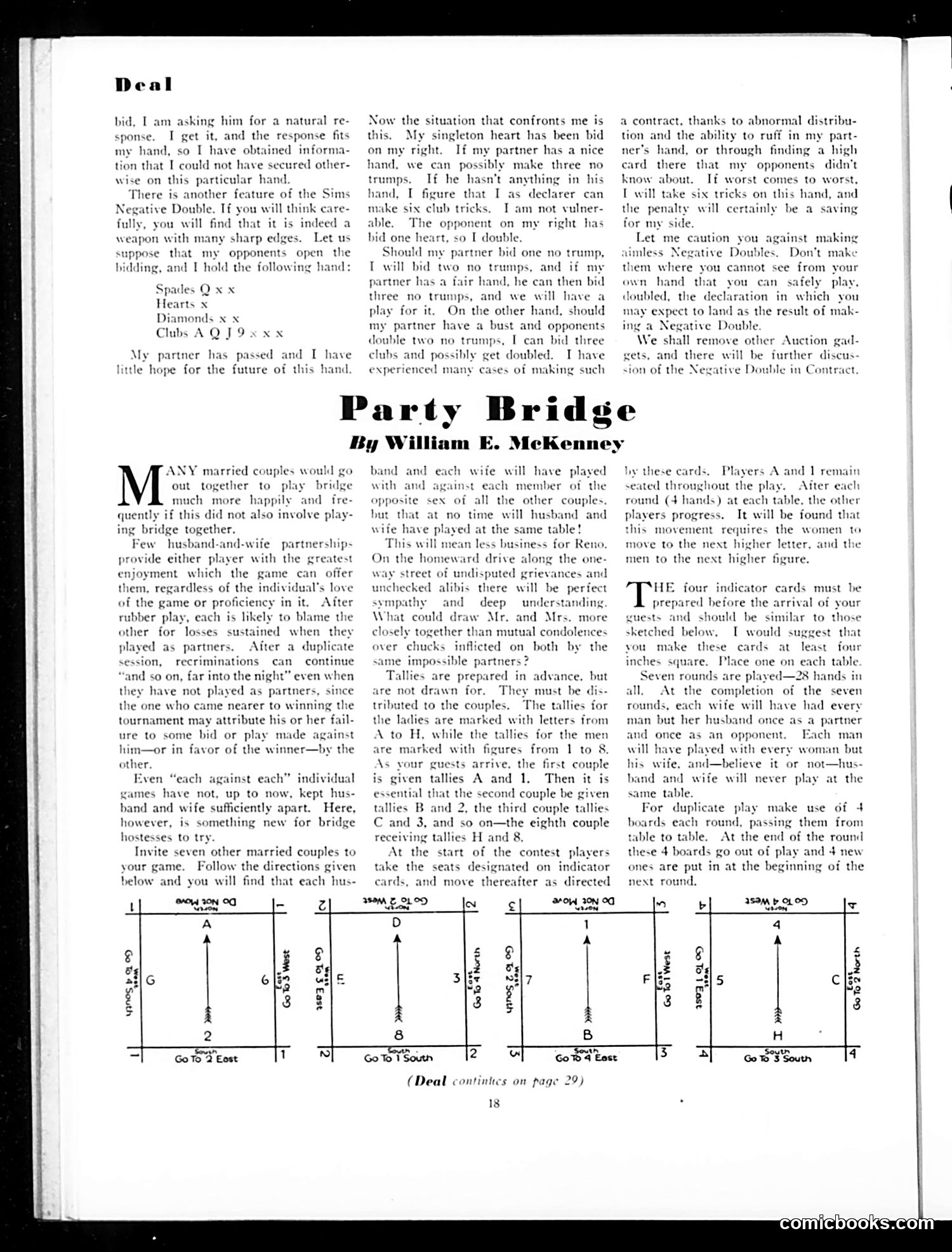
A restored page from Judge, 1933-05. Page through the whole issue in the reader above.
📄 Transcribed text from this page (OCR, searchable)
Machine-transcribed from the original scan — historical spelling and the odd misread are preserved.
Deal bid, I am asking him for a natural re- sponse. I get it, and the response fits my hand, so I have obtained informa- tion that I could not have secured other- wise on this particular hand. There is another feature of the Sims Negative Double. If you will think ¢: fully, you will find that it is indeed a weapon with many sharp edges. Let us suppose that my opponents open the bidding, and I hold the following hand: e- x Diamonds x x Clubs AQ J 9x xx My partner has passed and I have little hope for the future of this hand. ow the situation that confronts me is singleton heart has been bid on my right. If my partner has a nice hand, we can possibly make three no nps. If he hasn't anything in his hand, I figure that I as declarer can make six club tricks, I am not vulner- able. The opponent on my right has bid one heart, so I double. Should my partner bid one no trump, I will bid two no trumps, and if my partner has a fair hand, he can then bid three no trumps, and we will have a play for it. On the other hand, should my partner have a bust and opponents double two no trumps, [| can bid three clubs and possibly get doubled. I have experienced 1} ases of making such contract, thanks to abnormal distribu- tion and the ability to ruff in my part- ner’s hand, or through finding a high card there that my opponents didn’t know about. If worst comes to worst, T will take six tricks on this hand, and the penalty will certainly be a saving for my sid Let me caution you Negative Doub! Don’t make you cannot from your wn hand that you can safely play, tbled, the dec gainst making ess ation in which you may expect to land as the result of mak- ing a Negative Double. We shall remove other Auction gad- and there will be further discus- sion of the Negative Double in Contract Party Bridge By William E. McKenney ANY married couples would go out together to play bridge much more happily and quently if this did not also involve p ing bridge together. Few husband-and-wife partnerships le either player with the gre: joyment which the game can off hem, regardless of the individual's love of the game or proficiency in it. After rubber play, each is likely to blame the other for losses sustained when they played partners. After a duplicate sion, recriminations can continue “and so on, far into the night” even when they have not played as partners, since the one who came nearer to winning tournament may attribute his or } ure to some bid or play made against him—or in favor of the winner—by the oth iven “each against each” individual games have not, up to now, kept hus- band and wife sufficiently apart. Here, however, is something new for bridge hostesses to try. Invite seven other married couples to your game. Follow the directions given below and you will find that each hus- OW 20N O70, Cason 1803 ¢ OL °9 Tonn, GoTo 2 Eost GoTo 1 South band and each wiie will have played with and against each member of the site sex of all the other couples. that at no time will husband and wife have played at same table! This will mean less business for Reno. On the homeward drive alor way street of undisputed grievane ur s and ecked alibis there will be perfect sympathy and deep — understanding What could draw Mr. and Mrs. more ether than mutual condoler over chucks inflicted on both by the same impossible partners ? Tallies are prepared in advance, but are not drawn for. They must be dis- tributed to the couples. the ladies are ma A to H. while tallies for the men are marked with figures from 1 to 8. \s your guests arrive, the first couple is given tallies A and 1. Then it is essential that the second couple be given tallies B and 2, the third couple tallies C and 3, and so on—the eighth couple receiving tallies H and 8, At the start of the contest players take the seats designated on indicator closely to; he tallies for ked with letters from cards, and move thereafter as directed SOMA Z Of BME OLoD ss fi ards. PI oughout the play. Aiter each round (4 hands) at each table, the other players progress. It will be found that this mover hy these seated th. ayers A and 1 remain nent requires the women to move to the next higher letter, and the men to the next higher figure. ator cards must be e the arrival of your dl be similar to those est that cards at least four eon het rounds are played—28 hands in all, At the completion of the seven rounds, h wife will have had every man but her husband once as a partner and once as an opponent. ch man will have played with every woman but his wife, and—believe it or not—hus- band and wife will never play at the same table. For duplicate play make use of 4 boards each round, passing them from table to table. At the end of the round these 4 boards go out of play and 4 new ones are put in at the beginning of the next round. HE four indi prepared beic s and shot sketched below, T would su you make inches square. Place ot ble. Sever 359M b OLD, Seon 1 A Go Tol West Tost GoTo 2 North (Deal continues on page 2 18