
Judge, 1933-05 · page 19 of 36
Judge — May 1933 — page 19: what you’re looking at
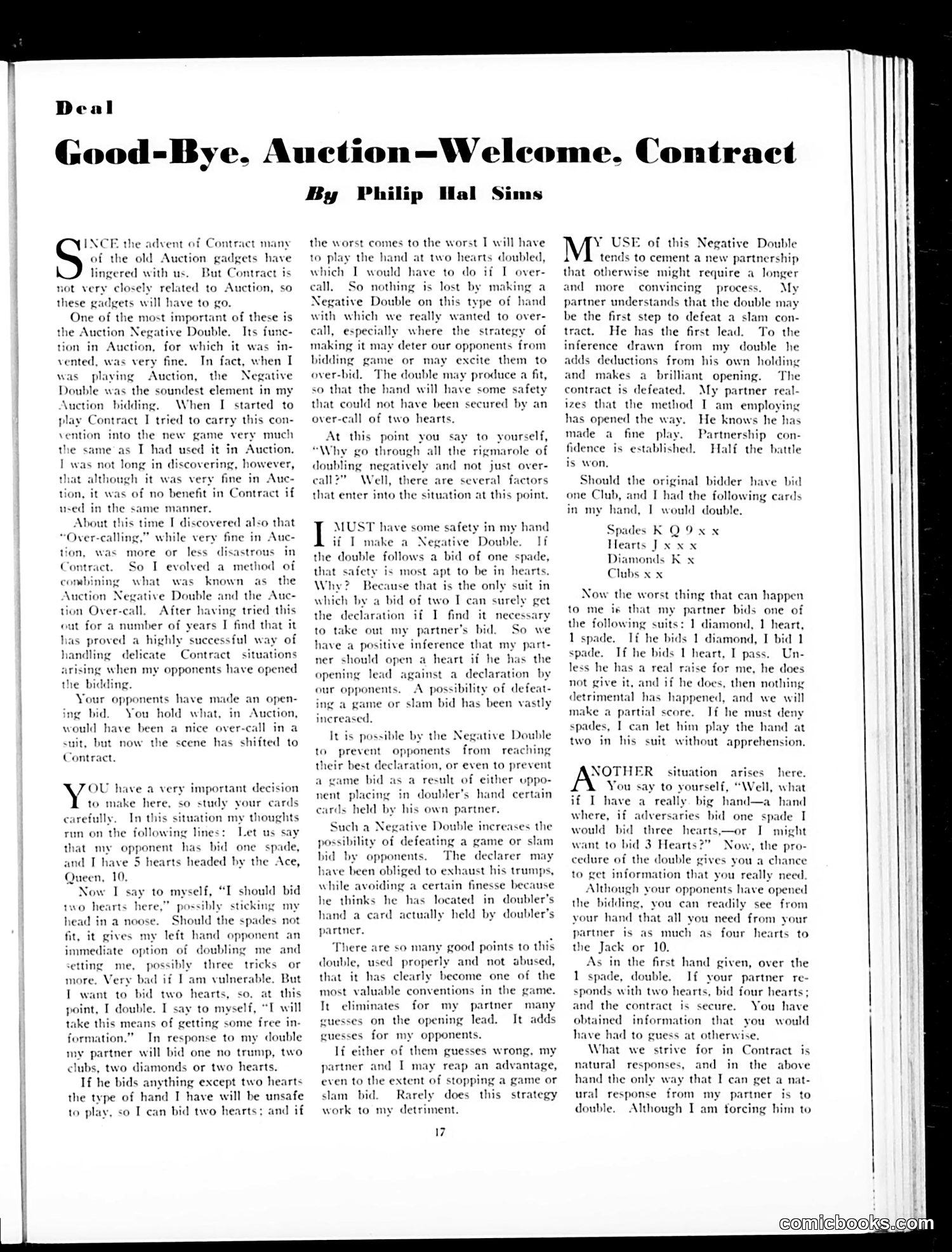
A restored page from Judge, 1933-05. Page through the whole issue in the reader above.
📄 Transcribed text from this page (OCR, searchable)
Machine-transcribed from the original scan — historical spelling and the odd misread are preserved.
Good-Bye. Auction=Welcome. Contract INCE the advent of C of the old Auction ga lingered with us. not very clos ract many ts have But Contract y related to Auction, so these gadgets will have to go. One of the most important of these is the Auction Negative Double. Its func- min Auction, for which it was in- vented, was very fine. In fact, when I was playing Auction, the Negative Double was the soundest element in my ion bidding. When I started to play Contract I tried to carry this con- vention into the new game very much the same as I had used it in Auction. I was not long in discovering, however, that although it was very fine in Au tion, it was of no benefit in Contract used in the same manner. About this time I discovered also that “Over-calling, tion, v Aue while very fine in Auc- more or disastrous in Contract. So I evolved a method of ng what was known as the Auction Negative Double and the Auc- tion Over-call less comb: After having tried this rs I find that it is proved a highly successful way of andling ¢ e Contract ising when my opponents have opened the bidding. Your opponents have made an open- ing bid. You hold what, in Auction, would have been a nice over-call in a suit, but now the scene has shifted to Contract. out for a number of ye JOU have a very important decision to make here, so study your cards carefully, Int run on the fc Let us say that my opponent has bid one spade, and T have 5 hearts headed by the Ace, Queen, 10. Now I two hearts situation my thoughts owing lines: y to myself, “I should bid ere,” possibly ; head in a noose. Should the spades not fit, it gives my left hand opponent an mediate option of doubling me and setting me, three tricks or more. Very bad if Lam vulnerable, But I want to bid two hearts, so. at this point, I double. I say to myself, “I will take this means of getting some free in. formation.” In response to my double my partner will bid one no trump, two clubs, two diamonds or two hearts. If he bids anything except two hearts the type of hand I have will be unsafe to play, so T can bid two hearts; and if possibly » play the hand at two hearts doubled, which I would e to do if I over- So nothing is lost by making a ative Double on this type of hand with which we really wanted to over- call, especially where the strategy of making it may deter our opponents from bidding game or may excite them to over-bid. The double may produce a fit, so that the hand will have some safety that could not have been secured by an over-call of two hearts. At this point you say to yourself, “Why go through all the rigmarole of doubling negatively and not just over- Well, there are several factors that enter into the situation at this point. P have some if MU ) if I make a Negative Double. If the double follows a bid of one spade, that safety is most apt to be in hearts. Wh Because that is the only suit in which by a bid of two [ can surely get the declaration if I find it y to take out my partner's bid. So we have a positive inference that my part- ner should open a heart if he has the opening lead ainst a declaration by our opponents. A possibility of defeat- game or slam bid has been vastly ased, in my hand neces y ing inere It is possible by the Negative Double to prevent opponents from reaching their best declaration, or even to prevent 1 game bid as a result of either oppc nt placing in doubler’s hand certain cards held by his own partner. Such a Negative Double incre: possibility of defi bid by ses the ating a game or slam opponents, The declarer may en obliged to exhaust his trumps, while avoiding a certain finesse because he thinks he has located in doubler’s have b hand a card actually held by doubler’s partner, ‘There are so many good points to th double, used properly and not that it has clearly become one o vused, the most valuable conventions in the game. It eliminates for my partner guesses on the opening lead. es for my opponents. many It adds ither of them guesses wrong, m partner and I may reap an advantage, even to the extent of stopping a game or slam bid. Rarely does this strate; work to my detriment. 17 Y USE of this Negative Double tends to cement a new partnership that otherwise might require a longer and more convincing process. My partner understands that the double ma’ be the first step to defeat a slam con- tract. He has the first lead. To the inference drawn from my double he adds deductions from his own holding and makes a brilliant opening. The contract is defeated. My partner real izes that the method I am employing has opened the way. He knows he has made a fine play. Partnership. con- fidence is established. Half the battle is won, Should the original bidder have bid one Club, and I had the following cards in my hand, I would double. Spades K Q9x x Hearts J x x x Diamonds K x Clubs x x Now the worst thing that can happen to me is that my partner bids one of the following suits: 1 diamond, 1 heart, 1 spade. If he bids 1 diamond, I bid 1 spade. If he bids 1 heart, I pass. Un- less he has a real raise for me, he does not give it, and if he does, then nothing detrimental has happened, and we will make a partial score. If he must de spades, I can let him play the hand at two in his suit without apprehension. NOTHER situation arises here. You say to yourself, “Well, what if I a really big hand—a hand where, if adversaries bid one spade I would bid three hearts,—or I want to bid 3 Heart cedure of the might Now, the pro- louble gives you a chance to get information that you really need Although your opponents have opened the bidding, you can readily see from your hi t all you need from your partner is as much as four hearts to the Jack or 10. s in the first hand given, over the 1 spade, double. If your partner re- sponds with two hearts, bid four hearts; and the contract is secure. You ha obtained information that you have had to guess at otherwise. What we strive for in Contract. is natural responses, and in the above hand the only way that I can get a nat- ural response from my partner is to double. Although I am forcing him to € would