
Judge, 1932-04-16 · page 24 of 36
Judge — April 16, 1932 — page 24: what you’re looking at
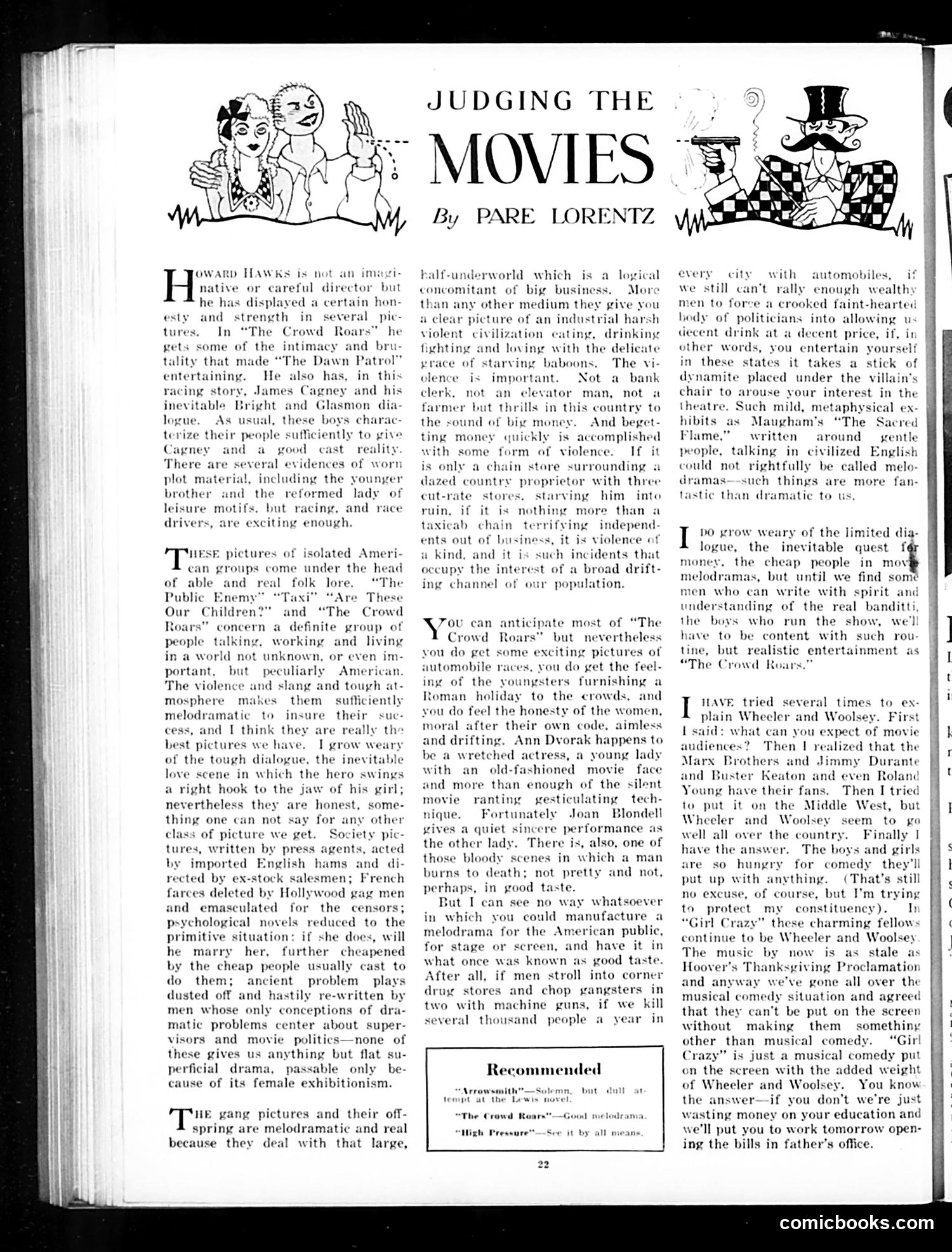
A restored page from Judge, 1932-04-16. Page through the whole issue in the reader above.
📄 Transcribed text from this page (OCR, searchable)
Machine-transcribed from the original scan — historical spelling and the odd misread are preserved.
. HAWKs is not an imaysi- H ative or careful director but he has displayed a certain hon- and strength in several pie- tures. In “The Crowd Roars” he yets some of the intimacy and bru- tality that made “The Dawn Patrol” entertaining. He also has, in this racing story, James Cagney and his inevitable Bright and Glasmon dia logue. As usual, these boys charac- terize their 7 le sufficiently t Cagney and a= yood = cast There are several evidences of worn plot material, including the younger brother and the reformed lady of leisure motifs, but racing, and race drivers, are exciting enough. esty HESE pictures of isolated ¢ can groups come under the h of able and | folk lore. Public Enemy Paxi” “Are These Our Children?” and “The Crowd * concern a definite group of le talking, working and living world not unknown, or even i portant, but peculiarly Amer The violence and slang and tough at- mosphere makes them sufficiently melod ic to insure their suc- nd I think they are really the best pictures we hav I grow weary of the tough dialogue, the inevi love scene in which the hero swings a right hook to the jaw of his girl; nevertheless they are honest, some- thing one can not say for any other class of picture we get. Society pic- tures, written by press agents, acted by imported English hams and di- rected by ex-stock salesmen; French farces deleted by Hollywood gag men and emasculated for the censors; psychological novels reduced to the primitive situation: if she d he mar her, further cheapened by the cheap people usually cast to do them; ancient problem a dusted off and hastily re-written men whose only conceptions of dr ic problems center about supe s and movie politics—none of these gives us anything but flat su- drama, passable only be- cause of its female exhibitionism. cess, HE ng pictures and their off- spring are melodramatic and real use they deal with that large, JUDGING THE MOVIES By PARE LORENTZ half-underworld which is yytical concomitant of big business. More than any other medium they give you a clear picture of an industrial harsh viole civilization eating, drinking fighting and loving with the delicate grace of starving baboons. The vi- olence is important. Not a bank clerk, not an elevator man, not a farmer but thrills in this country to the sound of biz money. And beget- ting money quickly is accomplished with some form of violence. If it is only a chain store surrounding a dazed country proprietor with thr cut-rate starving him = into in, if it is nothing more than a a ab chain terrifying independ- ents out of business, it is violence of a kind, and it is such incidents that occupy the interest of a broad drift- ing channel of our popt ion. 7oU can anticipate most of “The Crowd Roa but nevertheless you do get some exciting pictures of automobile races, you do get the feel- ing of the youngsters furnishing a Roman holiday to the crowds, and you do feel the honesty of the women, moral after their own code, aimless and drifting. Ann Dvorak happens to be a wretched actress, a young lady with an old-fashioned movie face and more than enough of the silent movie ranting yesticulating tech- nique. Fortunately Joan Blondel! vives a quiet sincere performance 3 the other lady. There is, also, one of those bloody scenes in which a man burns to death; not pretty and not, perhaps, in good taste. But I can see no v in which you could m melodrama for the American public, for stage or screen, and have it in what once was known as good taste. After all, if men stroll into corner drug stores and chop gangsters in two with machine guns, if we kill 1 thousand people a year in y whatsoever anufactur mended bat duit tempt at the “The Crowd 1 Good melodrama “High Pressure”—See it by all means every city with automobiles, we still can’t rally enough wealthy men to force a crooked faint-hearted body of politicians into allowing u decent drink at a decent price, if, ir other words, you entertain yourself these states it takes a stick of dynamite d under the villain’s chair to arouse your interest in the theatre. Such mild, metaphysical ex- hibits as Maugham'’s “The Sacred Flame.” written around — gentle people, talking in civilized English could not rightfully be called melo- dramas—such things are more fan- tastic than dramatic to us. I DO grow weary of the limited di logue, the inevitable quest f money, the cheap people in mov melodramas, but until we find some men who can write with spirit and understanding of the r banditti the who run the show, we'l have to be content with such rou tine, but. reg ic entertainment as “The Crowd Roars.” boys tried several times to ex- n Wheeler and Woolsey. First I said: what can you expect of movie audiences? Then I realized that the Marx Brothers and Jimmy Durante and Buster Keaton and even Roland Young have their fans. Then I tried to put it on the Middle West, but Wheeler and Woolsey seem to go well all over the countr. Finally 1 have the answer. The boys and girls are so hung for comedy they'll put up with anything. (That's still no excuse, of course, but I'm trying protect my constituency). In rl Crazy” these charming fellows continue to be Wheeler and Woolsey The music by now is as stale as Hoover's Thanksgiving Proclamation and anyway we've gone all over the musical comedy situation and agreed that they can’t be put on the screen without making them somethiny other than musical comedy. “Gir! Crazy” is just a musical comedy put on the screen with the added weight of Wheeler and Woolsey. You know the answer—if you don’t we're just wasting money on your education and we'll put you to work tomorrow open- ing the bills in father’s office. comicbooks.com