
Judge, 1932-01-09 · page 26 of 36
Judge — January 9, 1932 — page 26: what you’re looking at
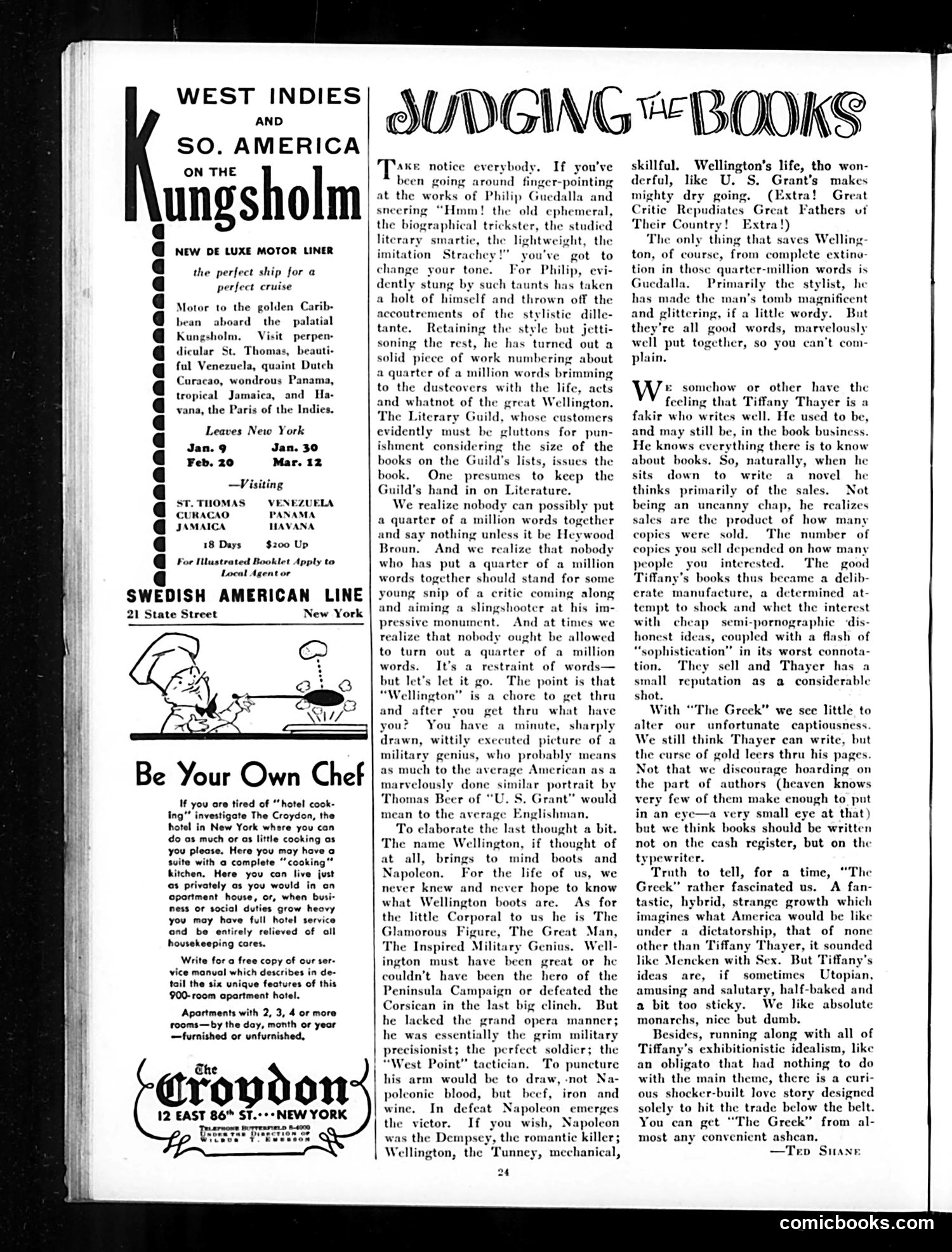
A restored page from Judge, 1932-01-09. Page through the whole issue in the reader above.
📄 Transcribed text from this page (OCR, searchable)
Machine-transcribed from the original scan — historical spelling and the odd misread are preserved.
WEST INDIES AND SO. AMERICA sholm ON THE NEW DE LUXE MOTOR LINER the perfect ship for a perfect cruise Motor to bean Kungsholm, V dicular St. Thom: ful Venezuela, quaint Du q a q q q q q q Curacao, wondrous Panama, q q q q q q rT | e golden Carib- the palatial perpen: , beauti- aboard tropical Jamaica, and Ha- vana, the Paris of the Indies, Leaves New York Jan. 9 Feb. 20 Jan. 30 Mar. 12 Visiting THOMAS. URACAO JAMAICA 18 Days For Illustrated Booklet Apply to Local Agent or q SWEDISH AMERICAN LINE 21 State Street New York VENEZUELA PANAMA HAVANA $200 Up Be Your Own Chef If you are tired of “hotel cook- ing’ investigate The Croydon, the hotel in New York where you can do as much or as little cooking os you please. Here you may have a @ complete “cooking” @ you can live just ly as you would in an epartment house, or, when busi- ness of social duties grow heavy you may have full hotel service end be entirely relieved of all housekeeping cores. Write fora free copy of our ser- vice manual which describes in di tail the six unique features of this 900-room apartment hotel. Apartments with 2, 3, 4 or more rooms—by the day, month or year —fur ed or unfurnished, Crovion 12 EAST 86" ST.-+>NEW YORK t wy AUDGING““ BOOKS Ake notice everybody. If you've been going around finger-pointing at the works of Philip Guedalls sneering “Hmm! the old epheme the biographical trickster, the studied literary smartie, the lightw t, the imitation Strachey !" got to change your tone. For Philip, evi- dently stung by such taunts has taken a holt of himself and thrown off the accoutrements of the stylistic dille- tante. Retaining the style but jetti- soning the rest, he has turned out a solid piece of work numbering about a quarter of a million words brimming to the dustcovers with the life, acts and whatnot of the great Wellington. The Literary Guild, whose customers evidently must be gluttons for pun- ishment considering the size of the books on the Guild's lists, issues the book. One presumes to keep the Guild’s hand in on Literature. We realize nobody can possibly put a quarter of a million words together and say nothing unless it be Heywood Broun. And we realize that nobody who has put a quarter of a million words together should stand for some young snip of a critic coming along and aiming a slingshooter at his im- pressive monument. And at times we realize that nobody ought be allowed to turn out a quarter of a million words. It’s a restraint of words— but let's let it go. The point is that “Wellington” is a chore to get thru and after you get thru what have you? You have a minute, sharply drawn, wittily executed picture of a military genius, who probably means as much to the average American as a marvelously done ar portrait by Thomas Beer of Grant” would mean to the average Englishman, To elaborate the last thought a bit. The ne Wellington, if thought of at all, brings to mind boots and Napoleon. For the life of us, we never knew and never hope to know what Wellington boots are. As for the little Corporal to us he is The Glamorous Figure, The Great Man, The Inspired Military Genius. Well- ington must have been great or he couldn't have been the hero of the Peninsula Campaign or defeated the Corsican in the last big clinch. he lacked the grand opera m ally the grim military sionist; the perfect soldier; the “West Point” tactician. To puncture his arm would be to draw, -not Na poleonic blood, but beef, iron and wine. In defeat Napoleon emerges the victor. If you wish, N sim 24 skillful. Wellington’s life, tho won- derful, like U. S. Grant’s makes shty dry going, (Extra! Great ¢ Repudiates Great Fathers uf Their Country! Extra! The only thing that saves Welling- ton, of course, from complete exting- tion in those quarter-million words is arily the stylist, he 's tomb magnificent and glittering, if a little wordy. But they’re all good words, marvelously well put together, so you can’t com- plain. W: somehow or other have the feeling that Tiffany Thayer is fakir who writes well. He used to be, and may still be, in the book business. He knows everything there is to know about books. So, naturally, when he sits down to write novel he thinks primarily of the sales. Not being an uncanny chap, he realizes sales are the product of how many copies were sold. The number of copies you sell depended on how many people’ you interes The good Tiffany’s books thus became a delib- crate manufacture, a determined at- tempt to shock and whet the interest with cheap semi-pornographic ‘dis- honest ideas, coupled with a flash of “sophistication” in its worst connota- tion. They sell and Thayer has a small reputation as a considerable shot. With “The Greek” we sce little to alter our unfortunate captiousness. We still think Thayer can write, but the curse of gold leers thru his pages. Not that we discourage hoarding on the part of authors (heaven knows very few of them make enough to put in an eye—a very small eye at that) but we think books should be written not on the cash register, but on the typewriter. Truth to tell, for a time, “The k” rather fascinated us. A fan- , hybrid, strange growth which imagines what America would be like under a dictatorship, that of none other than Tiffany Thayer, it sounded like Mencken with Sex. But Tiffany's ideas are, if sometimes Utopian, amusing and salutary, half-baked and a bit too sticky. We like absolute monarchs, nice but dumb. Besides, running along with all of Tiffany's exhibitionistic idealism, like an obligato that had nothing to do with the main theme, there is a curi- ous shocker-built love story designed solely to hit the trade below the belt. You can get “The Greek” from al- most any convenient ashcan, —Tev Suane comicbooks.com