
Judge, 1931-01-31 · page 24 of 36
Judge — January 31, 1931 — page 24: what you’re looking at
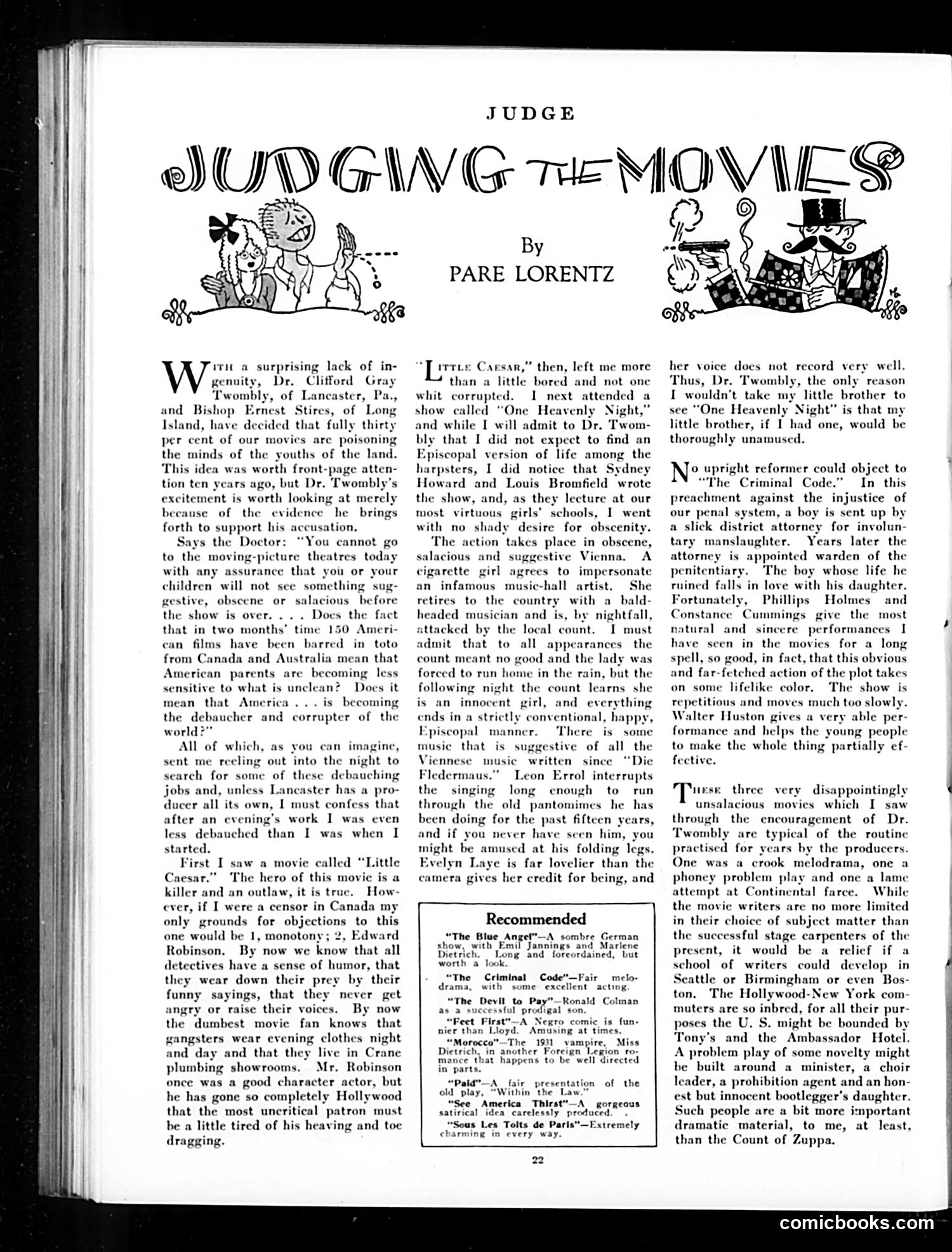
A restored page from Judge, 1931-01-31. Page through the whole issue in the reader above.
📄 Transcribed text from this page (OCR, searchable)
Machine-transcribed from the original scan — historical spelling and the odd misread are preserved.
JUVGIVG TEM iri a surprising lack of in- Wieemits Dr. Clifford G Twombly, of Lancaster, Pa., and Bishop Ernest Stires, of Long Island, have decided that fully thirty per cent of our movies are poisoning the minds of the youths of the land. This idea was worth front-page atten- tion ten years ago, but Dr. Twombly's excitement is worth looking at merely because of the evidence he brings forth to support his accusation. s the Doctor: “You cannot go to the moving-picture theatres today with any assurance that you or your children will not see something ‘sug- gestive, obscene or salacious before the show is over. . . . Does the fact that in two months’ time 150 Ameri- can films have been barred in toto from Canada and Aust mean that American parents are becoming less sensitive to what is unclean? Does it mean that America... is becoming the debaucher and corrupter of the world? All of which, as you can it sent me reeling out into the night to search for some of these debauching jobs and, unless Lancaster ducer all its own, I must confess that after an evening's work I was even less debauched than I was when I started. First I saw a movie called “Little Caesar.” The hero of this movie is a killer and an outlaw, it is true. How- ever, if I were a censor in Canada my only grounds for objections to this one would be 1, monotony; 2, Edward Robinson. By now we know that all detectives have a sense of humor, that they wear down their prey by their funny sayings, that they never get angry or raise their voices. By now the dumbest movie fan knows that gangsters wear evening clothes night and day and that they live in Crane plumbing showrooms. Mr. Robinson once was a good character actor, but he has gone so completely Hollywood that the most uncritical patron must be a little tired of his heaving and toe dragging. JUDGE By PARE LORENTZ Caesar,” then, left me more na little bored and not one whit corrupted. I next attended a show called “One H nly Night,” and while I will admit to Dr. Twom- bly that I did not expect to find an Zpiscopal version of life among the harpsters, I did notice that Sydney Howard and Louis Bromfield wrote the show, and, as they lecture at our most virtuous girls’ schools, I went with no shady desire for obscenity. The action takes place in obscene, acious and suggestive Vienna. A cigarette girl agrees to impersons an infamous music-hall artist. retires to the country with a bald- headed musician and jis, by nightfall, attacked by the local count. I must admit t to all appea s the count meant no good and the lady was forced to run home in the rain, but the following night the count learns she is an innocent girl, and everything ends in a strictly conventional, happy, Episcopal manner. There is some music that is suggestive of all the Viennese music written since “Die Fledermaus.” Leon Errol interrupts the singing long enough to run through the old pantomimes he has been doing for the past fifteen rs, and if you never h », you might be amused at his folding legs. n Laye is far lovelier than the mera gives her credit for being, and > seen Recommended “The Blue Angel”"—A sombre German w, with Emil Jannings and Marlene Dietrich. Long and foreordained, but worth a look. “The Criminal Code"—Fair melo- drama, with some excellent acting. “The Devil to Pay*—Ronald Colman ssful prodigal son. “Feet A Negro comic is fun- nier than Lloyd. Amusing at times. “Morocco"—The 1931 vampire, Miss Dietrich, in another Foreign Legion ro- mance that happens to be well directed in parts. “Paid”—A_ fair presentation of the old play, “Within the Law.” “See America Thirst"—A_ gorgeous satirical idea carelessly produced. “Sous Les Tolts de Paris"—Extremely charming in every way. 22 OVIES her voice docs not record very well. Thus, Dr. Twombly, the only reason I wouldn't take my little brother to see “One Heavenly Ni is that my little brother, if I had one, would be thoroughly unammused. No upright reformer could object to “The Criminal Code.” In this preachment against the injustice of our penal system, a boy is sent up by a slick district attorney for involun- anslaughter. Years later the is appointed warden of the penitentiary. The boy whose life he ruined falls in love with his daughter. Fortunately, Phillips Holmes and Constance Cummings give the most natural and. sincere performances I have scen in the movies for a long spell, so good, in fact, that this obvious and far-fetched action of the plot takes on some lifelike color, The show is repetitious and moves much too slowly. Walter Huston gives a very able per- formance and helps the young people e the whole thing partially ef- three very disappointingly acious movies which I saw through the encouragement of Dr. Twombly are typical of the routine practised for years by the producers. One was a crook melodrama, one phoney problem play and one a lame attempt at Continental farce. While the movie writers are no more limited in their choice of subject matter than the successful stage carpenters of the present, it would be a relief if a school of writers could develop in Seattle or Birmingham or even Bos- ton. The Hollywood-New York com- muters are so inbred, for all their pur- poses the U. S. might be bounded by Tony's and the Ambassador Hotel. A problem play of some novelty might be built around a minister, a choir leader, a prohibition agent and an hon- est but innocent bootlegger’s daughter. Such people are a bit more important dramatic material, to me, at least, than the Count of Zuppa. comicbooks.com