
Judge, 1931-01-17 · page 38 of 48
Judge — January 17, 1931 — page 38: what you’re looking at
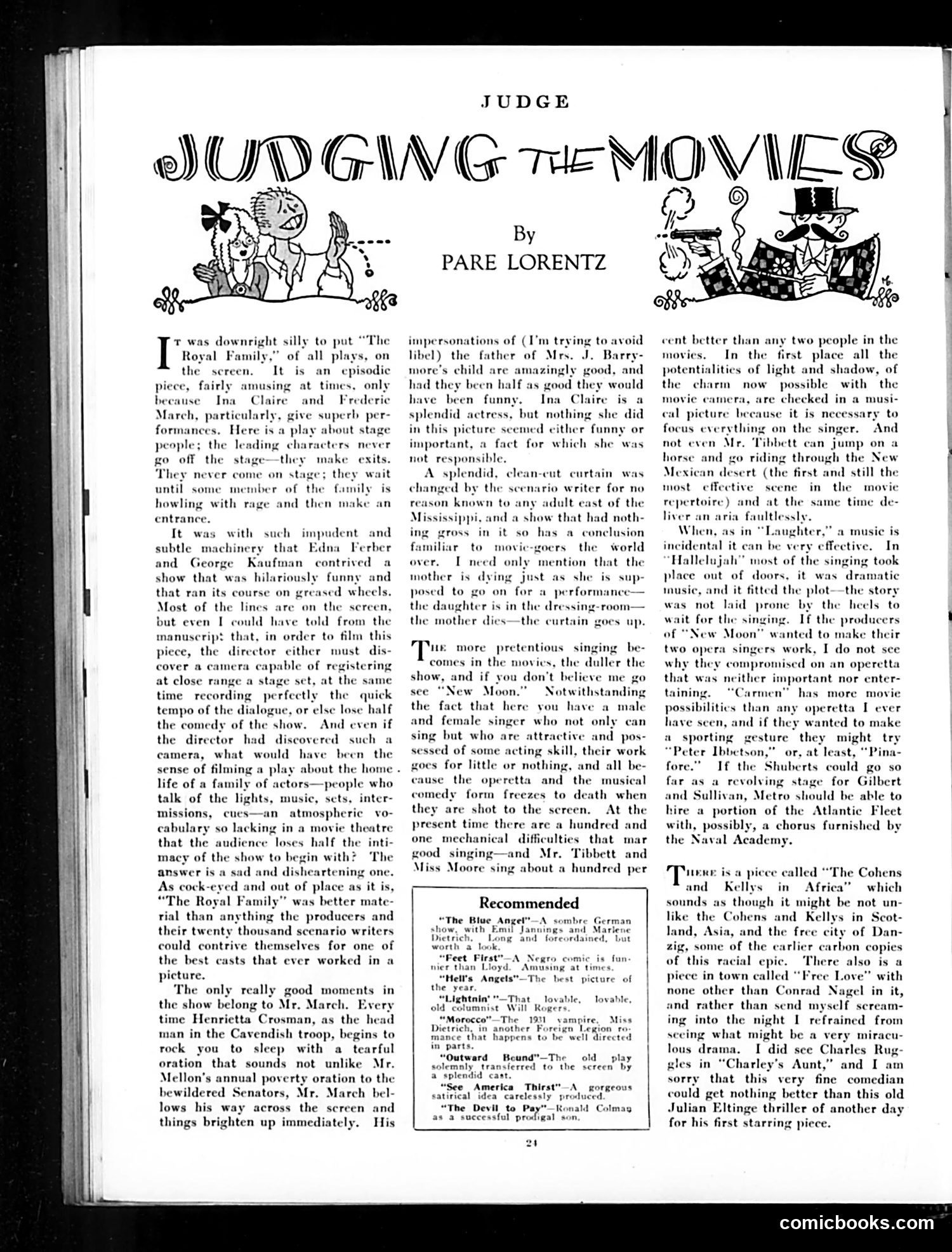
A restored page from Judge, 1931-01-17. Page through the whole issue in the reader above.
📄 Transcribed text from this page (OCR, searchable)
Machine-transcribed from the original scan — historical spelling and the odd misread are preserved.
JUDGE JUVGIVNG TEMOVIES + was downright silly to put “The I Royal Family,” of all plays, on the sereen. It is an cpisodic », fairly amusing at times, only beeause Ina Claire and Frederic March, particularly, give superb per- formances. Here is a pl: people; the le go off the st. They never con until some member of the family is howling with rage and then make an entrance. [t was with such impudent and subtle machinery that Edna Ferber and George Kaufman contrived a show that was hilariously funny and that ran its course on greased wheels. Most of the lines are on the sereen, but even I could have told from the manuscript that, in order to film this piece, the director either must dis- cover a camera capable of registering at close r: a stage set, at the same time recording perfectly the quick tempo of the dialogue, or else lose half the comedy of the show. And even if the director had discovered such a camera, what would have been the sense of filming a } life of a family of actors—people who talk of the lights, music, sets, inter- missions, cues—an atmospheric vo- cabulary so lacking in a movie theatre that the audience loses half th macy of the show to begin with? answer is a sad and disheartening one. As cock-eyed and out of place as it is, “The Royal ’ was better mate- rial than anything the producers and their twenty thousand scenario writers could contrive themselves for one of the best casts that ever worked in a picture, The only really good moments in the show belong to Mr. March. y time Henrietta Crosman, as the head man in the Cavendish troop, begins to rock you to sleep with a tearful oration that sounds not unlike Mr. Mellon's annual poverty oration to the bewildered Senators, Mr. March bel- lows his way across the screen and things brighten up immediately. His pie about sta ding el vters never ke exits. on stage; they wait they om about the home . By PARE LORENTZ impersonations of (I'm trying to avoid libel) the father of Mrs more’s child are ama had they been hal have been funny. Ina splendid actress, but nothing she did in this picture seemed either funny or important, a fact for which she was not responsible. A splendid, clean-eut curtain was changed by the scenario writer for no reason known to any adult east of the Mississippi, and a show that had noth- ing gross in it so has a conclusion familiar to movie-goers the world over. [need only mention that the mother is dying just as she is sup- posed to go on for a performance— the daughter is in the dressin the mother dies is a room— the curtain goes up. Niue more pretentious singing be- comes in the movies, the duller the show 1 if you don't believe me go see ew Moon.” Notwithstanding the fact that here you have a male and female singer who not only can sing but who are attractive and pos- sessed of some acting skill, their work for little or nothing, and all be- use the operetta and the musical nedy form freezes to death when are shot to the screen. At the the one me difficulties that’ mar good sing and Mr. Tibbett and Miss Moore sing about a hundred per Recommended “The Blue Angel”—A sombre ¢ show, with Emil Januings and M Dietrich, Long and. foreordaine worth a look “Feet First” A Negro cv nier than Lloyd. Amusing at times “Hell's Angets"—The best pictur the year “Lightnin’ "That lovable, old columnist Will Rogers Beund”—The old play solemnly transferred to the screen by a splendid cast. “See America Thirst” ical idea carelessly pr “The Devil to Pay"—Konald Colmag as a successful prodigal son gorgeous d ) ie) cent better than any two people in the movies. In the first place all the potentialities of light and shadow, of the charm now possible with the movie came rhecked in a a, are cal picture because : focus everything on the singer. ‘And not even Mr. ‘Tibbett can jump on a horse and go riding through the New Mexican desert (the first and still the most effective seene in the movie repertoire) and at the same time de- liver an aria faultlessly. When, as in “Laughter,” a music is incidental it can be very effective. In Hallelujah” most of the singing took place out of doors, it was dramatic music, and it fitted the plot-—the story was not laid prone by the heels to wait for the singing. If the producers of “New Moon” wanted to make their two opera singers work, I do not see why they compromised on an operetta that was neither important nor enter- “Carmen” has more movie possibilities than any operetta I ever have seen, and if they wanted to make a sporting gesture they might try “Peter Ibbetse or, at least, “Pina- fore.” If the Shuberts could go so far as a revolving stage for Gilbert and Sullivan, Metro should be able to hire a portion of the Atlantic Fleet with, possibly, a chorus furnished by the Naval Academy. iene is a piece called “The Cohens and Kellys in’ Africa’ which sounds as though it might be not un- like the Cohens and Kellys in Scot- land, Asia, and the free city of Dan- zig, some of the carlier carbon copies of this racial epic. There also is a piece in town called “Free Love” with none other than Conrad Nagel in it, and rather than send myself scream- ing into the night I refrained from secing what might be a very miracu- lous drama. I did see Charles Rug- gles arley’s Aunt,” and I am sorry that this very fine comedian could get nothing better than this old Julian Eltinge thriller of another day for his first starring piece. comicbooks.com ] f ,