
Judge, 1930-07-26 · page 26 of 36
Judge — July 26, 1930 — page 26: what you’re looking at
A restored page from Judge, 1930-07-26. Page through the whole issue in the reader above.
📄 Transcribed text from this page (OCR, searchable)
Machine-transcribed from the original scan — historical spelling and the odd misread are preserved.
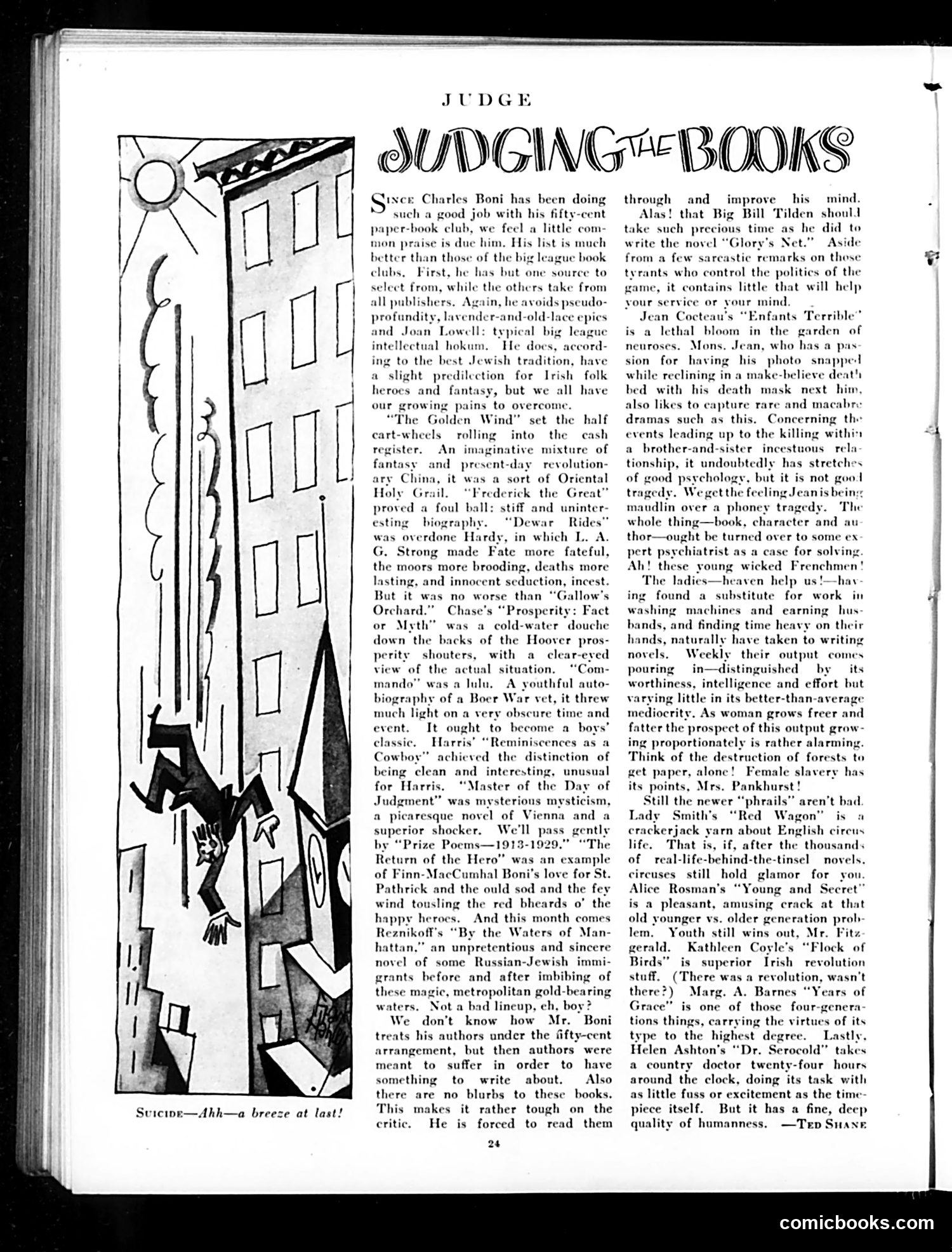
Svicior—Ahh—a breeze at last! JUDGE AUDGING“ BOOKS Gixee Charles Boni has been doing such a good job with his fifty-cent paper-book club, we feel a little com- mon praise is due him, His list is much better than those of the big league book clubs, First, he has but one source to select from, while the others take from all publishers, Again, he avoids pseudo- profundity, lavender-and-old-lace e and Joan Lowell: typical | intellectual hokum. He does, accord- ing to the best Jewish tradition, have a slight predilection for Irish folk heroes and fantasy, but we all have our growing pains to overcome. “The Golden Wind” set the half cart-wheels rolling into. the cash register. An imaginative mixture of fantasy and present-day revolution- ary China, it was a sort of Oriental Holy Grail. “Frederick the Great” proved a foul ball: stiff and uninter- biography. “Dewar Rides” was overdone Hardy, in which L. A. G, Strong made Fate more fateful, the moors more brooding, deaths more lasting, and innocent seducti But it was no worse than Orchard.” Chase's “Prosperity: or Myth” was a cold-water douche down the backs of the Hoover pros- perity shouters, with a clear-eved view of the actual situation, “Com- mando” was a lulu. A youthful auto- biography of a Boer War vet, it threw much light on a very obscure time and event. It ought to become a boy classic. Harris’ “Reminiscences as a Cowboy” achieved the distinction of being clean and interesting, unusual for Harris. “Master of the T Judgment” was mysterious mys' a picaresque novel of Vienna and a superior shocker. We'll pass gently by “Prize Pocms—1913-1929." “The Return of the Hero” was an example of Finn-MacCumhal Boni’s love for St. Pathrick and the ould sod and the fey wind tousling the red bheards o’ the happy heroes. And this month comes Reznikoff's “By the Waters of Man- hattan,” an unpretentious and sincere novel of some Russian-Jewish immi- grants before and after imbibing of these magic, metropolitan gold-bearing vaters. Nota bad lineup, eh, boy We don’t know how Mr. Boni treats his authors under the fifty-cent arrangement, but then authors were meant to suffer in order to have something to write about. Also there are no blurbs to these books. This makes it rather tough on the critic. He is forced to read them 24 estir through and improve his mind. Alas! that Big Bill Tilden should take such precious time as he did to write the novel “Glory's Aside from a few sarcastic remarks on those tyrants who control the politics of the game, it contains little that will help your service or your mind. Jean Cocteau'’s “Enfants Terrible” is a lethal bloom in the garden of Mons. Jean, who has a pas vin; neuroses. sion for hf while reclini bed with his de th mask next him, also likes to capture rare and macabre dramas such as this. Concerning the events leading up to the killing withi a brother-and-sister incestuous rel: tionship, it undoubtedly has strete! of good psychology. but it is not gool tragedy. We get the feeling Jeanis bein maudlin over a phoney tragedy. The whole thing—book, ch ter and au thor—ought be turned over to some ex pert psychiatrist as a case for solvin Ah! these young wicked Frenchm The lIadies—heaven help us!—hay ii found substitute for work in washing machines and earning hus bands, and finding time heavy on thei hands, naturally have taken to writing novels. Weekly their output comes pouring in—distinguished by its worthiness, intelligence and effort but varying little in its better-than-average mediocrity. As woman grows freer and fatter the prospect of this output grow- ing proportionately is rather alarming. Think of the destruction of forests to get paper, alone! Female sla its points, Mrs. Pankhurst ! Still the newer “phrails” aren’t bad. Lady Smith's “Red Wagon" is a crackerjack yarn about English cireus life. That is, if, after the thousands of real-life-behind-the-tinsel novels. circuses still hold glamor for yc Alice Rosman’s “Young and Secret” is a pleasant, amusing crack at that old younger vs. older generation prob lem. Youth still wins out, Mr. Fitz gerald. Kathl Coyle’s “Flock of Birds” is superior Irish revolution stuff. (There was a revolution, wasn't there?) Marg. A. Barnes “Years of Grace” is one of those four-genera- tions things, carrying the virtues of its type to the highest degree. Lastly, Helen Ashton’s “Dr. Serocold” takes a country doctor twenty-four hours around the clock, doing its task with as little fuss or excitement as the time piece itself. But it has a fine, deep quality of humanness. —Tepv Suanr ery has e comicbooks.com