
Judge, 1930-07-26 · page 25 of 36
Judge — July 26, 1930 — page 25: what you’re looking at
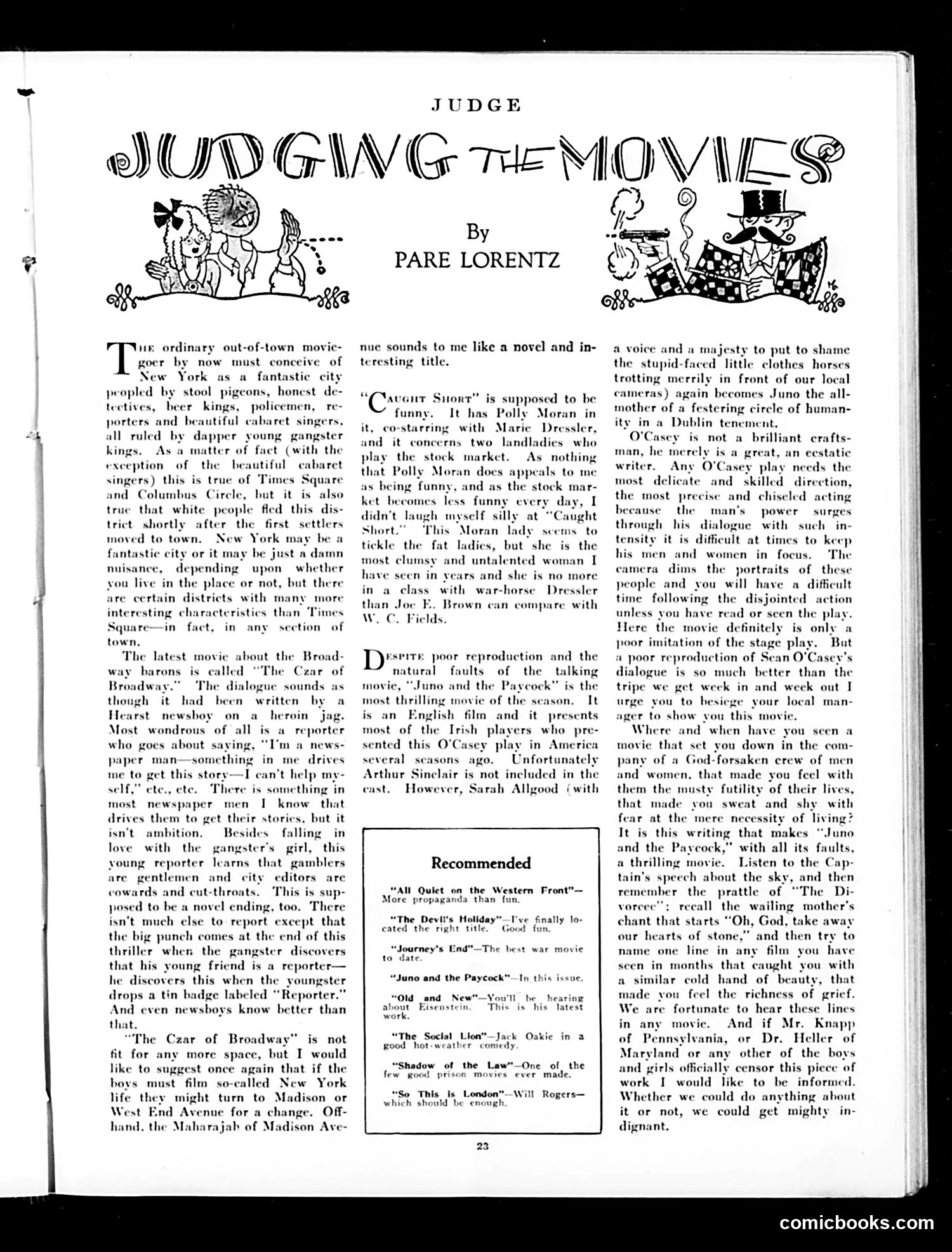
A restored page from Judge, 1930-07-26. Page through the whole issue in the reader above.
📄 Transcribed text from this page (OCR, searchable)
Machine-transcribed from the original scan — historical spelling and the odd misread are preserved.
a a SS eee OA tk ordinary out-of-town movie- "Tee by now must conceive of New York as a tie city peopled by stool pigeons, honest de- tectives, beer kings, policemen, re- porters and beautiful cabaret singers, all ruled by dapper young gangster kings. As a matter of fact (with the exception of the utiful cabaret singers) this is true of Times Square and Columbus Circle, but it is also true that white people fled this dis- trict shortly after the first settlers moved to t New York may be a fantastic city or it may be just a damn nuisance, depending upon whether you live in the place or not, but there are certain districts with many mor interesting characteristics than Times Square—in fact, in any section of town. The latest movie about the Broad- way barons is called “The Czar of Broadway.” The dialogue sounds as though it had been written. by a Hearst newsboy on a heroin j Most wondrous of all is a reporter who goes about . “Tm a news- i in me drives y—T can't help my- . ete. There is something in most newspaper men I know tha drives them to get their stories, but it isn't. ambition. Besides falling in love with the gangster’s girl, this young reporter learns that gamblers ind city editors are cowards and cut-throats. This is sup- posed to be a novel ending, too. There isn’t much else to report except that the big punch comes at the end of this thriller when the g ter discovers that his young friend is a reporter— he discovers this when the youngster drops a tin badge labeled Reporter.” And even newsboys know better than that. “The Czar of Broa fit for any more space, but I would like to suggest once again that if the boys must film so-called New York life they might turn to Madison or West End Avenue for a change. Off- hand. the Maharajah of Madison Ave- are gentlemen is not JUDGE By PARE LORENTZ nue sounds to me like a novel and in- teresting title. “Cavan Snore” is supposed to be funny. It has Polly Moran in it, co-starring with Marie Dressler, and it concerns two landladies who play the stock market. As nothing that Polly Moran does appeals to me as being funny, and as the stock mar- ket nes less funny eve sl didn't laugh myself silly at “Caught Short.” ‘This Moran lady seems. to tickle the fat ladies, but she is the most clumsy and untalented woman I have seen in years and she is no more in class with war-horse than Joe E. Brown W. C. Fields. Dressler un compare with D"= poor reproduction and the natural faults of the talking movie, “Juno and the Paycock” is the most thrilling movie of the season. It is an English film and it presents most of the Irish players who. pre- sented this O'Casey play in America several seasons ago. Unfortunately Arthur Sinclair is not included in the cast. However, Sarah Allgood (with Recommended “AM Quiet on the Western Front"— More propaganda than fun “The Devil's Molida: "ve finally lo- cated the right title. Good fur. “Journey's End"—The best war movie to date. “Juno and the Paycock"—In thi “Old and New"—You' Eisenstein, “The Social Lion*—Jack Oakie in a good hot-weather coniedy “Shadow of the Law"—One of the few good prison movies ever made. “So This is London”—Will Rogers— which should be enough GIWG TEM ov" Ls a voice and a majesty to put to shame the stupid-faced little clothes horses trotting merrily in front of our local cameras) again becomes Juno the all- mother of a festering circle of human- ity in a Dublin tenement. O'Casey is not abril crafts- man, he merely is a great, an ecstatic writer. Any O'C most delicate play needs the skilled direction, the most precise and chiseled acting because the man's power surges through his dialogue with such in- tensity it is difficult at times to keep his men and women in focus. The camera dims the portraits of these people and you will have a difficult time following the disjointed action unless you have read or seen the play. Here the movie definitely is only ‘a poor imitation of the st y. But 4 poor reproduction of logue is so much better than the tripe we get week in and week out I urge you to besiege your loc 1 man- ager to show you this movie. Where and when have you seen a movie that set you down in the com- pany of a God-forsaken crew of men and women, that made you feel with them the musty futility of their that made you sweat and. shy fear at the mere necessity of living? It is this writing that makes “Juno and the Paycock,” with all its faults, a thrilling movie. Listen to the Cap- tain’s speech about the sky, and then remember the prattle of “The Di- vorcee"’; recall the wailing mother’s chant that starts “Oh, God, take away our hearts of stone,” and then try to name one line in any film you have scen in months that caught you with a similar cold hand of beauty, that made you feel the richness of grief. e are fortunate to hear these lines in any mo And if Mr. Knap; or Dr. Heller of ; y other of the boys and girls officially censor this piece of work I would like to be informed. Whether we could do anything about it or not, we could get mighty in- dignant. comicbooks.com