
Judge, 1929-07-13 · page 11 of 36
Judge — July 13, 1929 — page 11: what you’re looking at
What you’re looking at
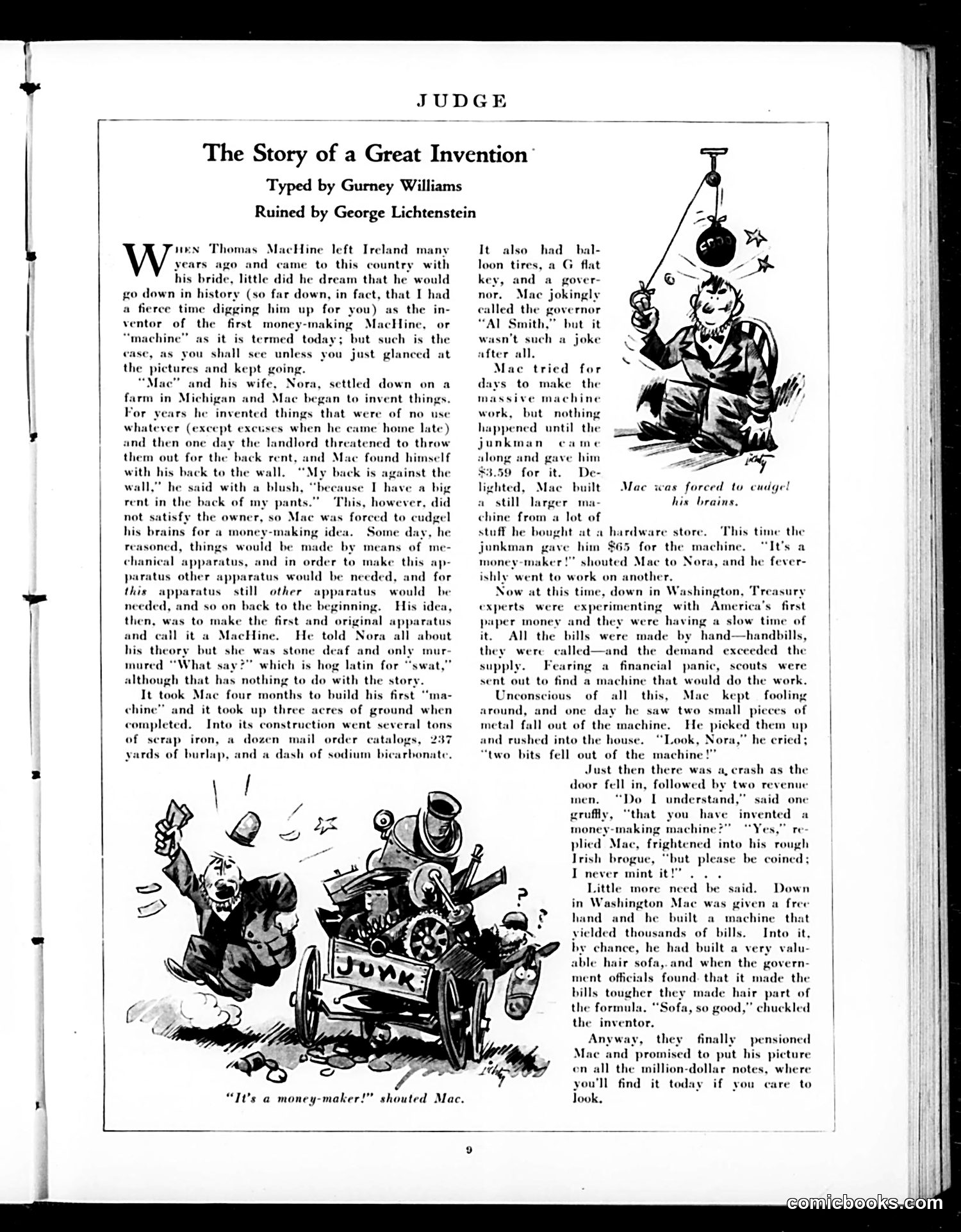
This is a satirical story illustrated with cartoons, lampooning both incompetent inventors and government bureaucracy. The protagonist, Thomas MacHine, an Irish immigrant, builds a useless four-month contraption he names the "MacHine." Through accident rather than design, it produces metal pieces he mistakes for currency. The satire targets multiple subjects: MacHine's bumbling incompetence; a reference to "Al Smith" (likely Governor Al Smith of New York, a contemporary political figure); and the Treasury Department's desperation during America's early paper money experiments. The revenue agents' arrival and MacHine's panicked Irish brogue ("I never mint it!") provide comedic relief. The punchline ridicules government credibility—they accept MacHine's nonsensical invention, reward him with a portrait on million-dollar bills, and somehow a hair sofa accidentally included in the machine supposedly improves bill durability. The entire narrative mocks both inventor-culture enthusiasm and governmental competence.
📄 Transcribed text from this page (OCR, searchable)
Machine-transcribed from the original scan — historical spelling and the odd misread are preserved.
JUDGE The Story of a Great Invention’ Typed by Gurney Williams Ruined by George Lichtenstein neN Thomas MacHine left Ireland many W: nd came to this country with his bride, little did he dream that he would go down in history (so far down, in fact, that I had a fierce time digging him up for you) as the i ventor of the first’ money-making MacH achine” as it is termed today; but such is the as you shall see unless you just glanced at pictures and kept goin; “M and his wife, No , settled down on a farm in Michigan and Mac began to invent things. For years he invented things that were of no use whatever (except excuses when he came home late) ned to throw and then one day the landlord thre: them out for the back rent, 2 Mae found himself with his h to the wall. back is against the wall,” he d with a blush, use T have a big rent in the back of my pants.” This, however, did not satisfy the owner, so Mac was forced to cudgel money-making idea. Some day, he -d, things would be made by means of 1 and in order to make this ap- aratus would be needed, and for still other apparatus would be needed, and so on back to the beginning. His i then, was to make the first and original apparatus and call it a MacHine. He told Nora all about his theory but she was stone deaf and only mur mured “What say?" which is hog latin for * although that has nothing to do with the stor It took Mac four months to build his first * ne" and it took up three acres of ground when npleted. Into its construction went several tons of scrap iron, yards of burlap, M this apparatus ” “It's @ money-maker! shouted Mac. It also had hal- loon tires, a G flat key, and a gover- nor. Mac jokingly called the governor “AL Smith,” but it wasn’t such a joke after all. Mac tried for to make the massive machine work, but nothing happened until the junk along and gave 59 for it. De- shted, Mac built still larger) ma- chine from a lot of stuff he bought t hardware store. junkman gave for the r money-maker!" shouted Mac to > ishly went to work on another. Now at this time, down in Washington, Treasury experts were experimenting with America’s first paper money and they were having a slow time of it. All the bills were made by hand—handbills, they were Med—and the demand exceeded the supply. Fearing a financial panic, scouts were sent out to find a machine that would do the work. Unconscious of all this, Mac kept fooling around, and one day he saw two small pieces of metal fall out of the machine. He picked them up and rushed into the house. “Look he cried; “two bits fell out of the machin Just then there was a, crash as the door fell in, followed by two revenue n came him Mac was forced to cudgel his brains. This time the chi “It's a a, and he fever- men. “Do L understand,” said one groffy, “that you have invented a money-tnaking machine?” “Yes,” re- plied’ Mac, frightened into his rough Irish brogue, “but please be coined; I never mint it!" 2. . Little more need be said. Down in Washington Mac was given a free hand and he built’ a machine that yielded thousands of bills. Into it, by chance, he had built a very valu- able hair sofa,.and when the govern- ment officials found. that it made the bills toughe the formu’ the inventor. nyway, they und promised to put his picture finally pensioned y on all the million-dollar notes, where you'll find it today if you care to look.