
Judge, 1929-07-06 · page 21 of 36
Judge — July 6, 1929 — page 21: what you’re looking at
What you’re looking at
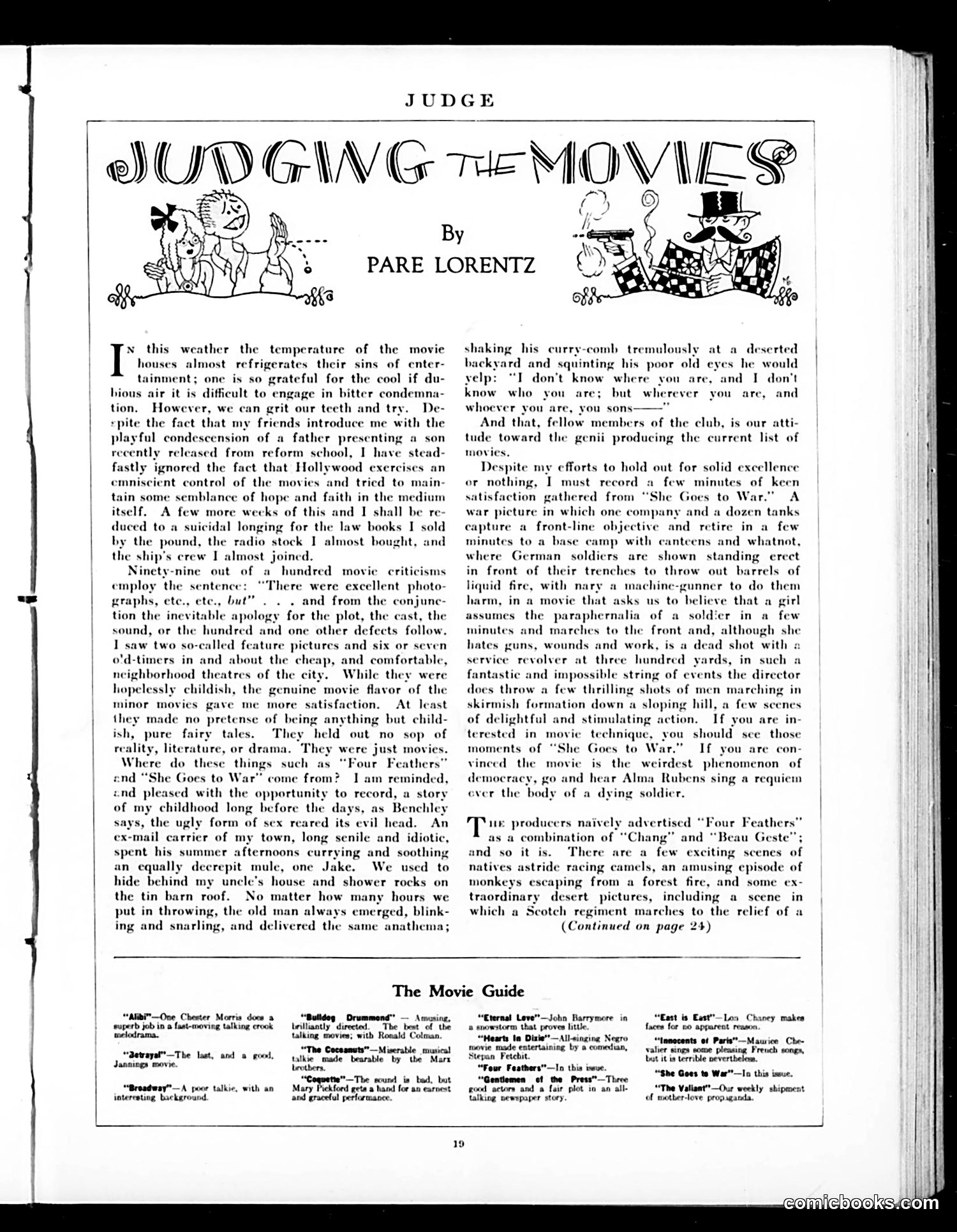
This is a film criticism essay by Pare Lorentz published in *Judge* magazine. Rather than a political cartoon, it's satire delivered through written commentary on 1920s Hollywood movies. Lorentz adopts a persona of mock-curmudgeonly superiority, claiming to evaluate films with "unmiscent control" while admitting he's surrendered to entertainment's mediocrity. He critiques contemporary war pictures like "She Goes to War" and "Four Feathers" for their absurd depictions—soldiers standing upright in trenches, women soldiers becoming sharpshooters in minutes despite hating violence. The satire targets both Hollywood's nonsensical storytelling and audiences' willingness to accept propaganda disguised as entertainment. His complaint that 99 of 100 film reviews contain "there were excellent photographs, etc., etc., but" mocks critics' inability to acknowledge a movie's complete failure. The humor relies on exaggerated complaint and the contrast between his pretended sophistication and his actual grudging enjoyment of pure escapism.
📄 Transcribed text from this page (OCR, searchable)
Machine-transcribed from the original scan — historical spelling and the odd misread are preserved.
JUDGE JLUDGIWG HMOVIES EN N this weather the temperature of the movie I houses almost refrigerates their sins of enter- tainment; one is so grateful for the cool if du- hious air it is difficult to engage in bitter condemna- tion. However, we can grit our teeth and try. De- rpite the fact that my friends introduce me with the playful condescension of a father presenting a son shaking his curry-comb tremulously at a deserted backyard and squinting his poor old eyes he would yelp: “I don't know where you are, and I don't know who you are; but wherever you are, and whoever you are, you sons: ‘ And that, fellow members of the club, is our atti- tude toward the genii producing the current list of recently released from reform school, I ha movies, fastly ignored the fact that Hollywood exercises an Despite my efforts to hold out for solid excellence pniscient control of the movies and tried to main- or nothing, I must record a few minutes of keen tain some semblance of hope and faith in the medium itself. A few more weeks of this and I shall be re- duced to a suicidal longing for the law books I sold by the pound, the radio stock I almost bought, and the ship's crew I almost joined. Ninety-nine out of hundred movie criticisms employ the sentence: “There were excellent: photo- graphs, ete., ete., but” . . . and from the conjune- tion the inevitable apology for the plot, the cast, the sound, or the hundred and one other defects follow. I saw two so-called feature pictures and s o'd-timers in and about the che: neighborhood theatres of the city. While they were hopelessly childish, the genuine movie flavor of the minor movies gave me more satisfaction. At least they made no pretense of being anything but child- ish, pure fairy tales. They held out no sop of reality, literature, or drama. They were just movies. Where do these things such as “Four Feathers” and “She Goes to War" come from? I am reminded, ed with the opportunity to record, a story y childhood long before the days, as Benchley the ugly form of sex reared its evil head. An ex-mail carrier of my town, long senile and i spent his summer afternoons currying and soothing an equally decrepit mule, one Jake. We used to hide behind my uncle’s house and shower rocks on the tin barn roof. No matter how many hours we put in throwing, the old man always emerged, blink- ing and snarling, and delivered the same anathema; xX or seven », and comfortable, satisfaction gathered from “She Goes to War.” A war picture in which one company and a dc capture a front-line minutes to a b objective and retire in a few amp with canteens and whatnot, where German. soldiers are shown standing erect in front of their trenches to throw out barrels of liquid fire, with nary a machine-gunner to do them harm, in a movie that asks us to believe that a girl assumes the paraphernalia of a soldier in a few minutes and marches to the front and, althou hates guns, wounds and work, is a dead shot with service revolver at three hundred yards, in such a fantastic and impossible string of events the director does throw a few thrilling shots of men marching in skirmish formation down a sloping hill, a fe of delightful imulating action. If you are in terested in technique, you should sce those moments of » Goes to War." If you are con- vinced the movie is the weirdest phenomenon of democracy, go and hear Alma Rubens sing a requiem ever the body of a dying soldier. y sce Ti producers naively advertised “Four Feathers" as a combination of “Chang” and “Beau Geste” ; and so it is. There are a few exciting scenes of ives astride ng camels, an amusing episode of monkeys escaping from a forest fire, and some ex- traordinary desert pictures, including a scene in which a Scotch regiment marches to the relief of a (Continued on page 24) The Movie Guide “Alibi"—One Chester Morris doce a : Drummond” — Armusing, superb job in a fast-moving talking crook melodrama. Uwilliantly directed. The best of the talking movies; with Ronald Colman. “The Coceamuts”—Miserable musical talkie made bearable by the Mart Levthers, “Coquette” —The sound is bed, but Mary Pickford gets a hand for an earnest and graceful perfarmance. “Detrayal”—The last, and a good, Jannings movie. A poor talkie, with an interesting background. “Eternal Leve’"—John Barrymore in yestorm that proves little “Hearts tn Diste’”—All-singing Negro movie made entertaining by a comedian, Stepan Fetehit. “Four Feathers”—In this isve. “Gentlemen ef the Prets”—Three good actory and a fair plot in an all- talking vewspaper story. “East is East”—Lon Chaney makes faces for no apparent reason. “tanecents of Paris”—Maurice Che- valier sings some pleasing French songs, but it is terrible pevertbelews. “She Goes to War—In this inmue. “The Valiant” —Our weekly shipment of wether-love propaganda.