
Judge, 1929-06-22 · page 25 of 40
Judge — June 22, 1929 — page 25: what you’re looking at
What you’re looking at
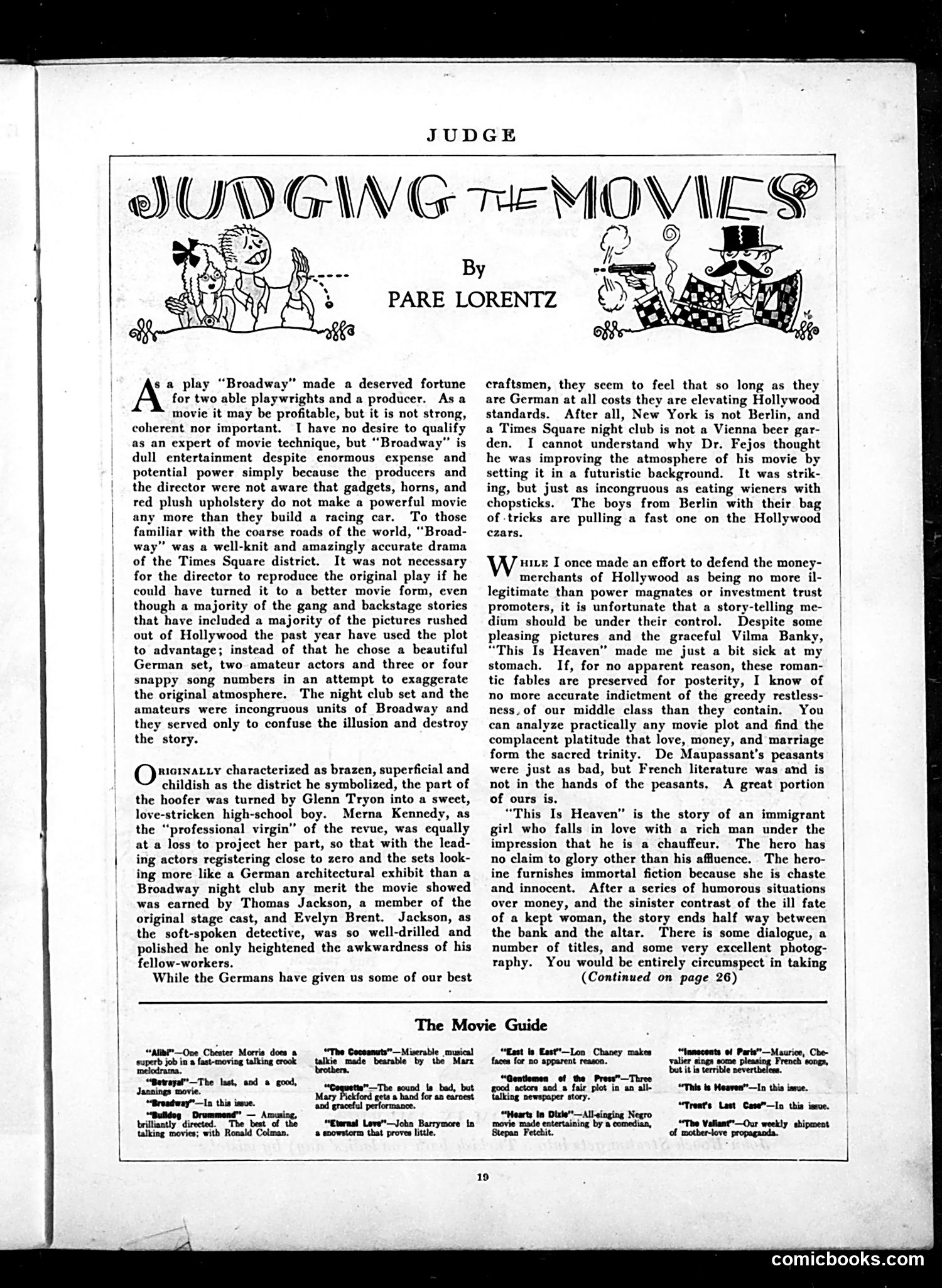
This page features a critical essay on 1920s cinema by Pare Lorentz. He reviews recent Hollywood films—notably "Broadway" (adapted from a stage play) and "This Is Heaven"—arguing that expensive production values and exotic sets don't compensate for weak storytelling. Lorentz criticizes German directors and set designers working in Hollywood, suggesting they prioritize visual spectacle over narrative coherence. He uses a sharp metaphor: "eating wieners with chopsticks"—culturally incongruous choices that undermine authenticity. He particularly targets "money-merchants" controlling Hollywood's narrative output, lamenting that romantic formulas ("love, money, and marriage") dominate because studios profit from mass-appeal sentimentality. The subtext reflects 1920s anxieties about European influence in American entertainment and concerns that commercial interests corrupt artistic integrity.
📄 Transcribed text from this page (OCR, searchable)
Machine-transcribed from the original scan — historical spelling and the odd misread are preserved.
JUDGE Te JUVGIWG re MOVIES | sa play “Broadway” made a deserved fortune A for two able playwrights and a producer. As a movie it may be profitable, but it is not strong, coherent nor important. I have no desire to qualify as an expert of movie technique, but “Broadway” is dull entertainment despite enormous expense and potential power simply because the producers and the director were not aware that gadgets, horns, and red plush upholstery do not make a powerful movie any more than they build a racing car. To those familiar with the coarse roads of the world, ‘‘Broad- way” was a well-knit and amazingly accurate drama of the Times Square district. It was not necessary for the director to reproduce the original play if he could have turned it to a better movie form, even though a majority of the gang and backstage stories that have included a majority of the pictures rushed out of Hollywood the past year have used the plot to advantage; instead of that he chose a beautiful German set, two amateur actors and three or four snappy song numbers in an attempt to exaggerate the original atmosphere. The night club set and the amateurs were incongruous units of Broadway and they served only to confuse the illusion and destroy the story. Quester characterized as brazen, superficial and childish as the district he symbolized, the part of the hoofer was turned by Glenn Tryon into a sweet, love-stricken high-school boy. Merna Kennedy, as the “professional virgin” of the revue, was equally at a loss to project her part, so that with the lead- ing actors registering close to zero and the sets look- ing more like a German architectural exhibit than a Broadway night club any merit the movie showed was earned by Thomas Jackson, a member of the original stage cast, and Evelyn Brent. Jackson, as the soft-spoken detective, was so well-drilled and polished he only heightened the awkwardness of his fellow-workers. While the Germans have given us some of our best craftsmen, they seem to feel that so long as they are German at all costs they are elevating Hollywood standards. After all, New York is not Berlin, and a Times Square night club is not a Vienna beer gar- den. I cannot understand why Dr. Fejos thought he was improving the atmosphere of his movie by setting it in a futuristic background. It was strik- ing, but just as incongruous as eating wieners with chopsticks. The boys from Berlin with their bag of tricks are pulling a fast one on the Hollywood czars. nite I once made an effort to defend the money- merchants of Hollywood as being no more il- legitimate than power magnates or investment trust promoters, it is unfortunate that a story-telling me- dium should be under their control. Despite some pleasing pictures and the graceful Vilma Banky, “This Is Heaven” made me just a bit sick at my stomach. If, for no apparent reason, these roman- tic fables are preserved for posterity, I know of no more accurate indictment of the greedy restless- ness, of our middle class than they contain. You can analyze practically any movie plot and find the complacent platitude that love, money, and marriage form the sacred trinity. De Maupassant’s peasants were just as bad, but French literature was and is not in the hands of the peasants, A great portion of ours is. “This Is Heaven” is the story of an immigrant girl who falls in love with a rich man under the impression that he is a chauffeur. The hero has no claim to glory other than his affluence. The hero- ine furnishes immortal fiction because she is chaste and innocent. After a series of humorous situations over money, and the sinister contrast of the ill fate of a kept woman, the story ends half way between the bank and the altar. There is some dialogue, a number of titles, and some very excellent photog- raphy. You would be entirely circumspect in taking (Continued on page 26) The Movie Guide euperb job in a fast-moving talking “Bavraya”—The last, and s good, rues /"—The sound ts bad, but Jenainas eoey'e! hs Mary Peckford grt hand for an earcest “Breatway"—In this ime. and graceful performance. teilliantly directed. "The best of the talking movies; with Ronald Colman, “The Coccanuts”—Miserable musical talkie made bearable by the Marx brothers. “Eternal Love"—Joha Barrymore in ‘8 snowstorm that proves little. rood and a fair plot in an all- actors s in an talking “East ls East’—Lon Chaney makes “tnmecents of Paris”—Maurice, Che- faces for no apparent reason. ing French valier songs, bovis terrible» of the Press” —" “This ts Heaven”—In this inve. “Trent's Last Case”—In this issue. “The Valiant” —Our ir 4 weekly shipment newspaper story. comicbooks.com