
Judge, 1929-05-11 · page 18 of 36
Judge — May 11, 1929 — page 18: what you’re looking at
What you’re looking at
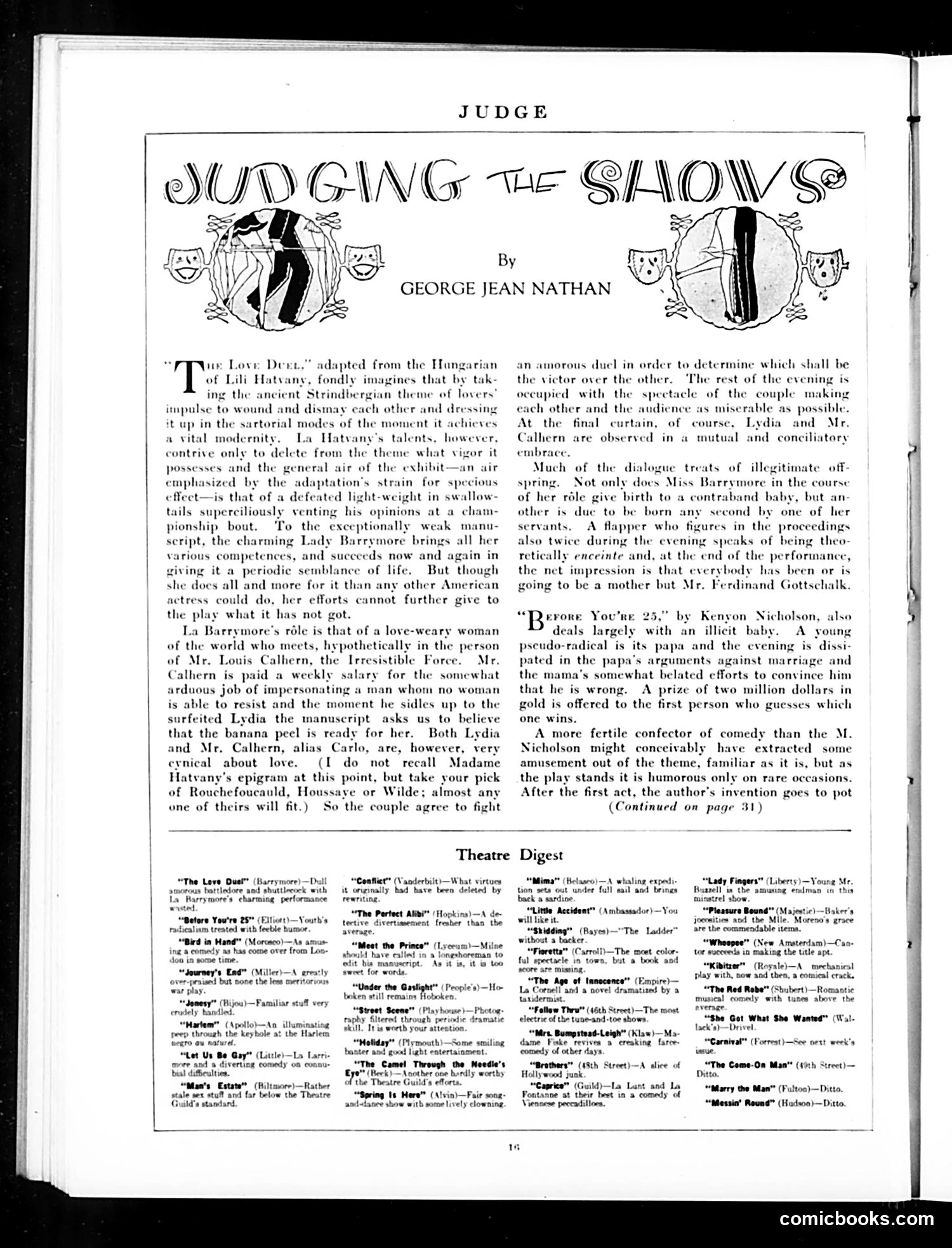
This page contains theater reviews by critic George Jean Nathan. The main review discusses "The Love Duel," a Hungarian-themed play adapted by Lili Hatvany, starring actress La Barrymore opposite actor Louis Calhern. Nathan criticizes the play as tedious despite Barrymore's skilled performance. The plot involves two world-weary lovers engaging in an "amorous duel" to determine who can resist the other—essentially a cynical romantic contest. Nathan finds the theme tired and notes the play's preoccupation with illegitimate children is handled poorly. A secondary review covers "Before You're 25" by Kenyon Nicholson, another play centered on an illicit baby, which Nathan finds similarly uninspired, describing it as humorous only occasionally. The "Theatre Digest" section at bottom provides brief capsule reviews of other Broadway productions, using rating-style descriptions of their merits or faults.
📄 Transcribed text from this page (OCR, searchable)
Machine-transcribed from the original scan — historical spelling and the odd misread are preserved.
JUDGE \ adapted from the Har fondly imagines that ian theme of lovers’ ve ne Love Dee | f Lili Hatvany ing the ancient Strindber; impulse to wound and dismay each other and dressing it up in the sartorial modes of the moment it achieves a vital modernity, La Hatvany’s talents, however, contrive only to delete from the theme what vigor it f the exhibit yoair emphasized by the adaptation’s strain for specious effect—is that of a defeated light-weight in swallow- tails superciliously venting his oy cham- pionship bout. the excepti ak manu- possesses and the general air script, the charming Lady Barrymore brings all her ceeds now and again in giving it a periodic semblance of life. But though ve all and more for it than any other American actress could do, her efforts cannot further give to the play what it has not got. various competences, and suc she ¢ La Barrymore's réle is that of a love-weary woman of the world who meets, hypothetically in the person of Mr. Louis Calhern, the Irresistible Fore Mr. Calhern is paid a weekly salary for the somewhat arduous job of impersonating a man whom no woman is able to resist and the moment he sidles up to the surfeited Lydia the manuscript asks us to believe that the banana peel is ready for her. Both Lydia and Mr. Calhern, alias Carlo, are, however, very cynical about love. (I do not recall Madame Hatvany’s epigram at this point, but take your pick of Rouchefoucauld, Houssaye or Wilde; almost any one of theirs will fit.) So the couple agree to fight By GEORGE JEAN NATHAN NG te SHOW an amorous duel in order to determine which shall be the victor over the other. The rest of the evening is occupied with the spectacle of the couple making ch other and the audience as miserable as possible. At the final curtain, of course, Lydia and Mr. Calhern are observed in a mutual and conciliatory embrace. Much of the dislogue treats of illegitimate off spring. Not only docs Miss Barrymore of her réle give birth to a contraband b: other is due to be born any second by one of her apy redings also twice during the evening speaks of being theo- rd, at the end of the performance, the net impression is that everybody has been or is going to be a mother but Mr. Ferdinand Gottschalk. “Byerone You're 25," by Kenyon Nicholson, also deals largely with an illicit baby. A young pseudo-radical is its papa and the evening is dissi pated in the papa’s arguments 4 ge and the mama’s somewhat belated efforts to convince him that he is wrong. A prize of two million dollars in gold is offered to the first person who guesses which one wins. A more fertile confector of comedy than the M. Nicholson might conceivably have extracted some amusement out of the theme, familiar as it is, but as the play stands it is humorous only on rare occasions. After the first act, the author's invention goes to pot (Continued on page 31) in the course oy, but an servants. A r who figures in the prov retically enceinte Theatre “Conflict” (Vanderbilt)—What virtues it orginally had have been deleted by " “The Love Ouel”™ (Harrymore)—Dull amorous battledore and shuttinevek with La Barrym 's charming performance rew wrted “The Pertect Alibi” (Hopkins) —A de- “Betore You're 25" (Elliott)—Voutb’s — tertive divertimement freaber than the radicalinm treated with feeble humor pel “Bird in Hand (Morcaco)—As ama ssagegt the Prince” (I 1 a comedy as has come over from Loo- yy mint grants, tn come time. edit bis manuscript. As it “Journey's End” (Miller)—A greatly sweet for words. over-praised but none the less meritorious poe “Under the Gasti phantom ii uth boken still remainy Hoboken Jesesy” (Bijou) —Familiar y handled. seat Seane” (Play honse)— 7 ting (APA filtered through pervodie dramatic Harfem’” (Apotlo)—An illuminating FRA? ssigered Shroush per muah the keybole at the Harlem Ero ow naturel. “Holiday” (Pymouth)—Some smiling “Let Us Be Gay” (Little) —La Larri- ¢ ant goad light entertainment. “The Camel Through the Needle’s eee and a diverting comedy oa connu- bal difdeulties. Eye" (Berk)—Another ane hordly worthy ne Theatre 's efforts. “Ban's Estate” (Biltmore) —Rather stale sex stull and far below the Theat “Spring Is Here” (Alvin)—Fair song- d's standard Digest “tima”™ (Belasro)—A whaling expedi- thon sets out under full sail and beings back a sardine. minstrel show. “Little Accident” (Ambassador)—You _ “Pleasure Bound" (Majestic) —aker's will Like it. jocesities and the Mile. Moreno’s grace “$hidding”” (Bayes)—"The Ladder” fe the commendable items. without s backer “whoopee” (New Amsterdam)—Can- “Fieretta” (Carroll)—The meet color. tor succeeds in mal the title apt. ful eoetarle s9 town, bat a book and {miiaer™ (Meme) A eh “The Age of ti (Empire) — PRAY With, cow and then, a comical ¢ La Cornell and a novel dramatized by a taxidermist. law Thru” (46th Street) —The most electric of the tune-and-toe shows. Mrs. Bumpstead-Leigh” (Klax)—Ma- dame Fiske revives a creaking farce: “Carnival” (Forrest)—See next week's comedy of other days. insue. “Brothers” (48th Street) —A slice of “The Come-On Man’ (42h Street)— Hollywood jusk Ditto, “Caprice” (Guild)—La Lunt and La “Barry the Man” (Fultos)—Ditto. Fontanne at their beet in a comedy of Viennese peecadillons. “Messin? Revad” (Hodsoo)—Ditto. “Lady Fingers” (Liber Buazell is the amung “She Get What She Wanted” (Wa!- lack’s)—Drivel oe comicbooks.com