
Judge, 1929-05-11 · page 15 of 36
Judge — May 11, 1929 — page 15: what you’re looking at
What you’re looking at
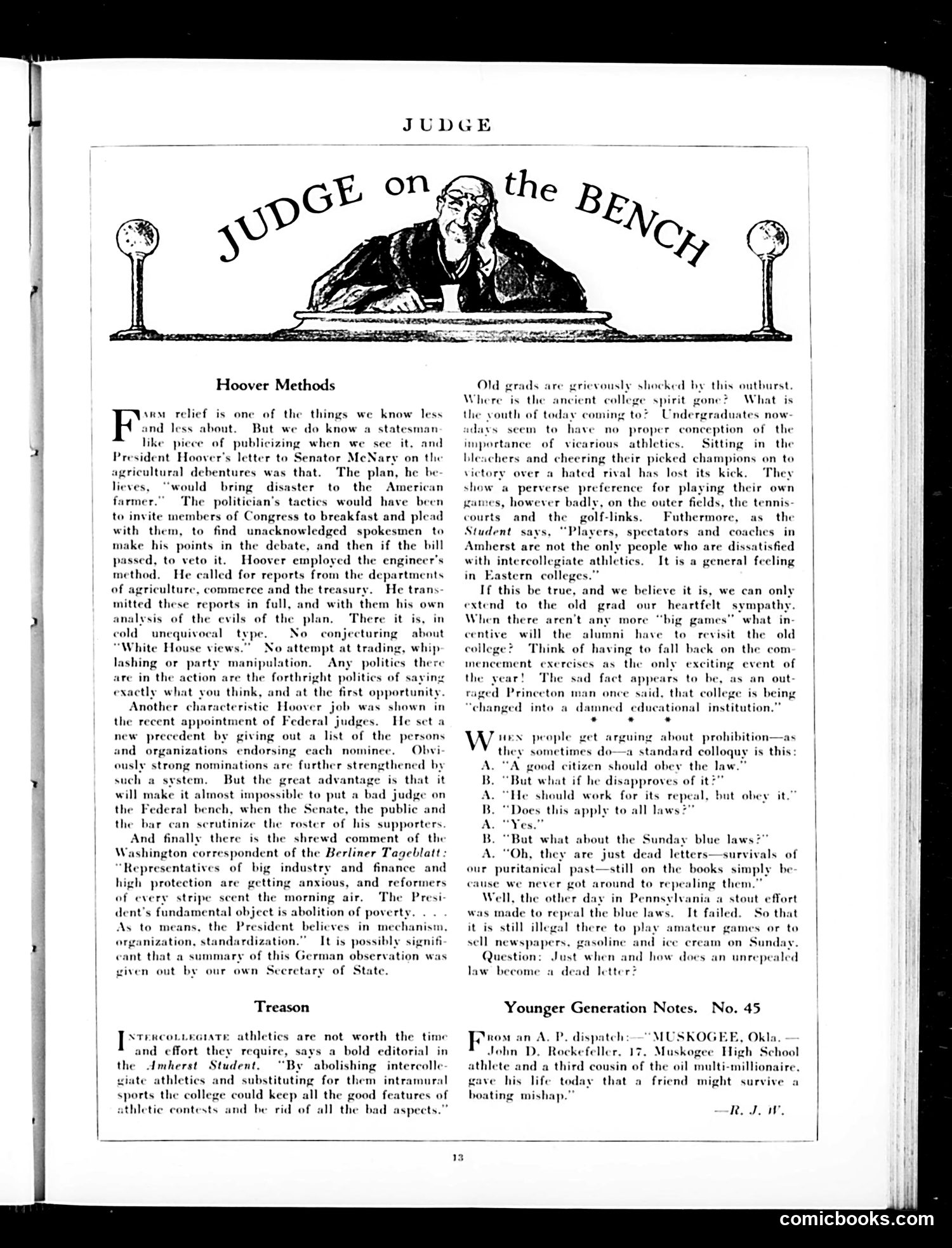
**"Hoover Methods"** praises President Herbert Hoover's administrative approach to farm relief policy. The article contrasts Hoover's transparent, data-driven method—publishing departmental reports and his analysis openly—with typical politician tactics of backroom dealing and manipulation. It particularly applauds his appointment of federal judges, noting he publicly lists endorsing organizations, making Senate scrutiny easier and preventing "bad judges" on the bench. The piece frames Hoover as an engineer-administrator who believes in "mechanism, organization, standardization" to abolish poverty, citing approval from a German newspaper correspondent. **"Treason"** mocks collegiate athletics' decline. An Amherst Student editorial advocates replacing intercollegiate sports with intramural ones. The satirist notes alumni are "grievously shocked," lamenting lost school spirit and the demise of "big games"—once alumni's reason to revisit campus. The piece ironically suggests colleges risk becoming merely "damned educational institutions" without competitive athletics. Both pieces employ satirical commentary on contemporary 1920s-era debates about government efficiency and university culture.
📄 Transcribed text from this page (OCR, searchable)
Machine-transcribed from the original scan — historical spelling and the odd misread are preserved.
Hoover Methods srm_ relief is one of the things we know less Fes less about. But we do know a statesn like piece of publicizing when we see it. and President Hoover's letter to Senator MeNary agricultural debentures was that. The plan, he be lieves, “would bring disaster to the American farmer.” The politician's tactics would have been to invite members of Congress to breakfast and plead with them, to find unacknowledged spokesmen to make his points in the debate, and then if the bill passed, to veto it. Hoover employed the engineer's method. He called for reports from the departments of agriculture, commerce and the treasury. He trans- mitted these reports in full, and with them his own Ivsis of the evils of the plan, There it is, in sd) unequivocal ty No conjecturing about White House views.” attempt at trading, whip lashing or party manipulation. Any polities there are in the action are the forthright politics of saying exactly what you think, and at the first opportunity. Another characteristic Hoover job was shown in the recent appointment of Federal judges. He set a new precedent by giving out a list of the persons and organizations endorsing cach nominee. Obvi ously strong nominations are further strengthened by such a system. But the great advantage is that it will make it almost impossible to put a bad judge on the Federal bench, when the Senate, the public and the bar ¢ serutinize the roster of his supporters. And finally there is the shrewd comment of the shington correspondent of the Berliner Tageblatt: “Representatives of big industry and finance and high protection are getting anxious, and reformers of every stripe scent the morning air. The Presi dent's fundamental object is abolition of poverty. . . As to means, the President believes in mechanism, organization, standardization.” It is possibly signifi cant that a summary of this German observation was given out by our own Sceretary of S yon the Treason [ste oLLeGiate athletics are not worth the time and effort they require, says a bold editorial in the Amherst Student. “By abolishing intercolle siate athletics and substituting for them intramural Sports the college could keep all the good features of athletic contests and be rid of all the bad aspects JUDGE ked by this outburst. Old grads are grievously sho Where is the ancient college spirit gone? What is to? Undergraduates now ve no proper conception of the | tting in the bleachers and cheering their picked champions on to victory over a hated rival has lost its kick. They show “a perverse preference for playing their own games, however badly, on the outer fields, the tennis- | the youth of today comin seem to | nee of vicarious athletics. courts and the golf-links. | Futhermore, the Student says, “Players, spectators and coaches in Amherst are not the only people who are dissatisfied with intercollegiate athletics. It is a general feeling in Eastern colleges. If this be true, and we believe it is, we can only extend to the old grad our heartfelt) sympathy. When there aren't any more “big games” what in- centive will the alumni have to revisit’ the old coll Think of having to fall back on the com- | mencement exercises as the only exciting event of the year! The sad fact appears to. be ed Princeton man once said. that colle anged into a ¢ as an out is being mned educational institution, . . * W HeN people get arguing about prohibition—as they sometimes do—a standard colloquy is this: A. “A good citizen should obey the B. “But what if he disapproves of i A. “He should work for its repeal, but obey it.” B. “Does this apply to all laws A. “Yes B. “But what about the Sunda A. “Oh, they are just dead letters—survivals of our puritanical past—still on the books simply be- | cause we never got around to repealing them.” Well, the other day in Pennsylvania a stout effort was made to repeal the blue laws. It failed. that it is still illegal there to play amateur games or to sell newspapers. gasoline and ice cream on Sunday. in unrepealed Question: Just when and how does law become a dead letter? Younger Generation Notes. No. 45 Fries an A. 2. dispateh: LE a. John D. Rockefeller. 1 High School athlete and a third cousin of the oil multi-millionaire, gave his life today that a friend might survive a boating mishap.” R.IW. comicbooks.com