
Judge, 1929-04-27 · page 15 of 36
Judge — April 27, 1929 — page 15: what you’re looking at
What you’re looking at
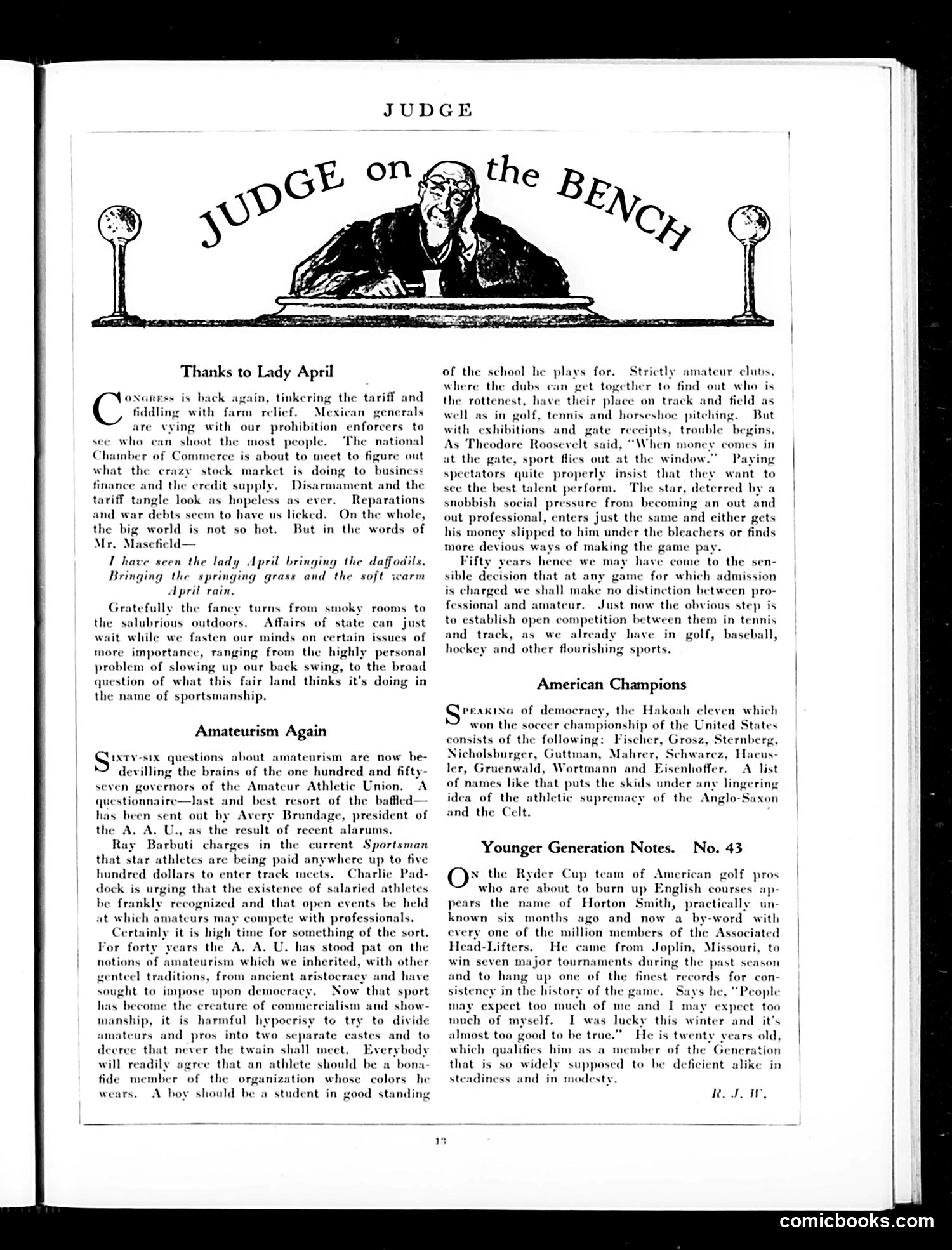
This page from Judge magazine (appears to be 1920s-era) contains three separate commentary pieces on American sports and politics: **"Thanks to Lady April"** opens with satirical jabs at current crises—tariff disputes, Mexican violence, prohibition enforcement failures, stock market chaos—before pivoting to spring sports as welcome relief. **"Amateurism Again"** addresses a genuine controversy: the Amateur Athletic Union's hypocrisy in enforcing amateur-only rules while star athletes like Ray Barbuti and Charlie Paddock openly receive payment. The author argues that with gate receipts and spectator demands, pretending sports remain amateur is absurd. Theodore Roosevelt is quoted approvingly: "When money comes in at the gate, sport flies out at the window." **"American Champions"** notes the Hakoah eleven (a Jewish soccer team from Palestine) won the U.S. championship, listing players with predominantly Jewish surnames. The satirical point—unstated but clear—challenges claims of "Anglo-Saxon athletic supremacy." The cartoon's scowling judge oversees these critiques of American hypocrisy and pretense.
📄 Transcribed text from this page (OCR, searchable)
Machine-transcribed from the original scan — historical spelling and the odd misread are preserved.
JUDGE Thanks to Lady April oxonress is back again, tinkering the tariff and C fiddling with farm relief. Mexican generals are vying with our prohibition enforcers to - who can shoot the most people. ‘The national mber of Commerce is about to meet to figure out crazy stock market is doing to. business nee and the credit supply. Disarmament and the tariff tangle look as hopeless as ever. Reparations and war debts seem to have us licked. On the whole, the big world is not so hot. But in the words of Mr. Masefield— T have seen the lady April bringing the daffodils. Bringing the springing grass and the soft warm April rain, Gratefully the fancy turns from smoky rooms to the salubrious outdoors. Affairs of state can just wait while we fasten our minds on certain issues of more importance, ranging from the highly personal problem of slowing up our back swing, to the broad question of what this fair land thinks it’s doing in the name of sportsmanship. Amateurism Again XTY-six questions about amateurism are now be- devilling the brains of the one hundred and fifty- seven governors of the Amateur Athletic Union. A questionnaire—last and best resort of the bafled— has been sent out by Avery Brundage, president of the A. A. U., as the result of recent al: Ray Barbuti charges in the that star athletes are being paid hundred di ums, ‘portsman nywhere up to five rs to enter track meets. Charlie Pad- dock is u that the exist of salaried athletes be frankly recognized and t open events be held at which amatcurs may compete with professionals. Certainly it is high time for something of the sort. For forty years the A, A. U. stood pat on the notions of amateurism which w herited, with other genteel traditions, from ancient aristoc nd have sought to impose upon democr: Now that sport has become the creature of commercialism and show- manship, it is harmful hypocrisy to try to divide amateurs and pros into two separate c: decree that never the twain shall meet. will readily agree that an fide member of the organi wears. A boy should be current tes and to very body thlete should be ation whose colors he student in good standing bon: of the school he plays for. Strictly amateur clubs. where the dubs can get together to find out who is the rottenest, have their place on track and field as well as in golf, tennis and horseshoe pitching. But with exhibitions and gate receipts, trouble begins. As Theodore Roosevelt said, “When money comes in at the gate, sport flies out at the window.” spectators quite properly insist that they want. to sce the best talent perform, The star, deterred b snobbish social pressure from becon out professional, enters just the same and either gets his money slipped to him under the bleachers or finds more devious ways of making the game pay. Fifty years hence we may have come to the sen- sible decision that at any game for which admission is charged we shall make no distinction between pro- fessional and amateur. Just now the obvious step is to establish open competition between them in tennis and track, as we already have in golf, baseball, hockey and other flourishing sports. American Champions S akine of democracy, the Hakoah eleven which won the soccer championship of the United States consists of the following: Fischer, Grosz, Sternberg, Nicholsburger, Guttman, Mahrer, Schwarez, Hacus- ler, Gruenwald, Wortmann and Eisenhoffer. A list of names like that puts the skids under any ling idea of the athletic supremacy of the Anglo- and the Celt. Younger Generation Notes. No. 43 the Ryder Cup team of American golf pros who are about to burn up English courses : pears the name of Horton Smith, practically un- known six months ago and now a by-word’ with every one of the million members of the Associated ad-Lifters. He came from Joplin, Missouri, to en major tournaments during the past season nd to hang up one of the finest records for con- sistency in the history of the game. Says he, “Peopk may expect too much of me and I may expect too much of myself. I was lucky this winter and it’s almost too good to be true.” He is twen rs old, which qualifies him as a member of the Gene that is so widely supposed to be de steadiness and in modesty. ent alike in RoW, comicbooks.com