
Judge, 1929-04-20 · page 20 of 36
Judge — April 20, 1929 — page 20: what you’re looking at
What you’re looking at
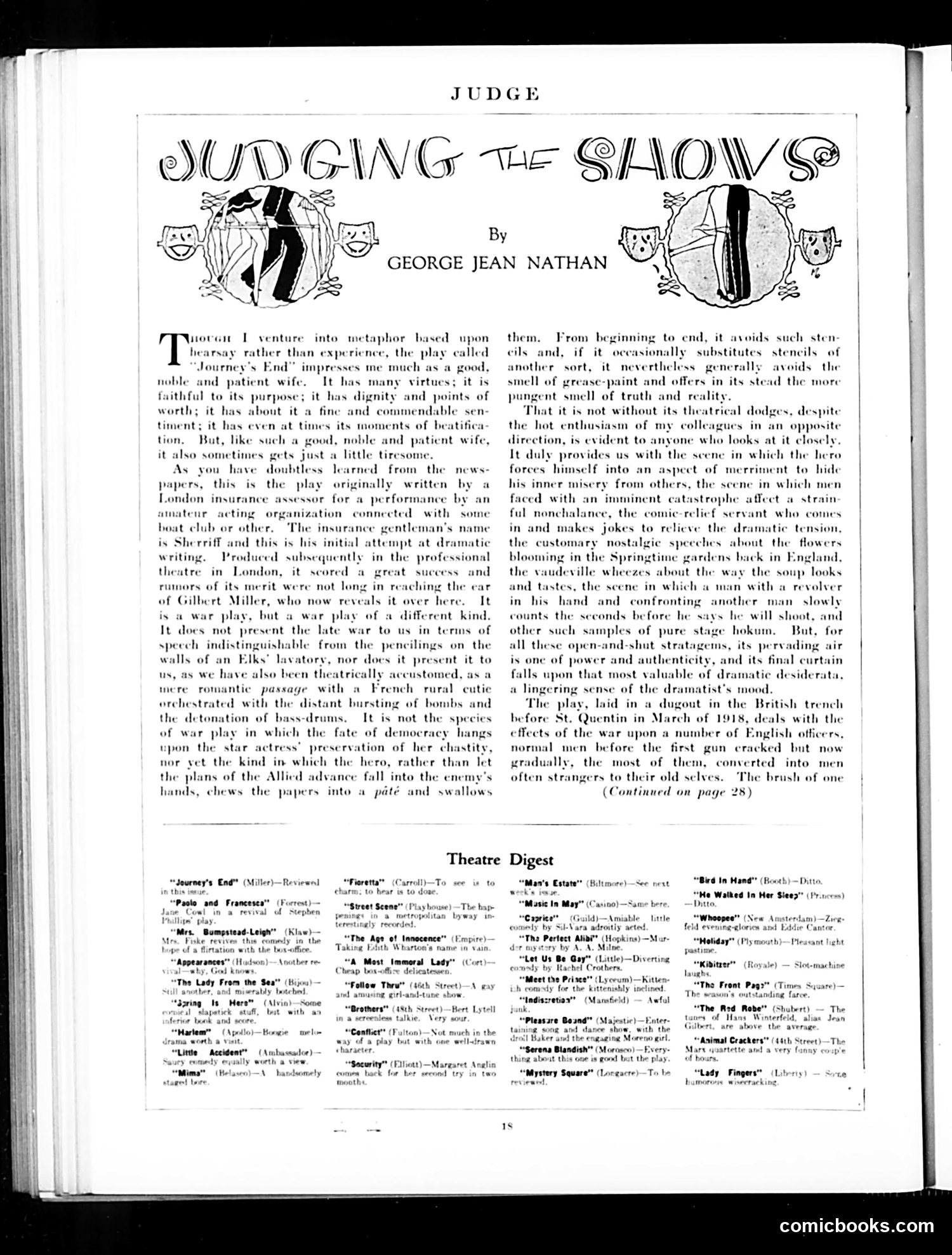
This is a theater review column, not a political cartoon. George Jean Nathan critiques the play *Journey's End*, a WWI drama written by R.C. Sherriff about British officers in a trench before the St. Quentin offensive in March 1918. Nathan praises the play's authenticity and emotional power while gently mocking its use of theatrical clichés—nostalgic speeches about English gardens, comic relief servants, the scene where a soldier counts seconds before shooting. He compares the play to "a good, noble and patient wife"—virtuous but sometimes tedious. The review celebrates that *Journey's End* avoids the overwrought melodrama typical of WWI plays: it doesn't rely on actresses' virtue plots, exaggerated sound effects, or crude soldier dialogue. Instead, it captures how men facing catastrophe mask despair with false cheerfulness—depicting genuine human psychology rather than stage hokum. The page also lists other current Broadway productions briefly reviewed.
📄 Transcribed text from this page (OCR, searchable)
Machine-transcribed from the original scan — historical spelling and the odd misread are preserved.
JUDGE woven T venture into metaphor based upon | hearsay rather than experience, the play called Journey's End” impresses me much as a good, noble and patient wife. It has many virtues; it is faithful to its purpose; it has dignity and points of worth; it has about it a fine and commendable sen timent; it has even at times its moments of beatifiea tion, But, like such a good, noble and patient wife, it also sometimes gets just a little tiresome. As you hi © doubtless learned from = the news- papers, this is the play originally written by a London insurance assessor for a performance by an tenr acting organi at club or other. ‘T ition connected with sor © insurance gentleman's name is Sherriff and this is his initial attempt at dramatic writing, Produced subsequently in the professional theatre in London, it scored a great success and rumors of its merit were not long in reaching the ear of Gilbert Miller, who now reveals it over here. It is a war play, but a war play of a different: kind. It does not present the late war to us in terms of speech indistinguishable from the pencilings on the walls of an Elks’ lavatory, nor docs it present it to us, as we hav also been theatrically accustomed, as a ntic passage with a French rural cutie 1 with the distant burst of bombs and the detonation of bass-drums. It is not the species of war play in which the fate of democracy ha upon the star actress’ preservation of her chastity, nor yet the kind in which the hero, rather than let the plans of the Allied advance fall into the enemy's hands, chews the papers into a paté mere rol orchestrat nd swallows “The Age of Innocence” (Empire) “Ah Mest tm “Appearances” (I. Another re y. Gad Cheap bas-< “The Lady From the Sea” (Hijou)— —Fatlow Thru” hoagie daring, te Hara” (Alvin) Some a ie Howie ole “Conflict (F Not much i way fa play bi » (Ambassador) — worth a view By Hyy\ 2 \)} SS ; W) GEORGE JEAN NATHAN them. From beginning to end, it avoids such sten cils and, if it) occasional substitutes stencils of another sort, it’ nevertheless rally avoids the smell of grease-paint and offers in its stead the more pungent smell of truth and re es, despite the hot enthusiasm of my collea an opposite direction, is evid At to anyone who looks at it closely. It duly provides us with the scene in which the hero forces himself into an aspect of merriment to hide his inner misery from others, the scene in which men faced with an imminent catastrophe affect a strain ful nonchalanee, the comic-relief servant who co! in and makes j s to relieve the dramatic tension, the customary nostalgic speeches about the flowers blooming in the Springtime gardens back in England, the vaudeville wheezes about the way the soup looks and tastes, the scene in which « man with a revolver in his hand and confronting another man slowly counts the seconds before he says he will shoot, and other such samples of pure stage hokum. But, for all these open-and-shut stratagems, its per mg air is one of power and authenticity, and its final curtain falls upon that most valuable of dramatic desiderata, sense of the dramatist’s mood. , put in the British trench - Quentin in March of 1918, deals with the effects of the war upon a number of English officers, normal men before the first: gun cracked but now gradually, the most of them, converted into: men often strangers to their old selves. The brush of (Continued on page 28) “Bird In Hand” (Booeh) ~Ditto. more)—See next ‘Music In May” (Casino) —Same bere 4)—Amiable little “whoopee” (New Av feld evening-ale m)—Zier- Tha Pertect Alibi” (1 mystory by AL AL Mu (Litthe)—Diverting “Holiday” (Plymouth) —Pieseant light ibitrer” (i laughs “The Front Pago” (T The « witstanding far Slot-machine sing song and dance show. with the | Baker and the engaging Moreno girl “Serena Blandish” (Moroso) —F thing about this ove is gond but the play “Mystery Square” (Lorgacte)—To be simat Crackers" (44th Street) —The comicbooks.com