
Judge, 1929-04-20 · page 15 of 36
Judge — April 20, 1929 — page 15: what you’re looking at
What you’re looking at
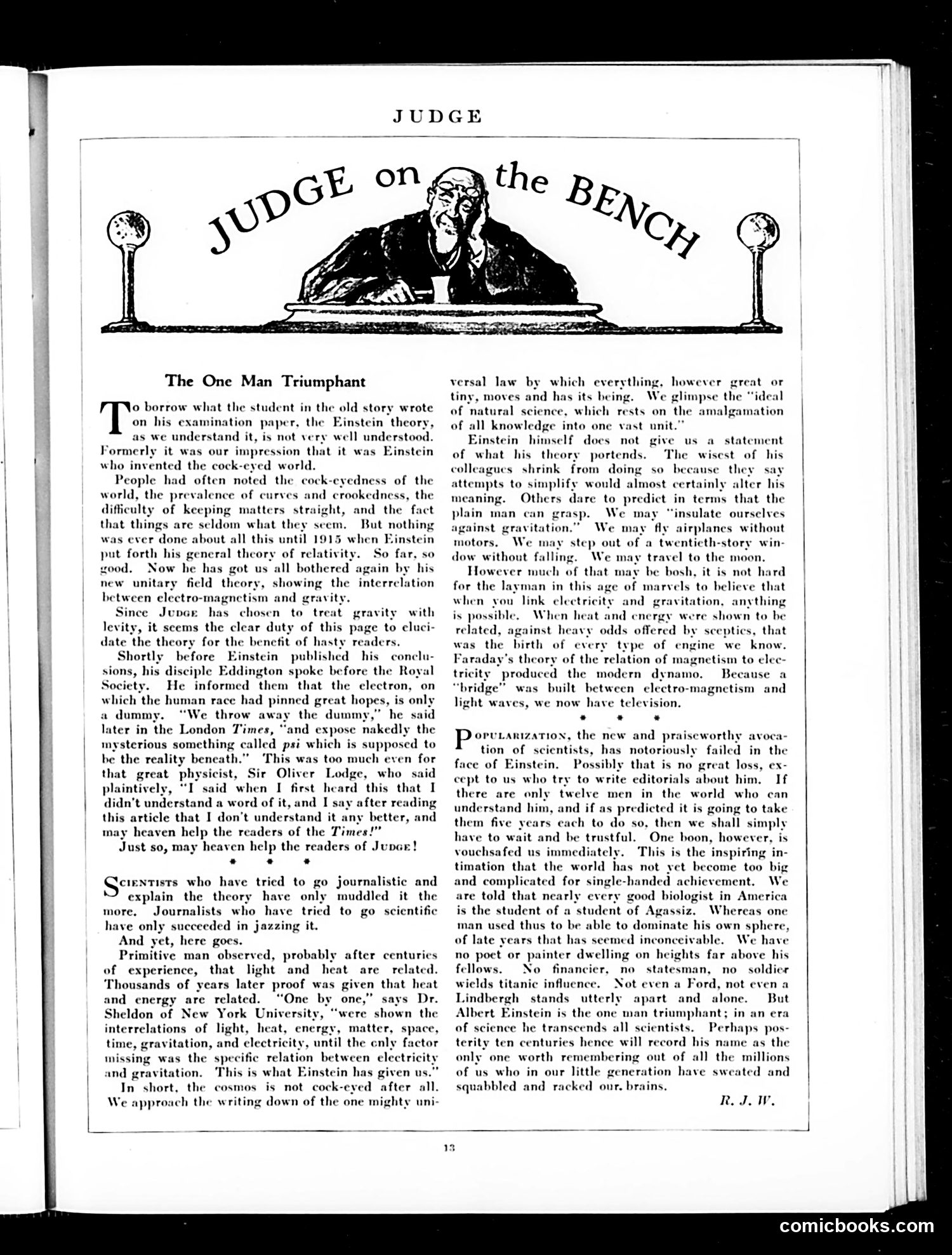
This article, titled "The One Man Triumphant," satirizes public confusion over Einstein's theories of relativity and his newer unitary field theory. The cartoon's judge represents rational skepticism facing incomprehensible scientific claims. The satire targets both Einstein's complexity and the pretense of journalists attempting to explain it. The writer quotes physicist Sir Oliver Lodge admitting he understands nothing, then asks heaven to help *Judge* magazine's readers—a self-deprecating joke suggesting the publication itself cannot adequately explain the theory. The piece mocks breathless popularization: predictions about motorless airplanes, stepping from twentieth-story windows safely, and moon travel are presented as either "bosh" or at least unverifiable. The final section notes that even "popularization" (explaining science to laypeople) has "notoriously failed" with Einstein—acknowledging the futility of the very article being read. The underlying joke: Einstein has become so influential that admitting incomprehension is universal and acceptable.
📄 Transcribed text from this page (OCR, searchable)
Machine-transcribed from the original scan — historical spelling and the odd misread are preserved.
The One Man Triumphant o borrow what the student in the on his examination paper, the as we understand it, »Id story wrote Einstein theory, ot very well understood. Formerly it was our impression that it was Einstein who invented the cock-eyed world. People had often noted the cock-eyedness of the world, the prevalence of curves and crookedness, the difficulty of keeping matters str: » and the fact that things are seldom what the. y seem, But nothing was ever done about all this until 1915 when Einstein put forth his general theory of relativity. good. Now he has got us all bothered again by his new unitary field theory, showing the interrelation between electro-magnetism and gravity. Since Jupar has chosen to treat gravity with levity, it seems the clear duty of this page to cluci- date the theory for the bencfit of hasty readers. Short before Einstein published his conclu- sions, his disciple Eddington spoke before the Royal Society. He informed them that the electron, on which the human race had pinned great hopes, is only a dummy. “We throw away the dummy,” he said later in the London Times, “and expose nakedly the mysterious something called psi which is supposed to be the reality beneath.” This was too much even for that great physicist, Sir Oliver Lodge, who said plaintively, “I said when I first heard this that I didn’t understand a word of it, and I say after reading this article that I don’t understand it any better, and may heaven help the readers of the Time: Just so, may heaven help the readers of June * . * So far, so cientists who have tried to go journalis' explain the theory have only muddled it the more, Journalists who have tried to go scientific have only succeeded in jazzing it. And yet, here goes. Primitive man observed, probably after centuries of experience, that light and heat are related. Thousands of years later proof was given that hi and energy are related. “One by one,” says Dr. Sheldon of New York U i “were shown the terrelations of light, heat, energy, matter, spac nd electricity, until the cnly specific relation between electricit This is what is not cock-e) writing down of the one missing was the and gravitation. In short, the We approach the cosmos versal law by which everythin tiny, moves and has its being. We glimpse the of natural science, which rests on the amalgamation of all knowledge into one vast unit.” Einstein himself does not give us a statement of what his theory portends. The wisest of his colleagues shrink from doing so be they say attempts to simplify would almost certainly alter his meaning. Others dare to predict in terms that the plain man can grasp. We may “insulate ourselves against gravitation.” We may fly airplanes without motors. We may step out of a twenticth-story win- dow without falling We may travel to the moon. However much of that may be bosh, it is noth Be for the layman in this age of marvels to believe th: when you link electricity and gravi is possible, When heat and related, inst he; vas the birth of y's theor: however gr ause tion, hea rgy were shown to be that know. vy odds offered by sceptics, every type of engine we of the relation of magnetism to elec- produced the modern dynamo. Because a was built between electro-magnetism and “bridge light waves, we now have television. . * * P LARIZATION, the new and prai . tion of scientists, has notoriously failed in. the face of Einstein. Possibly that is no great loss, ex- cept to us who try to write editorials about him. If there are only twelve men in the world who can understand him, and if as predicted it is going to take them five years cach to do so, then we shall simply have to wait and be trustful. One boon, however, is vouchsafed us immediately. This is the inspiring in- timation that the world has not yet become too big and complicated for single-handed achievement. We are told that nearly ¢ good biologist in America is the student of a student of Agassiz. Whereas one man used thus to be able to dominate his own sphere, of late years that has seemed inconceivable. We have no poct or painter dwelling on heights far above his fellows. No financier, no statesman, no_ soldier wields t ot even ¢ rd, not even a Lindbergh st utterly apart and alone. But Albert Einstein is the one man triumphant; in an era nce he transcends all scientists. Perhaps pos- terity ten centuries hence will record his name as the only one worth remembering out of all the of us who in our little generation have swez squabbled and racked our. brains. millions ted and RILW. comicbooks.com