
Judge, 1929-01-05 · page 15 of 36
Judge — January 5, 1929 — page 15: what you’re looking at
What you’re looking at
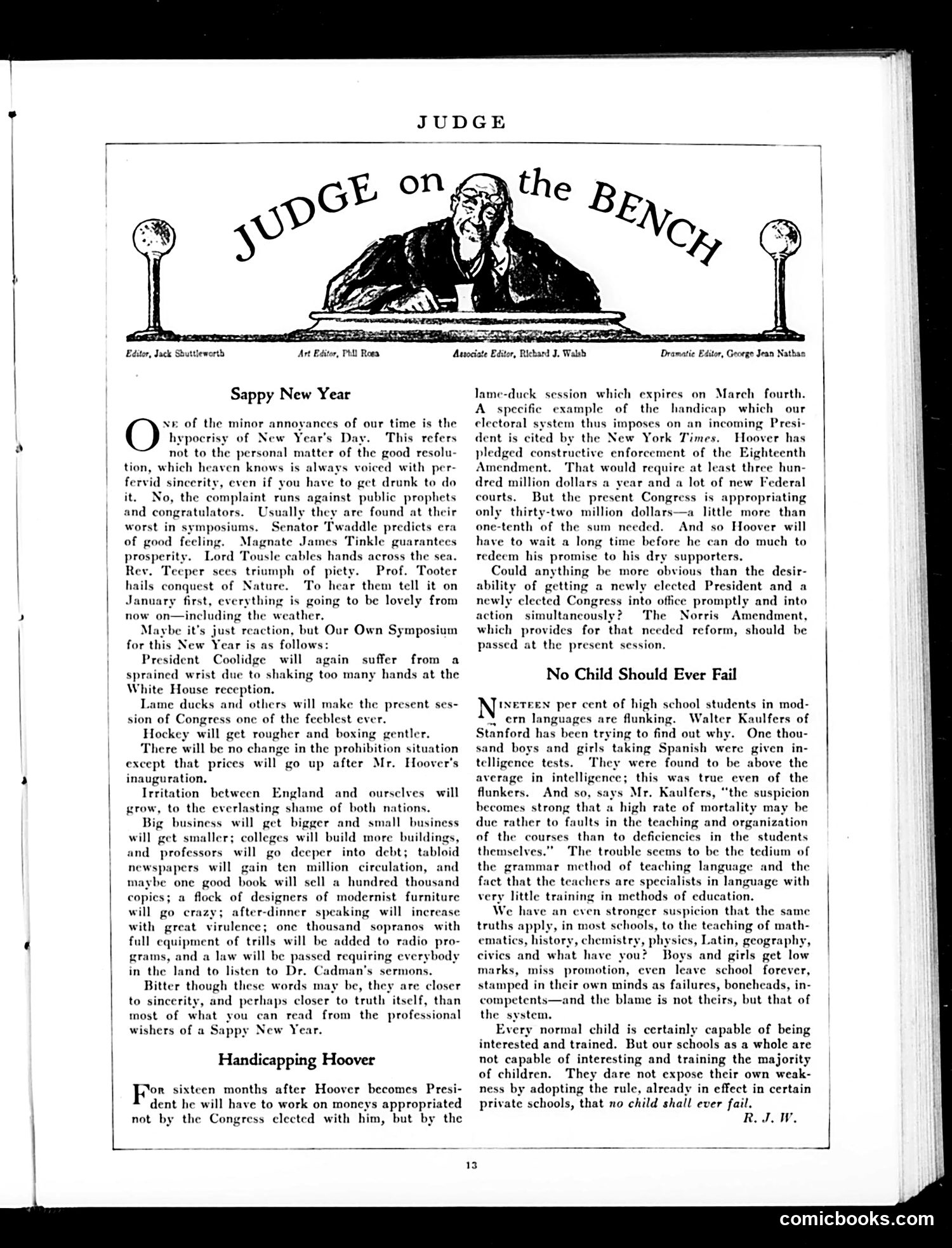
This page from Judge magazine (likely early 1929, given Hoover references) contains three satirical commentary pieces: **"Sappy New Year"** mocks the hypocrisy of New Year's predictions by public figures like politicians and business leaders who make grand promises. Rather than offering optimistic platitudes, Judge's "symposium" cynically predicts continued problems: Coolidge's sore wrist from handshakes, weak lame-duck Congress, Prohibition price increases, Anglo-American tensions, and growing business inequality. The satire suggests these professional "wishers" are dishonest. **"Handicapping Hoover"** critiques the electoral system's structural flaw: the incoming President (Hoover, inaugurated March 1929) cannot implement his agenda because Congress was elected under the previous administration and controls appropriations until March. The example given—Hoover's Prohibition enforcement pledge lacks sufficient funding—illustrates this problem. Judge advocates the Norris Amendment to fix this delay. **"No Child Should Ever Fail"** discusses Stanford researcher Walter Kaulfers' finding that high school students failing modern languages possess above-average intelligence, suggesting teaching methods rather than student ability are the problem.
📄 Transcribed text from this page (OCR, searchable)
Machine-transcribed from the original scan — historical spelling and the odd misread are preserved.
a Editor, Jack Shuttleworth Art Editor, Phll Rosa Sappy New Year nees of our time is the xe of the minor annoys hypocrisy of N ar’s Day. This refers not to the personal matter of the good resolu- tion, which heaven knows is always voiced with per- fervid sincerity, even if you have to get drunk to do it. No, the complaint runs against public prophets and congratulators. Usually they are found at their worst in symposiums. Senator ‘Twaddle predicts era of good feeling. Magnate James Tinkle guarantees prosperity. Lord Tousle cables hands across the sea. Rev. Teeper sees triumph of piety. Prof. Tooter hails conquest of Nature. To hear them tell it on January first, everything is going to be lovely from now on—including the weather. Maybe it's just reaction, but Our Own Symposium for this New Year is as follows: President Coolidge will again suffer from a sprained wrist due to shaking too many hands at the White House reception. Lame ducks and others will make the present ses- sion of Congress one of the feeblest ever. Hockey will get rougher and boxing gentler. There will be no change in the prohibition situation except that prices will go up after Mr. Hoover's inauguration. Irritation between England and ourselves will grow, to the everlasting shame of both nations. Big business will get bigger and small busin will get smaller; colleges will build more buildir and professors will go deeper into debt; tabloid newspapers will gain ten million circulation, and maybe one good book will sell a hundred thousand copics; a flock of designers of modernist furniture will go crazy; after-dinner speaking will increase with great virulence; one thousand sopranos with full equipment of trills will be added to radio pro- grams, and a law will be passed requiring everybody in the land to listen to Dr. dman’s sermons. Bitter though these words may be, they are closer to sincerity, and perhaps closer to truth itself, than most of what ad from the professional wishers of a Sappy New Year. Handicapping Hoover Fo sixteen months after Hoover becomes Presi- dent he will have to work on moneys appropriated not by the Congress clected with him, but by the Aasociate Editor, Richard J. Walsh Dramatie Editor, George Jean Nathas lame-duck session which expires on March fourth. A specific example of the handicap which our electoral system thus imposes on an incoming Presi- dent is cited by the New York Times. Hoover has pledged constructive enforcement of the Eighteenth Amendment. That would require at least three hun- dred million dollars a year and a lot of new Federal courts. But the present Congress is appropriating only thirty-two million dollars—a little more than one-tenth of the sum needed. And so Hoover will have to wait a long time before he can do much to redeem his promise to his dry supporters. Could anything be more obvious than the desir- ability of getting a newly elected President and a elected Congress into office promptly and into jon simultaneously? The Norris Amendment, which provides for that needed reform, should be passed at the present session. No Child Should Ever Fail Nees EN per cent of high school students in mod- ern languages are flunking. Walter Kaulfers of Stanford has been trying to find out why. One thou- sand boys and girls taking Spanish were given in- telligence tests. They were found to be above the average in intelligence; this was true even of the flunkers. And so, says Mr. Kaulfers, “the suspicion becomes strong that a high rate of mortality may be due rather to faults in the teaching and organization of the courses than to deficiencies in the students themselves.” The trouble seems to be the tedium of the grammar method of teaching language and the fact that the teachers are specialists in language with very little training in methods of education. We have an even stronger suspicion that the same truths apply, in most schools, to the teaching of math- s, history, chemistry, physics, Latin, geography, | civics and what have you? Boys and girls get low marks, miss promotion, even leave school forever, stamped in their own minds as failures, boneheads, in- competents—and the blame is not theirs, but that of the system. Every normal child is certainly capable of being interested and trained. But our schools as a whole are not capable of interesting and training the majority of children. They dare not expose their own weak- ness by adopting the rule, already in effect in certain private schools, that no child shall ever fail. RW. | comicbooks.com