
Judge, 1928-11-17 · page 15 of 36
Judge — November 17, 1928 — page 15: what you’re looking at
What you’re looking at
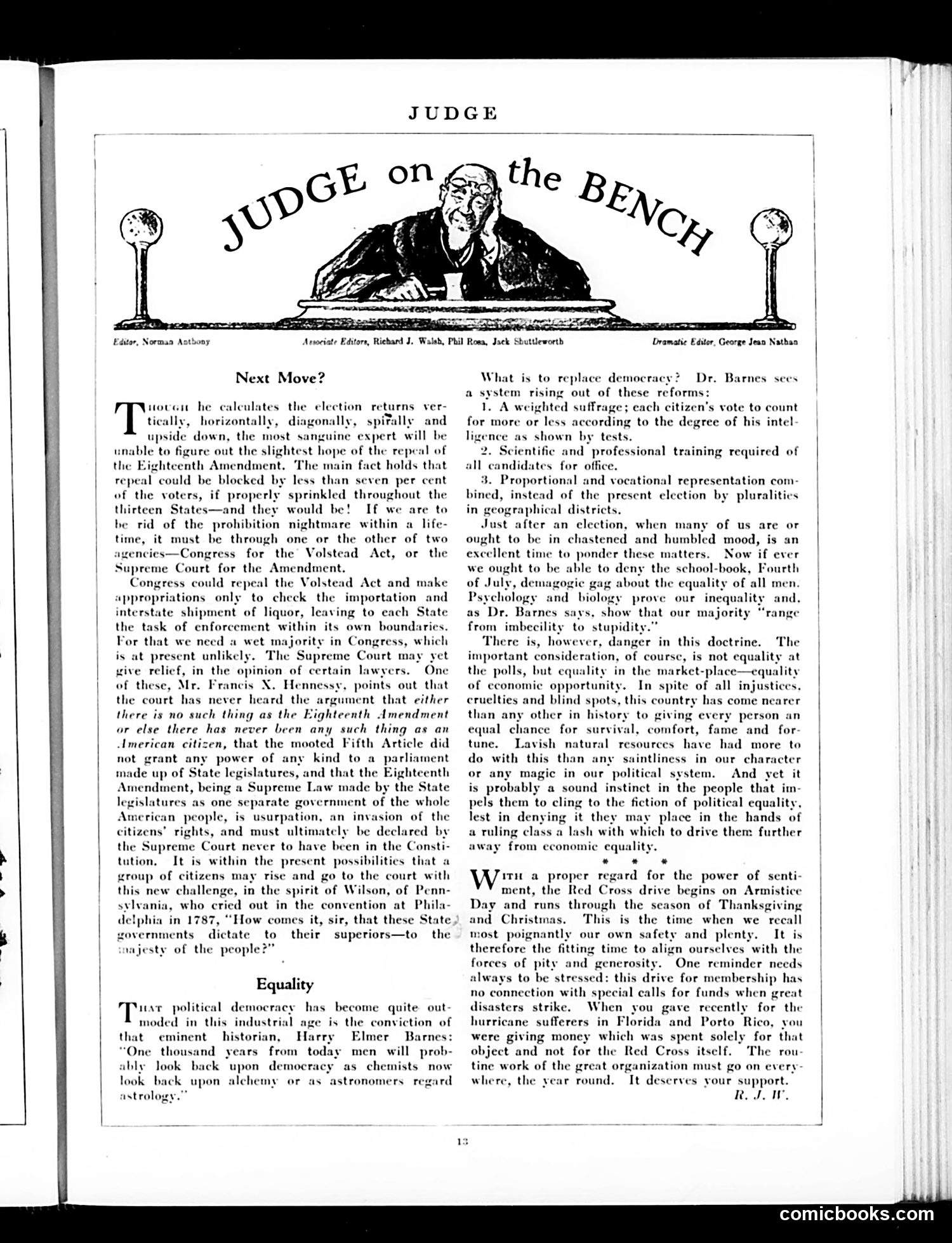
This page from *Judge* satirizes debates over Prohibition repeal and democratic reform circa the 1920s-30s. **"Next Move?"** discusses the Eighteenth Amendment (Prohibition), noting that repeal faces structural obstacles—it could be blocked by a small percentage of voters strategically placed in thirteen states. The article proposes two paths: Congressional repeal of the Volstead Act, or a Supreme Court challenge arguing the Amendment itself was unconstitutional. **"Equality"** critiques historian Harry Elmer Barnes's proposal to replace democracy with a system of weighted voting based on intelligence tests, scientific credentials for office, and proportional representation. The author acknowledges human inequality but warns against abandoning equal economic opportunity—the real democratic principle. He argues America has come closest to providing equal chances for survival and advancement despite its injustices. The satirical point: Barnes's "scientific" elitism, while acknowledging real inequality, would concentrate power among supposed intellectual superiors—a dangerous anti-democratic impulse masked as rational reform.
📄 Transcribed text from this page (OCR, searchable)
Machine-transcribed from the original scan — historical spelling and the odd misread are preserved.
JUDGE Editor, Norman Aotbooy Next Move? nove he es the election returns ver- tically, horizontally, diagonally, spitally and upside down, the most sanguine expert will be unable to figure out the slightest hope of the repeal of the Eighteenth Amendment. The main fact holds that repeal could be blocked by less than seven per cent of the voters, if properly sprinkled throughout the thirteen States—and they would be! If we are to be rid of the prohibition nightmare within a life- time, it must be through one or the other of two agencies—Congress for the Volstead Act, or the Supreme Court for the Amendment. Congress could repeal the Volstead Act and make appropriations only to. ¢ the importation and interstate shipment of liquor, leaving to each State the task of enforcement within its own boundaries. For that we necd a wet majority in Congress, which is at present unlikely. The Supreme Court may yet uive relief, in the opinion of certain lawyers. One of these, Mr. Francis X. Hennessy, points out that the court has never heard the argument that either there is no such thing as the Eighteenth Amendment or else there has never been any such thing as an American ci , that the mooted Fifth Article did not grant any power of any kind to a parliament made up of State legislatures, and that the Eighteenth Amendment, being a Supreme Law made by the State latures as one separate government of the whole ics in invasion of the citizens’ rights, and must ultimately be declared by the Supreme Court never to have been in the Consti- tution, It is within the present possibilities that a group of citizens may rise and go to the court with this new challenge, in the spirit of Wilson, of Penn- sylvania, who cried out in the convention at Phila- delphia in 1787, “How comes it, sir, that these State xovernments dictate to their superiors—to the vajesty of the people Equality Test political democracy hi moded in this industrial is the conviction of that eminent historian, Harry Elmer Barnes: “One thousand years from today men will prob- ably look back “upon democ look back upon alchemy or astrology.” become quite out- as chemists now as astronomers rr Anvociate Editors, Richard J, Walsh, Phil Roma, Jack Shuttleworth Dramatic Editor, George Jean Nathaa vy? Dr. Barnes sees wf out of these reforms: 1, A weighted suffrage; each citizen’s vote to count for more or less according to the degree of his intel s shown by tests. Scientific and’ professional training required of all candidates for office. 3. Proportional and vocational representation com- ed, instead the present election by pluralities in geographical districts. Just after an election, when many of us are or ought to be in chastened and humbled mood, is an excellent time to ponder these matters. w if ever we ought to be to deny the school-book, Fourth of Jul : gag about the equality of all men. Psychology and bialogy prove our inequality and, as Dr. Barnes says, show that our majority “range from imbecility to stupidity. There is, however, danger in this doctrine. The important consideration, of course, is not equality at the polls, but equality in the market-place—equality of economic opportunity. In spite of all injustic cruelties and blind spots, this country has come nearer than any other in history to giving every person an equal chance for survival, comfort, fame and for- tune. Lavish natural resources have had more to do with this than any saintliness in our character or any magic in our political system. And yet it is probably a sound instinct in the people that it pels them to cling to the fiction of political equality, lest in denying it they may place in the hands of a ruling class a lash with which to drive them further away from economic equality. *“ * «* itu a proper regard for the power of senti- ment, the Red Cross drive begins on Armistice Day and runs through the season of Thanksgiving and Christmas. This is the time when we recall most poignantly our own safety and plenty. It is therefore the fitting time to align ourselves with the forces of pity and generosity. One reminder needs al to be stressed: this drive for membership has no connection with special calls for funds when great disasters strike. When you gave recently for the hurricane sufferers in Florida and Porto Rico, you were giving money which was spent solely for that object and not for the Red Cross itself. The rou- tine work of the great organiz where, the year round. What is to replace deme a system ris! , demagog tion must go on every- It deserves your support. RJLW. comicbooks.com