
Judge, 1928-11-03 · page 21 of 36
Judge — November 3, 1928 — page 21: what you’re looking at
What you’re looking at
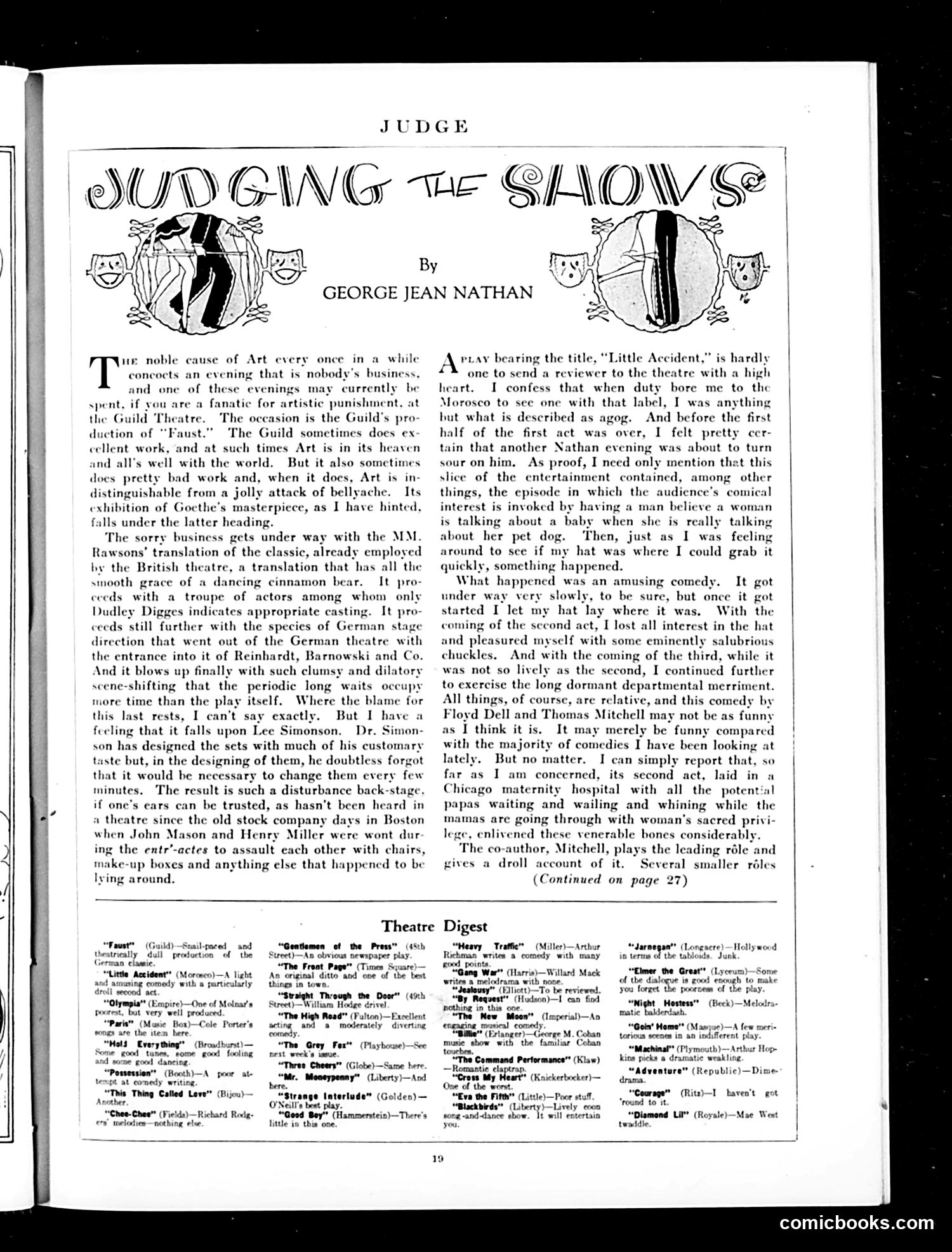
This is a theater review column by George Jean Nathan, a prominent drama critic of the early 20th century. The page contains no political cartoons—it's primarily text discussing theatrical productions. Nathan reviews two plays: the Guild Theatre's production of Goethe's "Faust" (which he harshly criticizes) and "Little Accident" at the Morosco Theatre (which he praises despite low expectations). His main complaints about "Faust" target the translation quality, acting, and particularly the scenic designer Lee Simonson, whose elaborate set changes caused such long delays between scenes that stagehands allegedly fought during intermissions. Nathan found the production technically incompetent and artistically pretentious. He praises "Little Accident"—a comedy by Floyd Dell and Thomas Mitchell about misunderstandings at a maternity hospital—for being genuinely entertaining, especially in the second act, despite its humble subject matter. The column represents elite theater criticism of the era, balancing artistic standards against entertainment value.
📄 Transcribed text from this page (OCR, searchable)
Machine-transcribed from the original scan — historical spelling and the odd misread are preserved.
JUDGE MUD GING we SHOWS? By GEORGE JEAN NATHAN ue noble cause of Art every once in a while I concocts an evening that is nobody's business, and one of these evenings may currently t spent the The oceasion is the Guild's pr duction of “Faust.” The Guild sometimes does ex cellent work, and at such times Art is in its heaven and all's well with the world, But it also sometimes does pretty bad work and, when it does, Art is in- distinguishable from a jolly attack of bellyache. Its exhibition of Goethe's masterpiece, as I have hinted, falls under the latter heading. The sorry business gets under way with the MM. Rawsons’ translation of the classic, already employed by the British theatre, a translation that has all the sinooth grace of a dancing cinnamon bear. ceeds with a troupe of actors among whom only Dudley Digges indicates appropriate It pro- ceeds still further with the species of German stage direction that went out of the German theatre with the entrance into it of Reinhardt, Barnowski and Co. And it blows up finally with such clumsy and dilatory scene-shifting that the periodic long waits occupy tore time th; y itself. Where the blame for this last rests, I can’t say exactly. But I ea feeling that it falls upon Lee Simonson. Dr. Simon- son has designed the sets with much of his customary taste but, in the designing of them, he doubtless forgot that it would be necessary to change them every few minutes. The result is such a disturbance back-stage. can be trusted, as hasn’t been heard in re since the old stock company days in Boston John Mason and Henry Miller were ing the entr’-actes to ass make lyin It pro- when wont dur ult each other with chairs, up boxes and anything else that happened to be around. \ ay bearing the title, “Little Accident,” is hardly 4% one to send a reviewer to the theatre with a high heart. I confess that when duty bore to the Morosco to see one with that label, I was anything but what is described as agog. And before the first half of the first act was over, I felt pretty cer- tain that another Nathan evening was about to turn sour on him, As proof, I need only mention that this of the entertainment conta things, the episode in which the interest is invoked by having a man believe a womé is talking about a baby when she is really talking about her pet dog. ‘Then, just as I was feeling around to sce if my hat was where I could grab it quickly, something happened. What happencd was an amusing comedy. It got under way very slowly, to be sure, but once it got started I let my hat lay where it was. With the of the second act, I lost all interest in the hat and pleasured myself with some eminently salubrious chuckles. And with the coming of the third, while it was not so lively as the second, I continued further to exercise the long dormant departmental merriment. All things, of course, are relative, and this comedy by Floyd Dell and Thomas Mitchell may not be as funny s I think it is. It may merely be funny compared with the majority of comedies I have been looking at lately. But no matter. I can simply report that, so far as I concerned, its second act, laid in a Chicago maternity hospital with all the potential papas waiting and wailing and whining while the u as are going through with woman's sacred privi- -, enlivened these venerable bones considerably The co-author, Mitchell, plays the leading réle and gives a droll account of it. Several smaller réles (Continued on page 27) me slice ned, among other audience's comi am Theatre Digest “Faust” (C theatrically di German elassie “Little Accident’? (Morceco)—A light and amusing comedy with a particularly droll second. act. ympia” (Empire) One of Mstnar's but very well p ie” (Music Bat) Cole. Porter's are the item here old Every thiog” (Bron! tunes, some good id) —Snail-paced Production of and the pling ““Chee-Chee” (Fields)—Richard Revig- ery inelodies—notbing else “Gentlemen of the Press” Street)—An obvious newspaper pla “The Front Page” (Times Siuare)— An original ditto and one of the best things in town “Straight Through the Door” (49h liam Hosige drivel Pulton)—Excellent ‘a moderately diverting ‘The Grey Fox" (Playbowe) ext week's issue. “Three Cheery” (Globe) —Same “Mr, Moneypenny” (Literty)—And bere. “Strange latertude” (Golden) — O'Neill's best play. “Good Boy” (Hammerstein)—There’s little in this one. “Se “Heavy Traffic” (Millet)—Arthur nan writes a comedy with many points “Gang War” (Ila) writes a melodrama with none. “ dealeusy” (Elictt)—To be reviewed. “By Request” (Hudson)—I can find pothing in this one “The New Moen engagi peal comedy. aime (Erlanger)—George M. Cohan music show with the familiar Coban touches. “The Command Performance” (Kia) —Romantie claptrap. jeart” (Knickerbocker)— Willard Mack (lmperial)—An )—Poce stuf. y)—Lively econ song-and-dance show. It will entertain you Hollywood “Elmer the Great” (Lyceum) of the dialogue is & you forget the poornes of “Might Hostess”? matic balderdash. “Goin’ Home” (Masive)—A few meri- torious scenes in an indifferent play “Machinal” (Ply mouth)—Arthu kine picks @ dramatic weakling. “Adventure” (Republic)—Di drama, “Courage” ‘round to it. ‘Diamond Lil” (Royale) Some (Ritz)—I haven't got —Mae West comicbooks.com