
Judge, 1928-11-03 · page 11 of 36
Judge — November 3, 1928 — page 11: what you’re looking at
What you’re looking at
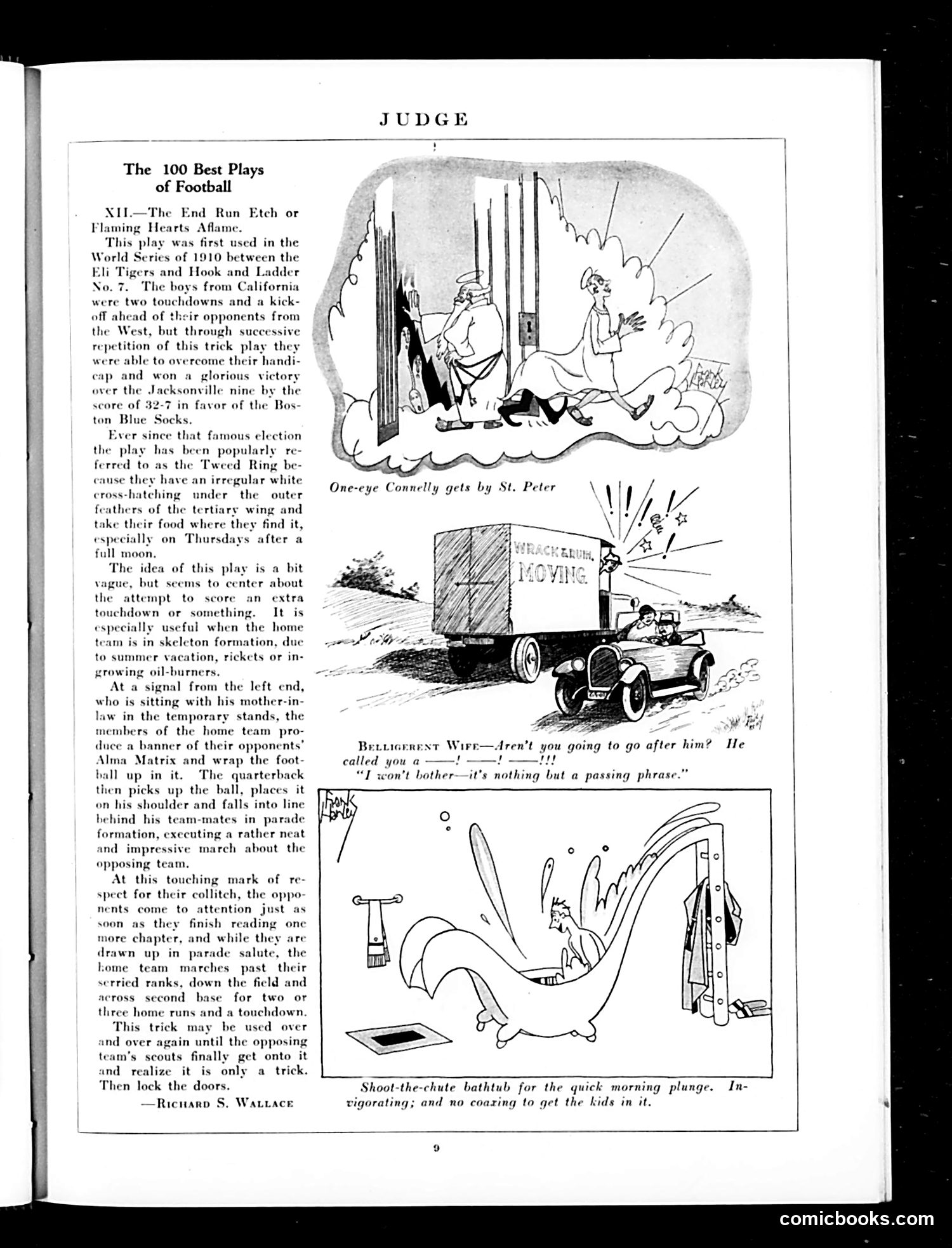
This page satirizes American football through absurdist humor, deliberately mixing football terminology with nonsense. The text describes "The End Run Etch" play from a fictional 1910 game between Yale and a fire department, absurdly claiming the winning score was 32-7 in favor of the "Boston Blue Socks" (a baseball team name, not football). The three cartoons below parody domestic life: one shows a car hitting a moving van, another depicts a wife's indignation at her husband's casual response to being insulted (calling insults mere "passing phrases"), and the third advertises a novelty bathtub slide for children. The humor relies on incongruity—treating football plays with mock-serious analysis while describing obviously impossible situations, mixing sports, mixing real and fake teams, and combining football with baseball terminology. This reflects Judge's style of absurdist satire typical of early 20th-century American humor magazines.
📄 Transcribed text from this page (OCR, searchable)
Machine-transcribed from the original scan — historical spelling and the odd misread are preserved.
The 100 Best Plays of Football X1II.—The End Run Etch or Flaming Hearts Aflame. This play was first used in the World Series of 1910 between the Eli Tigers and Hook and Ladder No. 7. The boys from California were two touchdowns and a kick- off ahead of their opponents from the West, but through successive repetition of this trick play they were able to overcome their handi- cap and won a glorious victory over the Jacksonville nine by the score of 32-7 in favor of the Bos- ton Blue Socks. Ever since that famous election the play has been popularly. re- ferred to as the Tweed Ring be- cause they have an irregular white cross-hatching under the outer feathers of the tertiary wing and take their food where they find it, especially on Thursdays after a full moon. The idea of this play is a bit vague, but seems to center about the attempt to score an extra touchdown or something. It is especially useful when the home team is in skeleton formation, due to summer vacation, rickets or in- growing oil-burners. At a signal from the left end, who is sitting with his mother-in- law in the temporary stands, the members of the home team pro- 1 banner of their opponents’ a Matrix and wrap the foot- ball up in it. The quarterback then picks up the ball, places it on his shoulder and falls into line behind his team-mates in parade formation, executing a rather neat and impressive march about the opposing team. At this touching mark of re- spect for their collitch, the oppo nents come to attention just as soon as they finish reading one more chapter, and while they are drawn up in parade salute, the Lome team marches past. their serried ranks, down the field and across second for two or three home runs and a touchdown. This trick may be used over ind over again until the opposing team’s scouts finally get onto it and realize it is only a_ trick. Then lock the doors. —Ricnarp S. Warrace base JUDGE eer Betricerest Wire—Aren’t you going to go after him? called you a ——! ——! ——!! “I won't bother—it's nothing but a passing phrase.” He Shoot-the-chute bathtub for the quick morning plunge. vigorating; and no coaxing to get the kids in it. comicbooks.com