
Judge, 1886-05-08 · page 2 of 20
Judge — May 8, 1886 — page 2: what you’re looking at
What you’re looking at
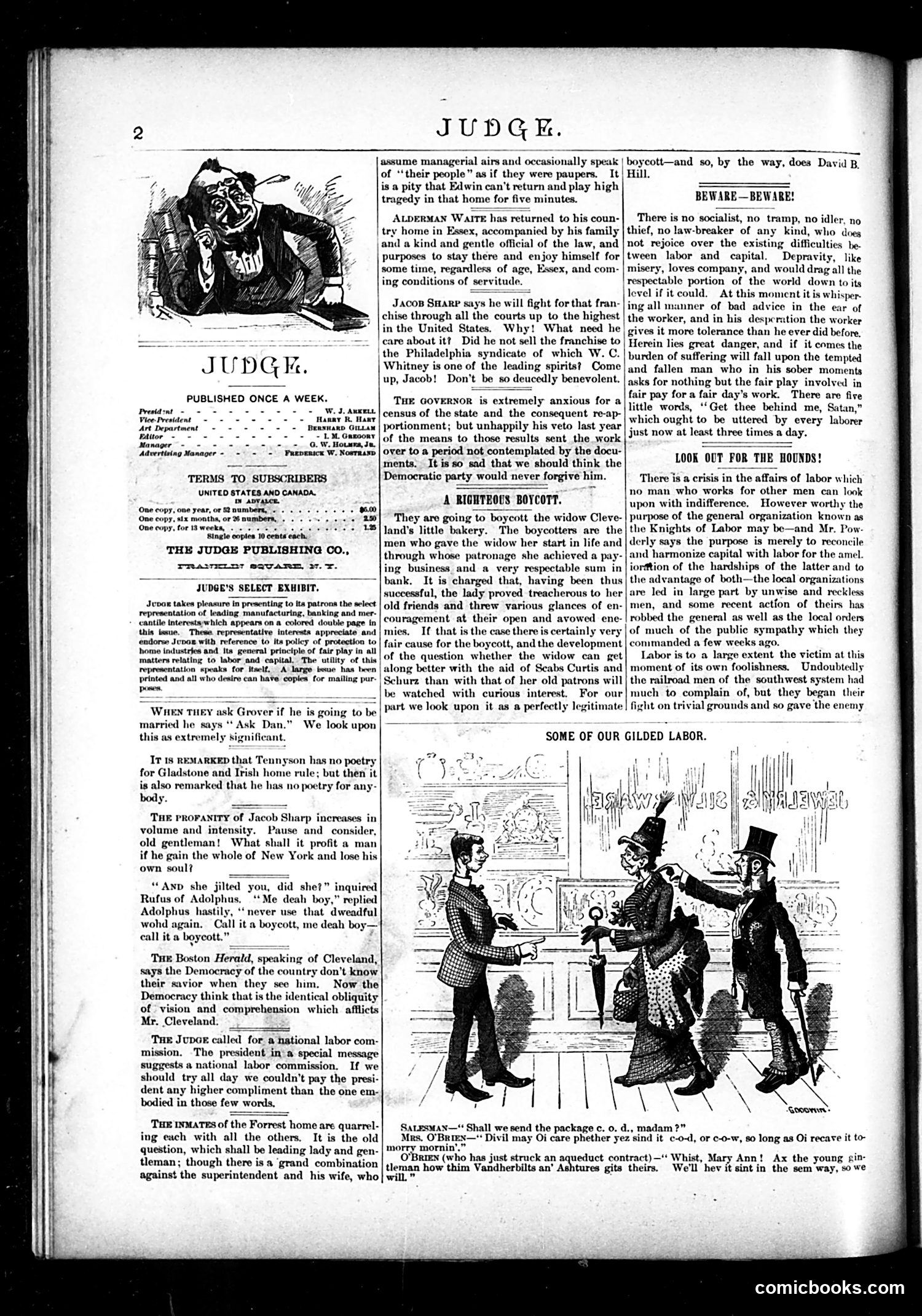
This page contains editorial commentary and a cartoon titled "Some of Our Gilded Labor." The cartoon depicts wealthy figures in top hats (representing capitalists or the wealthy class) interacting with working-class people, illustrating the magazine's critique of labor relations and class disparity during the Gilded Age. The accompanying text discusses labor organization issues, including a "righteous boycott" against a widow (likely a business owner), and debates about labor commissions and workers' rights. The editorial argues that labor disputes reveal fundamental conflicts between capital and labor, suggesting wealthy industrialists exploit workers. The satire targets the hypocrisy of the wealthy elite who claim benevolence while perpetuating poor working conditions—the core critique of Gilded Age labor exploitation that animated progressive reform movements.
📄 Transcribed text from this page (OCR, searchable)
Machine-transcribed from the original scan — historical spelling and the odd misread are preserved.
JUDGE. JUDGK. PUBLISHED ONCE A WEEK. Presidsnt W. J. Anaen Vice-President Art Department Fattor - Manager Advertiat ing Manager - TERMS TO SUBSCRIBERS UNITED STATES AND CANADA. 1 ADYALCE. One copy, one year, or @ numbers, . 2. . One copy, six months, or 36 numbers, One copy, for IS weeks, . ss ‘Single copies 10 cen THE JUDGE PUBLISHING CO., rmaormin: sqvann, 3.5. “JUDGE'S SELECT EXHIBIT, Jvoar takes pleasure in presenting to Ita patrons the select representation of leading manufacturing, banking and mer- cantile tnteresta;which appears on a colored double page in this tewe. These. representative intereste appreciate and endorse Jvpas with reference to its policy of protection to home industrjes and ita general principle of fair play in all matters relating to labor and capital, The utility of this representation «peaks for itself. A large beue has been printed and all who desire can have copies for mailing pur- Powe WHEN THEY ask Grover if he is going to be married he says “Ask Dan.” We look upon this as extrem Ir 18 REMARKED that Tenny for Gladstone and Irish home ru is also remarked that he has no poetry for any- body. on has no poetry but then it THE PROFANITY of Jacob Sharp increases in volume and intensity, Pause and consider, old gentleman! What shall it profit a man if he gain the whole of New York and lose his own soul? “Axp she jilted you shet” inquired Rufus of Adolphus, ‘Me deah boy,” replied Adolphus hastily, ‘‘never use that dweadful wohd again. it a boycott, me deah boy— call it a boycott Tue Boston Herald, speaking of Cleveland, says the Democracy of the country don't know their savior when they see him. Now the Democracy think that is the identical obliquity of vision and comprehension which afflicts Mr. Cleveland. ‘Tar Jupoe called for a hational labor com- mission, The president in’ a special message suggests a national labor commission. If we should try all day we couldn't pay the presi- dent any higher compliment than the one em- bodied in those few words. THE INMATES of the Forrest home are quarrel- ing each with all the others, It is the old question, which shall be leading lady and gen- tleman; though there is a ‘grand combination against the superintendent and his wife, who assume managerial airs and occasionally speak of “their people” as if they were paupers. It is a pity that Edwin can't return and play high ALDERMAN Walre has returned to his coun- try home in Essex, accompanied by his family and a kind and gentle official of the law, and purposes to stay there and enjoy himself for some time, regardless of age, Essex, and com- ing conditions of servitud JACOB SHARP says he will fight for that fran- chise through all the courts up to the highest in the United States. Why! What need he care about it? Did he not sell the franchise to the Philadelphia syndicate of which W. C. Whitney is one of the leading spirits? Come up, Jacob! Don't be so deucedly benevolent. THE GOVERNOR is extremely anxious for a census of the state and the consequent re-ap- portionment; but unhappily his veto last year of the means to those results sent the work over to a period not contemplated by the docu- ments. It isso sad that we should think the Democratic party would never forgive him. A RIGHTEOUS BOYCOTT. They are going to boycott the widow Cleve- land’s little bakery. The boycotters are the men who gave the widow her start in life and through whose patronage she achieved a pay- ing business and a very respectable sum in bank, It is charged that, having been thus successful, the lady proved treacherous to her old friends and threw various glances of en- couragement at their open and avowed ene- mies. If that is the case there is certainly very fair cause for the boycott, and the development of the question whether the widow can get along better with the aid of Scabs Curtis and Schurz than with that of her old patrons will be watched with curious interest. For our part we look upon it as a perfectly le; SOME OF OUR |boyeott—and 0, by the way, does David B. Hill. BEWARE —BEWARE! There is no socialist, no tramp, no idler, no ry, loves company, and would drag all the respectable portion of the world down to its level if it could. At this moment it is whisper. ing all manner of bad advice in the ear of the worker, and in his desperation the worker | gives it more tolerance than he ever did before. | Herein lies great danger, and if it comes the burden of suffering will fall upon the tempted jand fallen man who in his sober moments asks for nothing but the fair play involved in fair pay for a fair day’s work. There are five little words, ‘‘Get thee behind me, Satan,” which ought to be uttered by every laborer just now at least three times a day, LOOK ‘OT FOR THE HOUNDS! ‘There is a crisis in the affairs of labor which no man who works for other men can look upon with indifference. However worthy the purpose of the general organization known as the Knights of Labor may be—and Mr. Pow- derly says the purpose is merely to reconcile and harmonize capital with labor for the amel. iorftion of the hardships of the latter and to the advantage of both—the local organizations are led in large part by unwise and reckless men, and some recent actfon of theirs has robbed the general as well as the local orders of much of the public sympathy which they commanded a few weeks ago. Labor is to a large extent the victim at this moment of its own foolishness. Undoubtedly the railroad men of the southwest system had much to complain of, but they began their fight on trivial grounds and so gave the enemy GILDED LABOR. SaLesMAN—‘ Shall we send the package c. o. d. morry mornin’.” O'BRIEN (who has just struck an tleman how thim Vaadherbilts an’ Ashtures gits wil Qooonn ., madam ?” Mrs, O'Brrex—“ Divil may Oi care phether yez sind it c-o-d, or c-o-w, 80 long as Oi recave it to- jueduct contract)—‘ Whist, Mary Ann! Ax the young gin- theirs. We'll hev it sint in the sem way, s0 we comicbooks.com