
A ComicBooks.com exhibition
The Carpet-Bag
The Boston humor weekly that printed Mark Twain's first nationally-circulated sketch. Edited by Benjamin Penhallow Shillaber, it ran burlesque, tall tales, and woodcut caricature — the American comic-paper tradition, not the penny blood. Here is its full 1852 run, restored.
For a few months in 1851, a Boston printer named Benjamin Penhallow Shillaber launched a cheap weekly of comic writing and called it The Carpet-Bag. It lasted only into 1853, but two things it did in that short life have kept it in the histories. In its pages Shillaber ran the sayings of "Mrs. Partington," the malaprop-prone widow he had invented — the closest thing antebellum America had to a recurring comic character. And on May 1, 1852, it printed a sketch called "The Dandy Frightening the Squatter," signed only with initials, that was the first work by the young Samuel Clemens — Mark Twain — to reach a national audience. The same paper gave early room to Charles Farrar Browne, soon to be famous as Artemus Ward.
A humor weekly, not a penny blood
The Carpet-Bag belongs to the American comic-paper tradition, not the sensational serial. It carried burlesque, tall tales, light verse, literary sketches, and wood-engraved caricature — genteel amusement and topical jest for a literate city readership, sold by the week. It sat between the serious literary miscellany and the illustrated humor sheet, and it helped make Boston, for a moment, a center of comic writing. The paper drew on the older tradition of American humor — the frontier tall tale, the newspaper hoax, the comic lecture — and pointed toward the illustrated funny papers still decades off.
The nameplate
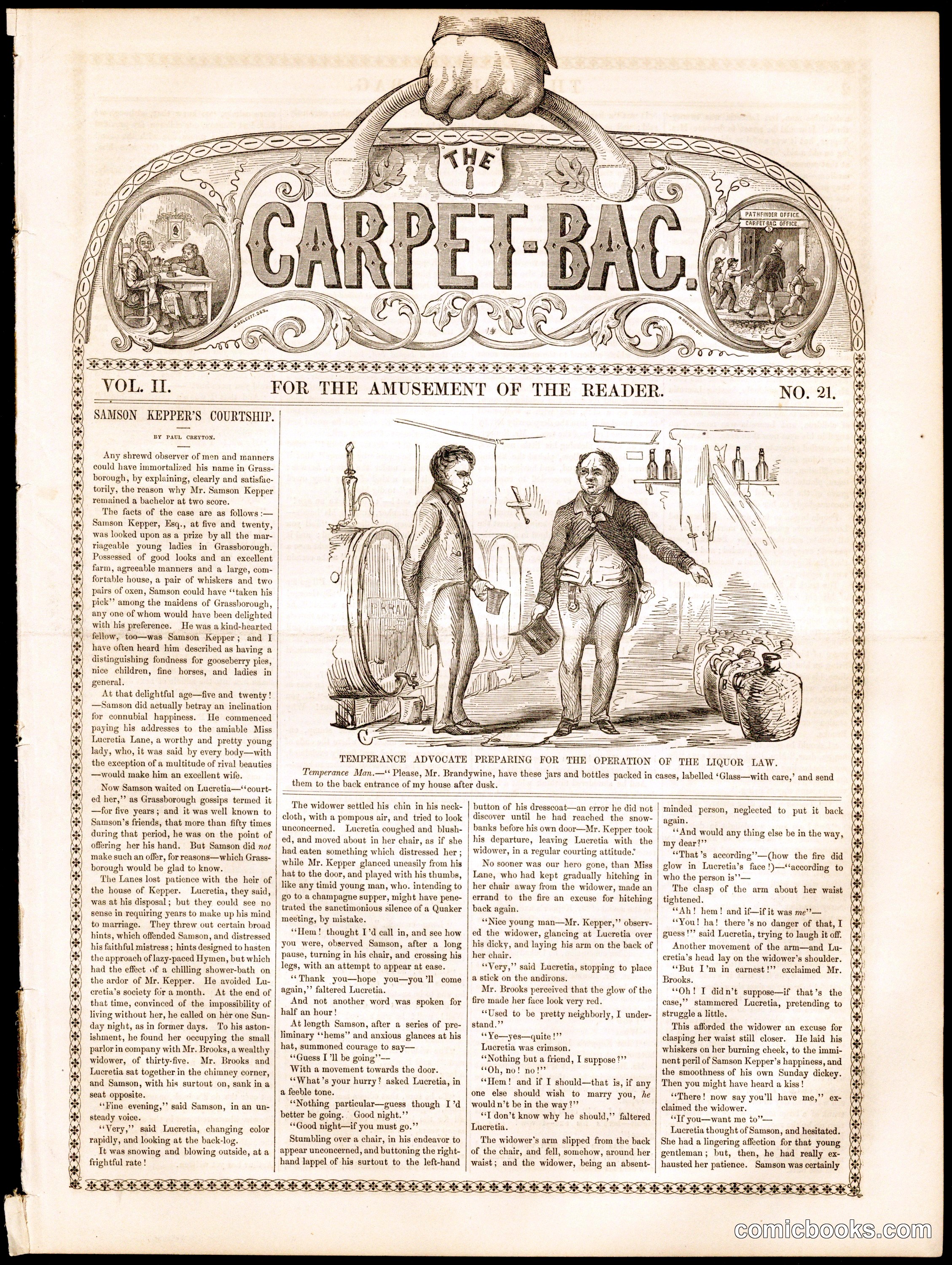
Every issue led with the same engraved masthead: a hand grasping a carpet bag, flanked by small woodcut vignettes, over the ornate Victorian title. Below it, week to week, ran the comic wood engravings that gave the text its pictures — rough, bold, made to be printed fast and read at a glance. The covers gathered here are the full 1852 run of Volume II, restored and freely explorable — the year Twain first found his way into print.
A timeline
- 1851Benjamin Penhallow Shillaber launches The Carpet-Bag in Boston as a weekly of humor and light literature.
- 1851Shillaber's malapropping widow "Mrs. Partington" becomes the paper's signature comic character.
- 1852The full Volume II run gathered here — the paper at its height, week by week through the year.
- 1852May 1: The Carpet-Bag prints "The Dandy Frightening the Squatter," Mark Twain's first nationally-circulated sketch.
- 1852Charles Farrar Browne — the future Artemus Ward — appears among its early comic contributors.
- 1853The paper folds after roughly two years, its short run outlasted by the reputations it helped start.
The Carpet-Bag did not survive its own decade — it closed in 1853, after barely two years — but almost no comic paper of its size has left a longer shadow. It gave Mark Twain his first national printing and Artemus Ward an early platform, and it carried Shillaber's "Mrs. Partington" at a time when a paper built around a recurring comic character was still a novelty. The humor it printed — the tall tale, the burlesque sketch, the topical jest set beside a wood-engraved cartoon — is recognizably the raw material the American funny paper and, eventually, the comic would be built from.
What survives in these front pages is a snapshot of antebellum Boston laughing at itself: the ornamental nameplate, the comic vignettes, the dense columns of light verse and satire, sold cheap and read fast. The engravings are plain and the paper was never meant to last, which makes the full 1852 run gathered here the more worth keeping. Every issue is public domain, restored and freely explorable, presented by comicbooks.com.