
A ComicBooks.com exhibition
Boys' Story Papers
Before the comic book there were the boys' story papers — cheap, heavily illustrated weeklies of shipwrecks, school scrapes, pirates, and empire. Three of them, from Victorian London to turn-of-the-century Detroit, presented honestly and restored.
Before there were comic books there were the boys' story papers — cheap, heavily illustrated weeklies that ran serialized adventure fiction for a young readership hungry for shipwrecks, school scrapes, pirates, and far-flung empire. They sat on the newsstand beside the penny dreadful and shared its economics — a penny or two, a fresh installment every week, a lurid or heroic front-page woodcut to pull the reader in — but aimed themselves at boys and, often, at their parents' idea of what boys ought to read.
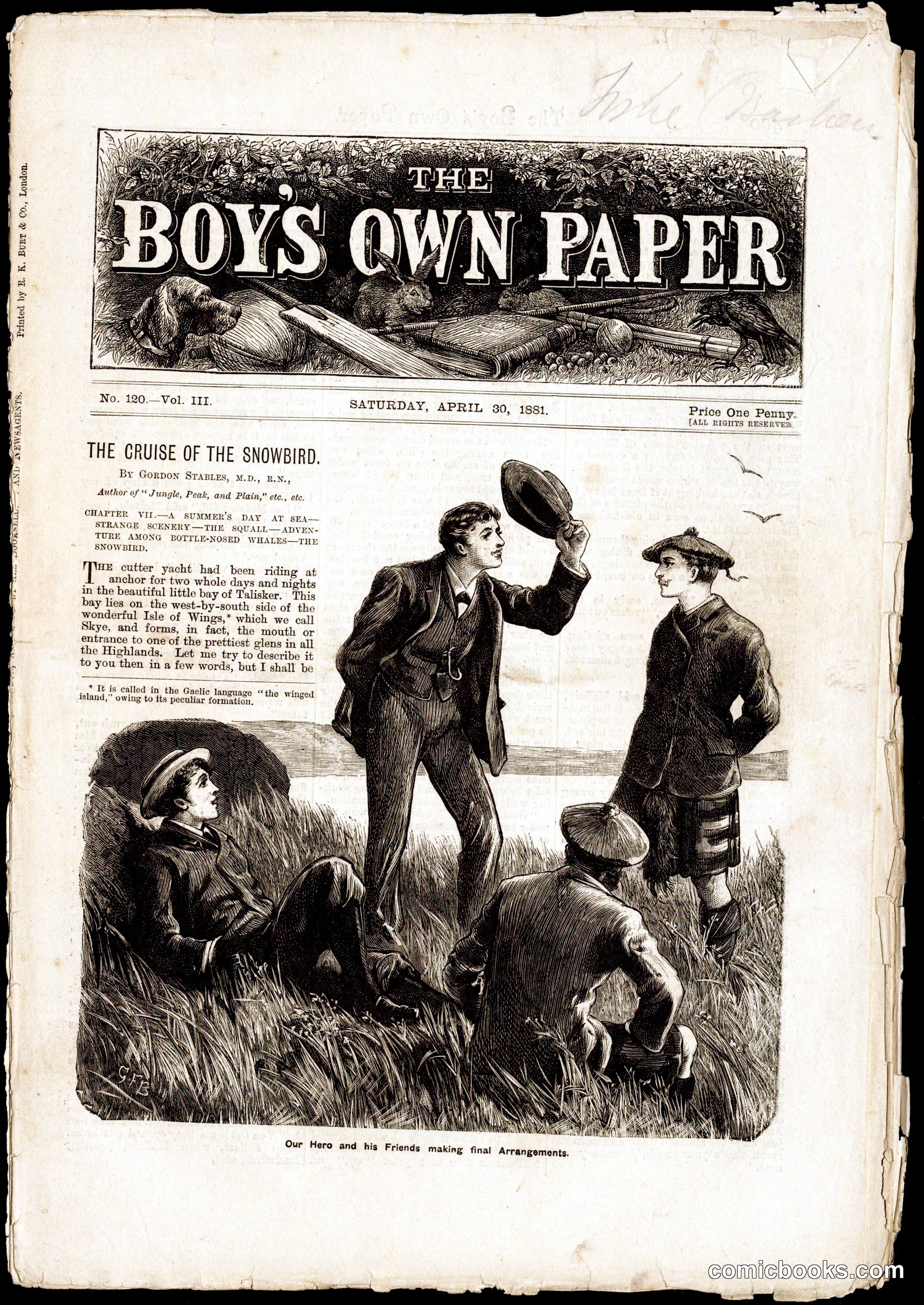
This gallery gathers three of them. The Boy's Own Paper (London, 1879), published by the Religious Tract Society, offered wholesome adventure, school stories, natural history, and how-to columns as a deliberate answer to the dreadfuls. Young Folk's Weekly Budget (London) was a brisk British boys' paper of serialized adventure, running fiction like Kairon, the Young Charioteer. The American Boy (Detroit, 1899) carried the same appetite across the Atlantic — outdoor stories, sport, and self-improvement for a rising American readership.
Every cover here is public domain, scanned from the Villanova University Digital Library and restored, watermarked, and presented at comicbooks.com. Together they trace the illustrated adventure weekly the comic book would inherit.
A timeline
- 1866Edwin J. Brett launches Boys of England, cementing the illustrated boys' adventure weekly in Britain.
- 1878Young Folk's Weekly Budget runs serialized adventure fiction such as Kairon, the Young Charioteer.
- 1879The Religious Tract Society founds The Boy's Own Paper as a wholesome answer to the penny dreadfuls.
- 1899The American Boy begins in Detroit, carrying the boys'-paper formula across the Atlantic.
What became of the boys' paper
The formula proved durable. The weekly serial, the cliffhanger installment, the bold front-page illustration, the running hero a reader could follow week to week — all of it carried straight into the story papers' successors and, a generation later, into the American comic book. The boys who read about Kairon the charioteer or the cruise of the Snowbird were the grandfathers of the readers who bought Action Comics No. 1.
These covers carry the adventure-and-empire themes of their moment plainly. We present them as a historical record — restored, dated, and public domain — the illustrated weekly the comic book grew out of.