
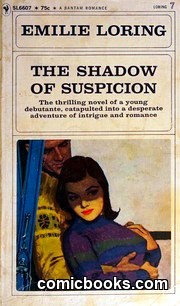
A woman in a jeweled mask peers through a doorway, her expression tense with intrigue. The cover announces "The thrilling novel of a young woman menaced by deadly enemies and adventures of intrigue and romance." By mid-century, pulp magazines had saturated the market with adventure serials, their painted covers promising danger and mystery to readers for a dime. This instance exemplifies the mystery-thriller variant—a subgenre distinct from the earlier weird fiction and science fiction pulps, yet sharing their visual language: vivid color, dramatic lighting, and a protagonist caught in immediate peril. The woodcut-style typography and portrait composition were standard industry practice, designed to grab newsstand attention. Pulp magazines like this one served as direct precursors to the comic book format, sharing both narrative conventions and visual storytelling techniques.
📖 This public-domain issue is being restored page-by-page for our free reader — check back soon.
About this artifact
- Date
- 1955
- Rights
- Public domain — free to view, share, and reuse.
- Restoration
- Digitally restored and hosted by ComicBooks.com.
Part of our mission to preserve and restore the public-domain heritage of the medium.