
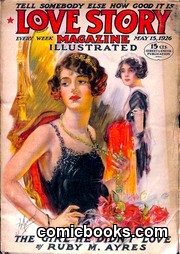
A woman in an evening gown gazes over her shoulder while a man's silhouette appears in shadow behind her—a composition typical of 1920s romance pulp. The cover line "The Girl He Didn't Love Enough" promises domestic drama and emotional conflict. Love Story Magazine, among the most commercially successful pulps, competed for readers through painted covers depicting romantic entanglement and yearning. These magazines, printed on cheap wood-pulp paper and sold for a dime, dominated newsstands alongside adventure and detective titles. While romance pulps rarely pioneered new genres like their science-fiction and weird-horror counterparts, they shaped visual storytelling conventions—particularly the emotional close-up and the intimate yet mysterious female figure—that would profoundly influence comic book cover design and interior narrative techniques.
📖 This public-domain issue is being restored page-by-page for our free reader — check back soon.
About this artifact
- Date
- May 15, 1926
- Rights
- Public domain — free to view, share, and reuse.
- Restoration
- Digitally restored and hosted by ComicBooks.com.
Part of our mission to preserve and restore the public-domain heritage of the medium.