
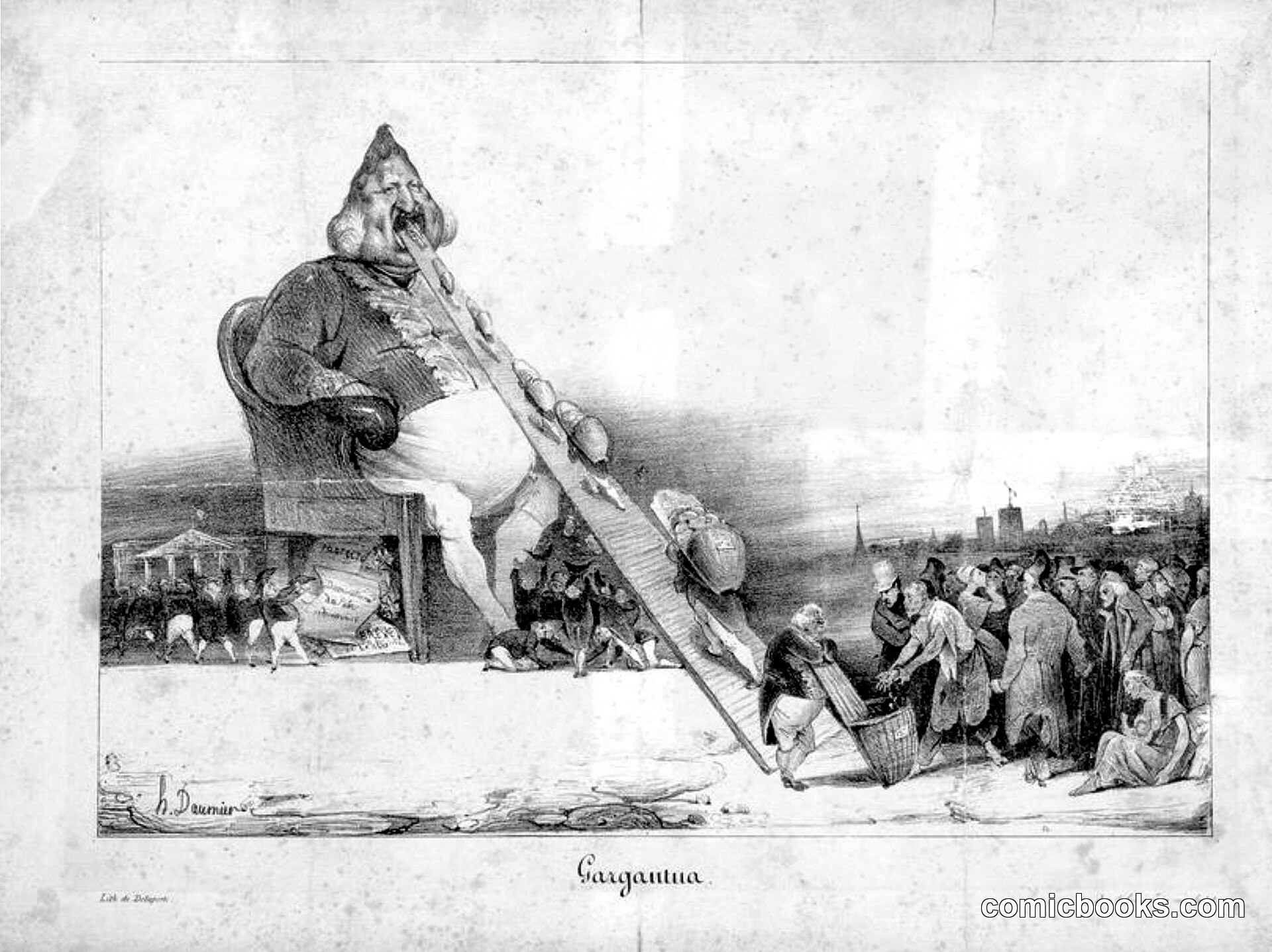
Honoré Daumier's Gargantua (1831) is among the most notorious political caricatures in French history, remembered as much for its consequences as for its content. The lithograph depicts King Louis-Philippe as Gargantua, the gluttonous giant of Rabelais, enthroned atop a ramp up which the poor toil to feed him baskets of coin, while beneath him officials and cronies gather the rewards. The image is a scathing indictment of a regime that taxed the common people to enrich a privileged few, rendering the "Citizen King" as an insatiable, bloated appetite consuming his subjects' wealth. The French authorities responded with force: the print was suppressed, and Daumier was prosecuted and ultimately sentenced to imprisonment for the offense. The episode became a landmark in the struggle over freedom of the press in nineteenth-century France, where caricature was treated as a genuine political threat. Daumier went on to a long and celebrated career as a lithographer, painter, and one of the greatest social satirists of his age, producing thousands of prints. Gargantua endures as a symbol of the cartoonist's courage and of the state's fear of the drawn line—vivid proof that a single image could provoke a government to prison a man.
About this artifact
- Creator
- Honoré Daumier
- Date
- 1831
- Rights
- Public domain — free to view, share, and reuse.
- Restoration
- Digitally restored and hosted by ComicBooks.com · high-resolution version available.
Part of our mission to preserve and restore the public-domain heritage of the medium.