
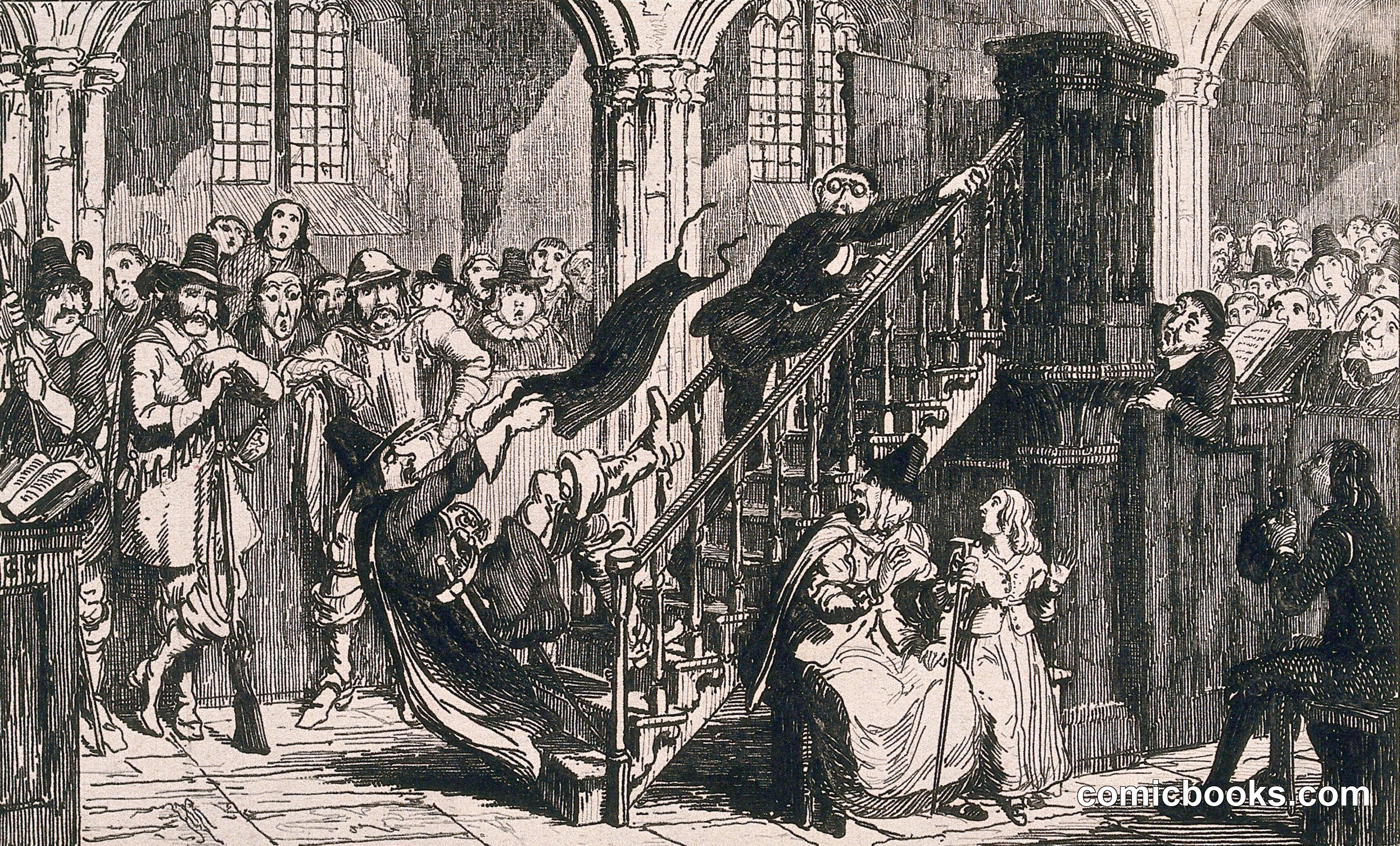
A wood engraving after George Cruikshank captures a moment of comic catastrophe inside a crowded church: a man pitches headlong down the pulpit staircase, hauling the officiating clergyman's robes with him, while congregants—rendered with the broad facial exaggeration typical of the period—recoil, gape, or suppress laughter. Cruikshank (1792–1878), inheritor of Gillray and Rowlandson's tradition of physiognomic comic distortion, channeled that lineage into illustrated books and serial plates that sit precisely at the hinge between print satire and the sequential comic strip. Class is legible in every figure's costume and expression—the respectable pew-holders horrified, the rearward crowd gleefully amused. That layered crowd-reaction, read left to right like panels, is the grammar comics would formalize within a generation.
About this artifact
- Date
- c. 1840, after George Cruikshank
- Rights
- Public domain — free to view, share, and reuse.
- Restoration
- Digitally restored and hosted by ComicBooks.com · high-resolution version available.
Part of our mission to preserve and restore the public-domain heritage of the medium.